Environmental Importance of PAH Monitoring
Polycyclic Aromatic Hydrocarbons (PAHs) represent a critical class of environmental contaminants that demand rigorous monitoring in soil matrices. These persistent organic pollutants originate primarily from incomplete combustion of organic materials, including fossil fuels, wood, and waste. The environmental significance of PAH monitoring stems from their well-documented carcinogenic, mutagenic, and teratogenic properties, with compounds like benzo[a]pyrene classified as known human carcinogens.
Soil serves as a major sink for PAHs due to their hydrophobic nature and strong affinity for organic matter. According to environmental chemistry literature, PAHs can persist in soils for decades, posing long-term risks to ecosystems and human health through various exposure pathways including soil ingestion, dermal contact, and groundwater contamination. Regulatory frameworks worldwide, including the U.S. Environmental Protection Agency’s Contract Laboratory Program, mandate comprehensive PAH analysis in soil samples to assess contamination levels and guide remediation efforts.
The complexity of soil matrices presents unique analytical challenges. As noted in environmental extraction literature, “Even with careful selection of the primary extraction mechanism, considerable additional clean-up is often required prior to analysis” due to co-extracted humic substances, inorganic matrix components, and sulfurous compounds that can interfere with accurate quantification.
Soil Extraction Methods Prior to SPE
Effective PAH analysis begins with proper liberation of analytes from the solid soil matrix. Traditional extraction methods have evolved to balance efficiency with environmental considerations, moving away from solvent-intensive approaches toward more sustainable techniques.
Soxhlet Extraction
Soxhlet extraction remains a benchmark method for exhaustive PAH recovery from soil samples. This continuous extraction technique typically employs solvents like dichloromethane or acetone-hexane mixtures, operating through repeated cycles of solvent reflux. While Soxhlet provides excellent recovery for even tightly bound PAHs, it suffers from significant drawbacks including lengthy extraction times (typically 16-24 hours), substantial solvent consumption, and the potential for thermal degradation of sensitive analytes.
As environmental chemists have noted, “Much as for solid biological samples, a prerequisite for the successful extraction of soil or sludge samples is liberation of the analytes from a solid matrix into a liquid one. Soxhlet extraction, homogenization in an extraction buffer or some other physical manipulation may be needed.”
Ultrasonic Extraction
Ultrasonic extraction offers a faster, more efficient alternative to traditional Soxhlet methods. This technique utilizes high-frequency sound waves to create cavitation bubbles that disrupt soil particles and enhance solvent penetration. Typical extraction times range from 15-30 minutes with significantly reduced solvent volumes compared to Soxhlet extraction.
Key advantages of ultrasonic extraction include:
- Reduced extraction time (minutes versus hours)
- Lower solvent consumption
- Ability to process multiple samples simultaneously
- Minimized thermal degradation risk
However, method optimization is crucial, as extraction efficiency depends on factors including solvent selection, soil-to-solvent ratio, extraction time, and ultrasonic power settings. For PAHs, solvent systems typically combine polar and non-polar components to effectively extract compounds across a wide range of hydrophobicities.
SPE Cleanup for Removing Humic Substances
Soil extracts present formidable cleanup challenges due to the presence of humic and fulvic acids—complex organic macromolecules that can interfere with chromatographic analysis and detector response. As documented in environmental analysis literature, “The extract is rich in humic and fulvic acids, and may also contain a high level of sulfurous compounds and other inorganics.”
Florisil-Based Cleanup
Florisil (magnesium silicate) has been historically employed for PAH cleanup, particularly in regulatory methods. This polar sorbent effectively retains polar interferences while allowing non-polar PAHs to pass through or be selectively eluted. However, as noted in method development studies, “Historically, SPE using a Florisil cartridge clean-up, has been used to perform only a part of the potential clean-up role of which it is capable.”
Modern approaches often combine Florisil with additional cleanup steps to address its limitations in removing all matrix interferences.
Gel Permeation Chromatography (GPC)
For comprehensive removal of high molecular weight interferences like humic acids, GPC serves as an effective preliminary cleanup step. This size-exclusion technique separates compounds based on molecular size, effectively removing large humic substances while retaining smaller PAH molecules. The U.S. EPA Statement of Work for soil analysis specifically includes “a gel permeation step (to eliminate large species such as humic acids)” as part of the cleanup protocol.
Dispersive Solid Phase Extraction (d-SPE)
Recent advancements include d-SPE approaches using primary secondary amine (PSA), C18, or graphitized carbon black sorbents added directly to soil extracts. These sorbents effectively remove various matrix components through multiple interaction mechanisms, providing cleaner extracts for subsequent analysis.
Sorbent Selection for PAH Enrichment
Selecting appropriate SPE sorbents for PAH enrichment requires consideration of analyte properties, matrix complexity, and detection requirements. PAHs, being non-polar compounds with high octanol-water partition coefficients (log Kow > 4), interact strongly with hydrophobic sorbents.
C18 Bonded Silica
Octadecylsilane (C18) bonded silica represents the most widely used sorbent for PAH enrichment from aqueous or aqueous-organic extracts. Its long alkyl chains provide excellent retention for non-polar compounds through hydrophobic interactions. As documented in SPE literature, “C18 bonded silica sorbents have been extensively used for the trace enrichment of polycyclic aromatic hydrocarbons from aqueous environmental samples.”
Key considerations for C18 sorbent selection include:
- Carbon loading (typically 17-20%)
- Particle size (40-60 μm for optimal flow characteristics)
- Endcapping to reduce secondary interactions with residual silanols
- Bed mass (100-500 mg depending on sample volume and analyte concentration)
Polymeric Sorbents
Hydrophobic polymeric sorbents like polystyrene-divinylbenzene (PS-DVB) offer advantages over silica-based materials for certain applications. These sorbents typically exhibit:
- Higher capacity for non-polar compounds
- Wider pH stability range (typically pH 1-14)
- Reduced secondary interactions
- Better retention of more polar PAHs and their derivatives
Graphitized Carbon Black
For challenging matrices containing highly polar interferences, graphitized carbon black provides unique selectivity through both hydrophobic and π-π interactions. This sorbent effectively retains planar PAH molecules while allowing many polar interferences to pass through.
Mixed-Mode Sorbents
For comprehensive cleanup and enrichment, mixed-mode sorbents combining hydrophobic and ion-exchange functionalities can address complex soil matrices. These sorbents allow sequential removal of different interference classes through optimized wash protocols.
Example Workflow for Soil Extract Purification
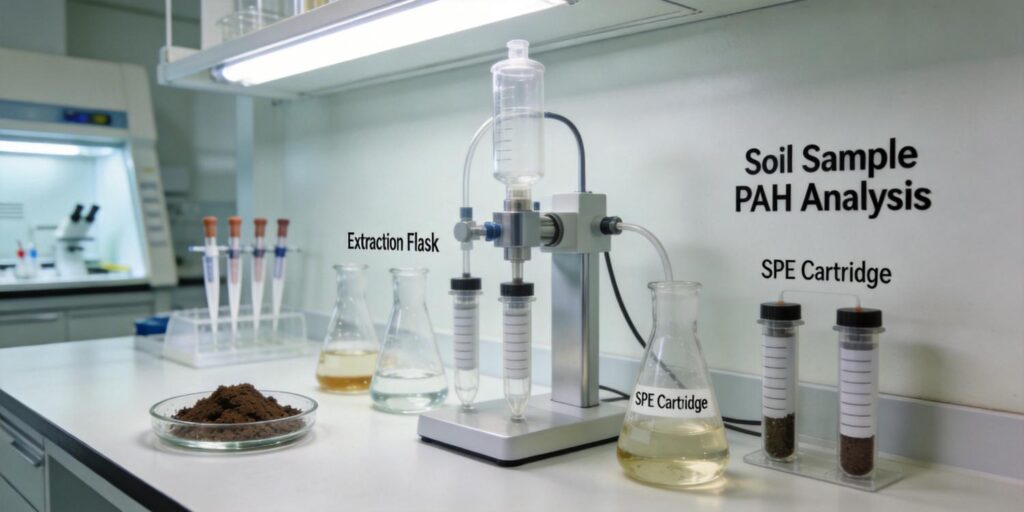
A comprehensive PAH analysis workflow integrates extraction, cleanup, and enrichment steps to achieve reliable results. The following optimized protocol demonstrates current best practices:
Step 1: Soil Extraction
Weigh 10 g of homogenized soil (dried and sieved to <2 mm) into extraction vessel. Add 20 mL of acetone:dichloromethane (1:1, v/v) and extract using ultrasonic bath for 30 minutes at 40°C. Centrifuge at 3000 rpm for 10 minutes and transfer supernatant to evaporation vessel. Repeat extraction twice with fresh solvent. Combine extracts and evaporate to near dryness under gentle nitrogen stream at 35°C.
Step 2: Extract Reconstitution
Reconstitute dried extract in 5 mL of hexane for GPC cleanup or directly in appropriate solvent for SPE enrichment.
Step 3: GPC Cleanup (Optional)
For heavily contaminated soils, inject reconstituted extract onto GPC system using Bio-Beads S-X3 or equivalent packing. Collect PAH fraction (typically 15-35 minute window) and evaporate to 1-2 mL.
Step 4: SPE Conditioning
Condition 500 mg C18 SPE cartridge with 5 mL of methanol followed by 5 mL of deionized water at flow rate of 1-2 mL/min. Do not allow sorbent to dry completely.
Step 5: Sample Loading
Dilute concentrated extract to 100 mL with deionized water (ensure organic content <5%). Load onto conditioned SPE cartridge at 2-3 mL/min. Rinse sample vessel with 10 mL of water and add to cartridge.
Step 6: Interference Removal
Wash cartridge with 5 mL of water:methanol (90:10, v/v) to remove polar interferences. Dry cartridge under vacuum for 5 minutes to remove residual water.
Step 7: Analyte Elution
Elute PAHs with 5 mL of dichloromethane into collection tube. Evaporate eluate to 1 mL under gentle nitrogen stream at 35°C. Transfer to autosampler vial for analysis.
GC-MS or LC-MS Detection Improvements
The effectiveness of SPE cleanup directly impacts detection sensitivity and reliability in both gas chromatography-mass spectrometry (GC-MS) and liquid chromatography-mass spectrometry (LC-MS) analyses.
GC-MS Analysis Improvements
Proper SPE cleanup provides significant benefits for GC-MS analysis:
- Reduced Matrix Effects: Removal of non-volatile compounds prevents contamination of GC inlet and column, maintaining chromatographic performance
- Improved Peak Shape: Cleaner extracts reduce peak tailing and broadening, enhancing resolution of critical PAH isomers
- Enhanced Detector Response: Reduced chemical noise improves signal-to-noise ratios, lowering detection limits
- Extended Instrument Lifetime: Minimized contamination reduces maintenance frequency and extends column life
For GC-MS analysis, particularly important is the removal of sulfur compounds that can interfere with electron capture detection or cause detector contamination.
LC-MS Analysis Improvements
For LC-MS applications, SPE cleanup addresses specific challenges:
- Ion Suppression Reduction: Removal of humic substances and other ionizable matrix components minimizes ionization suppression in ESI or APCI sources
- Source Contamination Prevention: Clean extracts reduce buildup on ion source components, maintaining sensitivity
- Improved Chromatographic Separation: Reduced matrix interference allows better retention time reproducibility and peak shape
- Enhanced Method Robustness: Consistent extract cleanliness improves method transferability and inter-laboratory comparability
Detection Limit Improvements
Comprehensive SPE cleanup typically achieves detection limit improvements of 5-10× compared to untreated extracts. For regulatory monitoring where detection limits in the low ng/g range are required, effective sample preparation becomes critical. Studies have demonstrated that “optimized SPE methods can achieve recoveries >80% with relative standard deviations of less than 10% for a range of PAHs” when properly implemented.
Quality Control Considerations
To ensure method reliability, incorporate appropriate quality control measures:
- Method blanks to monitor contamination
- Matrix spikes to assess recovery efficiency
- Surrogate standards to monitor extraction and cleanup performance
- Internal standards for quantification normalization
- Continuing calibration verification standards
For laboratories seeking optimized SPE solutions for PAH analysis, HLB SPE cartridges provide excellent performance for a wide range of environmental applications. For high-throughput needs, 96-well SPE plates offer automation compatibility and improved productivity.
By implementing these SPE strategies, environmental laboratories can achieve reliable, sensitive PAH analysis in soil extracts while meeting regulatory requirements and maintaining analytical quality standards.