Integrating SPE into LC-MS Analytical Methods
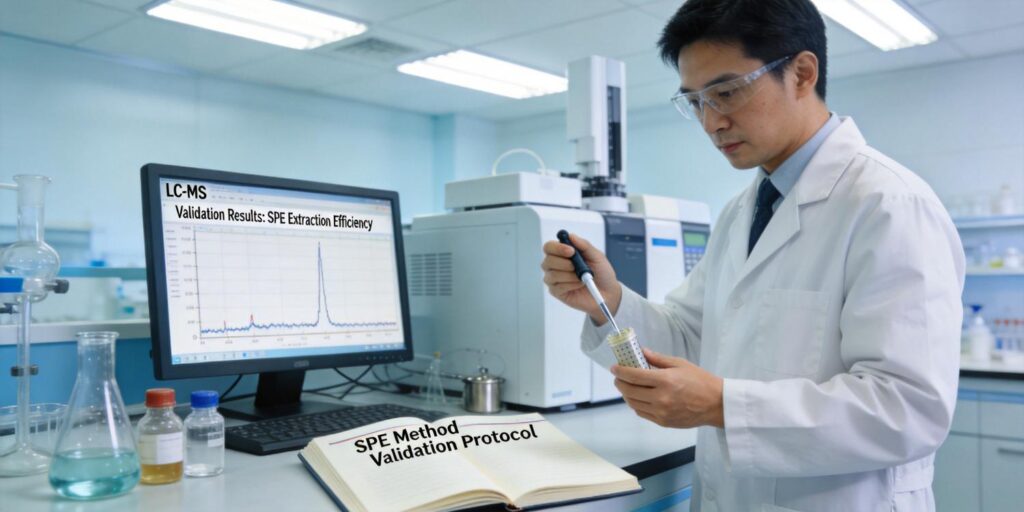
Solid-phase extraction (SPE) has become an indispensable tool in modern analytical chemistry, particularly when combined with liquid chromatography-mass spectrometry (LC-MS) workflows. The integration of SPE into LC-MS methods represents a strategic approach to sample preparation that addresses the unique challenges of mass spectrometric analysis while leveraging the complementary strengths of both techniques.
Historically, SPE emerged in 1974 when researchers discovered that C18 column packing material could selectively retain steroids from urine samples, leading to the development of commercial SPE devices. Today, approximately 60% of published SPE applications combine SPE with HPLC in some form, with LC-MS workflows representing a significant portion of these applications.
The Evolution of SPE-LC-MS Integration
The marriage of SPE and LC-MS is particularly synergistic because both techniques rely on sorbent-liquid partition processes and require precise fluid handling. Early implementations involved using SPE cartridges as guard columns or “switchable” columns before the advent of commercial SPE devices. Martin et al. (1979) demonstrated an innovative approach where a sample column was placed between C18 and silica columns, allowing for trapping of species at both ends of the polarity spectrum while intermediate polarity compounds passed through to the detector.
Modern SPE-LC-MS integration has evolved significantly, with two primary approaches dominating current practice:
1. Off-line SPE Combined with LC-MS
Off-line SPE remains the most common approach, where SPE cartridges are used independently before LC-MS analysis. This method provides several advantages:
- Sample Cleanup: Biological samples are notoriously dirty, and injecting them directly onto sensitive LC-MS instruments makes little sense. SPE significantly increases column life while reducing downtime for source cleaning.
- Concentration: SPE actually concentrates samples on the column, allowing for reproducible results at very low analyte levels.
- Selectivity: Unlike liquid-liquid extraction (LLE), which extracts many compounds generally, SPE provides increased selectivity for specific analytes.
Research by Bowers et al. (1997) demonstrated that in some cases, the HPLC separation step can be eliminated entirely, with the SPE cartridge alone providing cleanup and solvent exchange. However, early LC-MS users who attempted to eliminate sample preparation entirely discovered rapid declines in signal intensity and spectral quality due to components like proteins depositing in transfer capillaries and interfaces.
2. On-line SPE Combined with LC-MS
On-line SPE represents a more integrated approach where SPE cartridges function as substitutes for analytical columns, particularly in clinical and preclinical samples during drug approval processes. This approach offers:
- Reduced Analysis Time: With no chromatographic separation step, analysis times can be as short as one minute compared to 10-30 minutes for traditional HPLC-UV.
- Improved Throughput: The 96-well plate format has become standard for high-throughput screening, allowing parallel processing of multiple samples.
- Automation Compatibility: On-line systems can be fully automated, reducing human intervention and improving reproducibility.
Selecting Sorbent Chemistries During Method Design
The selection of appropriate sorbent chemistry is critical to successful SPE-LC-MS method development. The choice depends on several factors including analyte properties, matrix composition, and analytical requirements.
Fundamental SPE Modes
SPE operates in two primary modes, often described as “digital chromatography”:
1. Matrix Adsorption Mode
In this mode, analytes remain unretained (k ~ 0) while the matrix is retained (k >> 1). This approach offers no preconcentration advantage and typically produces less clean eluates. Sample loading is often gravity-fed, and this mode is used less frequently than analyte adsorption.
2. Analyte Adsorption Mode
Here, analytes are retained (k >> 1) while the matrix remains unretained (k ~ 0) and/or strongly retained (k >> 1). This mode provides significant preconcentration factors and cleaner extracts. Loading typically occurs at 1-3 drops per second, with recovery inversely proportional to flow rate.
Sorbent Chemistry Selection Criteria
When selecting sorbent chemistries, consider the following factors:
- Analyte Characteristics: Structure, pKa, polarity, functional groups, solvent solubility, and stability
- Matrix Properties: Possible interferences, pH, ionic strength, solvent solubility, and qualitative/quantitative variability
- Final Requirements: Restrictions on final solvent and concentration based on technique or instrument limitations
Common Sorbent Chemistries
Several sorbent chemistries have proven particularly effective for LC-MS applications:
1. Reversed-Phase Sorbents (C18, C8, HLB)
These sorbents are ideal for non-polar to moderately polar compounds. Hydrophilic-lipophilic balance (HLB) sorbents, such as those offered by Poseidon Scientific, provide balanced retention for a wide range of analytes and are particularly effective for pharmaceutical applications.
2. Mixed-Mode Sorbents (MCX, WCX, MAX, WAX)
Mixed-mode sorbents combine reversed-phase and ion-exchange mechanisms, offering superior selectivity for charged analytes. Poseidon Scientific’s MCX (mixed-mode cation exchange) and MAX (mixed-mode anion exchange) cartridges are particularly valuable for pharmaceutical analysis where both hydrophobic and ionic interactions are important.
3. Ion-Exchange Sorbents
These sorbents are specifically designed for charged analytes and can provide exceptional selectivity when properly matched to analyte charge characteristics.
Optimizing Conditioning, Washing, and Elution Steps
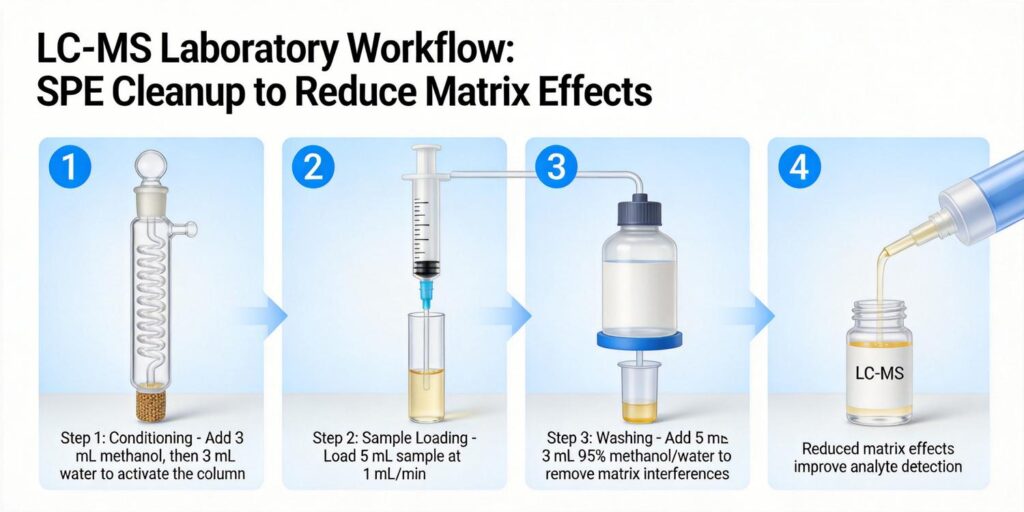
Proper optimization of SPE steps is essential for achieving high recoveries and clean extracts. The fundamental steps for SPE adsorption mode include:
1. Preconditioning
Preconditioning prepares the cartridge to accept the sample. Typically, this involves:
- Methanol or acetonitrile to wet the sorbent
- Weak solvent (water or buffer) to condition the sorbent for sample loading
2. Sample Loading
During loading, weakly retained matrix compounds elute while analytes and other matrix components are retained. Optimal loading flow rates are typically 1-3 drops per second, with recovery inversely proportional to flow rate.
3. Washing
Washing removes interferences using solvents that won’t elute the analytes. The washing step is critical for removing matrix components that could cause ionization suppression in LC-MS.
4. Elution
Elution releases analytes in the smallest possible volume. The elution solvent should be stronger than the preconditioning solvent to ensure complete analyte recovery.
Optimization Strategies
Successful optimization requires a systematic approach:
- Research the Problem: Review previous SPE and analysis conditions for the analyte and matrix
- Characterize the Analyte: Understand structure, pKa, polarity, functional groups, and stability
- Characterize the Sample Matrix: Identify possible interferences and matrix properties
- Screen Conditions: Systematically test different sorbents and solvent combinations
- Validate Performance: Evaluate recovery, selectivity, and reproducibility
Evaluating Matrix Effects and Recovery
Matrix effects represent one of the most significant challenges in LC-MS analysis, particularly when using atmospheric pressure ionization techniques. SPE plays a crucial role in mitigating these effects.
Understanding Matrix Effects
Matrix effects occur when co-extracted endogenous interferences from biofluids suppress or enhance analyte ionization, potentially leading to false negatives or inaccurate quantification. SPE addresses this challenge through:
- Selective Extraction: Removing interfering compounds that cause ionization suppression
- Cleanup: Eliminating humics and other species that can interfere with analysis
- Concentration: Enabling ultra-trace level detection through effective preconcentration
Recovery Assessment
SPE recoveries should exceed 90% absolute recovery. Lower recoveries typically indicate suboptimal parameter adjustment, including issues with solubility, pH, or solvent strength. Unlike LLE, which often struggles with reproducible high recovery, SPE consistently achieves excellent recovery through proper method optimization.
Practical Considerations
When evaluating matrix effects and recovery:
- Use Appropriate Internal Standards: Stable isotope-labeled analogs are ideal for compensating for matrix effects
- Perform Matrix-Matched Calibration: Prepare calibration standards in matrix to account for extraction efficiency
- Conduct Post-Column Infusion Experiments: Identify regions of ion suppression or enhancement
- Evaluate Multiple Lots: Test different lots of matrix to ensure method robustness
Establishing Calibration and Internal Standards
Proper calibration and internal standard selection are critical for accurate quantification in SPE-LC-MS workflows.
Calibration Strategies
Several calibration approaches are commonly used:
1. External Calibration
External calibration involves preparing calibration standards in solvent. While simple, this approach doesn’t account for matrix effects or extraction efficiency.
2. Matrix-Matched Calibration
Matrix-matched calibration standards are prepared in blank matrix and processed through the entire SPE-LC-MS workflow. This approach accounts for both matrix effects and extraction efficiency but requires appropriate blank matrix.
3. Standard Addition
Standard addition involves spiking known amounts of analyte into aliquots of the sample. This approach is particularly useful when appropriate blank matrix is unavailable.
Internal Standard Selection
Internal standards compensate for variability in sample preparation and analysis. Ideal internal standards should:
- Be chemically similar to the analyte
- Exhibit similar extraction characteristics
- Not be present in the sample matrix
- Be stable throughout the analysis
Stable isotope-labeled analogs are generally preferred because they exhibit nearly identical chemical properties to the analyte while being distinguishable by mass spectrometry.
Validation for Regulatory Compliance
Method validation is essential for regulatory compliance in pharmaceutical, environmental, and clinical applications. Key validation parameters for SPE-LC-MS methods include:
1. Specificity
Demonstrate that the method specifically measures the analyte in the presence of potential interferences. This typically involves analyzing blank matrix and matrix spiked with potential interferences.
2. Linearity
Establish the concentration range over which the method provides proportional response. Typically, a correlation coefficient (r) of ≥0.99 is required.
3. Accuracy and Precision
Accuracy (closeness to true value) and precision (reproducibility) should be evaluated at multiple concentration levels. Acceptance criteria typically require accuracy within ±15% of nominal and precision with ≤15% RSD.
4. Recovery
Extraction recovery should be consistent and reproducible. While absolute recovery isn’t critical if consistent, recoveries above 90% are generally expected for well-optimized SPE methods.
5. Matrix Effects
Quantify matrix effects using post-column infusion or post-extraction addition experiments. Matrix effects should be consistent across different lots of matrix.
6. Stability
Evaluate analyte stability under various conditions including storage, freeze-thaw cycles, and in processed samples.
Example Pharmaceutical Analysis Workflow
To illustrate the practical application of SPE-LC-MS method development, consider a typical pharmaceutical analysis workflow for drug quantification in plasma:
Step 1: Method Design
Begin by researching the drug’s physicochemical properties and previous analytical methods. For a basic drug with pKa around 8.5, a mixed-mode cation exchange (MCX) sorbent from Poseidon Scientific would be appropriate.
Step 2: Sample Preparation
- Protein Precipitation: Add internal standard and acetonitrile to plasma samples
- Centrifugation: Remove precipitated proteins
- SPE Conditioning: Condition MCX cartridge with methanol followed by water
- Sample Loading: Load supernatant onto cartridge
- Washing: Wash with 2% formic acid in water, then methanol
- Elution: Elute with 5% ammonium hydroxide in methanol
Step 3: LC-MS Analysis
Analyze eluates using reversed-phase LC with MS/MS detection. Use a short gradient to separate the drug from potential interferences.
Step 4: Method Validation
Validate the method according to regulatory guidelines, including specificity, linearity, accuracy, precision, recovery, matrix effects, and stability assessments.
Step 5: Routine Analysis
Implement the validated method for routine sample analysis, including appropriate quality control samples to monitor method performance.
Conclusion
Successful analytical method development for SPE-LC-MS workflows requires a systematic approach that integrates sample preparation with analytical detection. By carefully selecting sorbent chemistries, optimizing SPE conditions, evaluating matrix effects, establishing appropriate calibration strategies, and conducting thorough validation, analysts can develop robust methods that meet regulatory requirements while providing accurate and reliable results.
The continued evolution of SPE technology, including developments in sorbent chemistry and automation, promises to further enhance the capabilities of SPE-LC-MS workflows. As demonstrated by Poseidon Scientific’s comprehensive range of SPE products—including HLB, MCX, MAX, WAX, WCX cartridges and 96-well plates—modern SPE offers powerful solutions for the challenges of contemporary analytical chemistry.
By following the principles outlined in this guide and leveraging appropriate SPE technologies, analytical chemists can develop efficient, reliable methods that maximize the potential of LC-MS analysis while minimizing matrix effects and ensuring regulatory compliance.