Balanced Hydrophilic-Lipophilic Retention Principle of HLB Sorbents
Hydrophilic-Lipophilic Balanced (HLB) sorbents represent a revolutionary advancement in solid-phase extraction technology. Unlike traditional silica-based sorbents that rely on either purely hydrophobic or hydrophilic interactions, HLB sorbents incorporate a unique copolymer structure that provides balanced retention capabilities across a wide polarity range.
The fundamental principle behind HLB technology involves a carefully engineered copolymer of divinylbenzene and N-vinylpyrrolidone. This combination creates a sorbent with both hydrophilic (water-loving) and lipophilic (fat-loving) characteristics. The hydrophilic pyrrolidone groups provide excellent wettability and retention for polar compounds, while the lipophilic divinylbenzene components offer strong retention for non-polar analytes. This balanced approach allows HLB sorbents to effectively retain compounds across a broad spectrum of polarities without the need for complex pH adjustments or multiple extraction steps.
One of the most significant advantages of HLB sorbents is their water-wettable nature. Traditional reversed-phase sorbents require conditioning with organic solvents to wet the hydrophobic surface before aqueous samples can be loaded. HLB sorbents, however, are inherently water-wettable, allowing direct loading of aqueous samples without compromising analyte recovery. This characteristic eliminates the conditioning and equilibration steps required by other polymeric and silica-based sorbents, reducing the number of processing steps from five to three and resulting in significant time and solvent savings.
The stability of HLB sorbents across the entire pH range (0-14) further enhances their versatility. This pH stability allows analysts to work with samples at extreme pH conditions without damaging the sorbent or compromising retention capabilities. Additionally, HLB sorbents exhibit no silanol interactions, eliminating secondary interactions that can complicate method development and reduce reproducibility.
Drug Classes Compatible with HLB Extraction
HLB sorbents demonstrate exceptional versatility in extracting a wide range of drug classes, making them ideal for broad-spectrum screening applications. The balanced retention mechanism allows for efficient extraction of acidic, basic, and neutral compounds simultaneously, a capability that traditional single-mode sorbents cannot match.
For acidic drugs such as ibuprofen (pKa 5.2), ketoprofen (pKa 5.9), and other non-steroidal anti-inflammatory drugs, HLB sorbents provide excellent recovery when samples are properly pH-adjusted. Research shows that lowering sample pH from 6.0 to 5.0 increases ibuprofen recovery on hydrophobic phases by decreasing ionization and increasing the non-ionic molecular form available for hydrophobic interactions.
Basic drugs including opioids, amphetamines, β-blockers, and tricyclic antidepressants are effectively retained on HLB sorbents. The extraction of basic drugs from complex matrices like plasma and serum benefits from HLB’s ability to remove interfering fatty acids and neutral compounds that typically complicate solvent extraction methods. Studies demonstrate that mixed-mode SPE methods using HLB-based cartridges allow rapid recovery of diverse basic drug groups including β-blockers, β-agonists, opiates, and alkaloidal drugs without the need for back extraction or lengthy clean-up procedures.
Neutral compounds such as barbiturates, benzodiazepines, and various therapeutic drugs show excellent recovery on HLB sorbents. The high capacity of HLB for polar compounds makes it particularly effective for drugs with moderate to high polarity that might be poorly retained on traditional C18 sorbents.
Specific applications documented in forensic and clinical literature include extraction of:
- Gamma hydroxybutyric acid (GHB) from urine
- Benzoylecgonine (cocaine metabolite) from serum, plasma, and whole blood
- Opiates including morphine and codeine from various biological matrices
- Tricyclic antidepressants from serum and plasma
- Benzodiazepines from serum and plasma
- Various therapeutic and abused drugs from urine, serum, and whole blood
Conditioning and Equilibration for Reproducible Retention
Proper conditioning and equilibration are critical for achieving reproducible results in SPE applications. While HLB sorbents offer the advantage of being water-wettable and can theoretically be used without conditioning, optimal performance often requires careful attention to these steps, particularly when working with complex biological matrices.
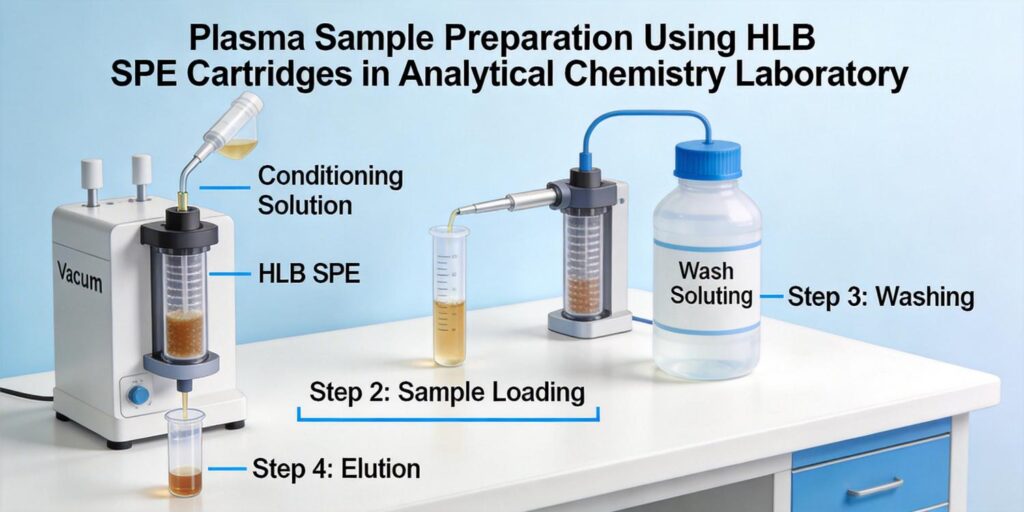
Traditional SPE conditioning involves two key steps: first, wetting the sorbent with an organic solvent (typically methanol or acetonitrile) to prepare the hydrophobic surface for aqueous sample interaction; second, equilibrating with an aqueous solution or buffer to create the proper environment for analyte retention. For HLB sorbents, the conditioning process can be simplified but should not be overlooked.
Recommended conditioning protocol for HLB cartridges:
- Solvent conditioning: Pass 1.5 mL of methanol per 100 mg of sorbent through the column at low vacuum (approximately 3 in. Hg). This step ensures complete wetting of the sorbent bed and opens the pore structure for optimal analyte interaction.
- Aqueous equilibration: Follow with 1 mL of deionized water or appropriate buffer per 100 mg of sorbent to remove excess organic solvent that could interfere with hydrophobic binding.
It’s crucial to maintain the sorbent in a wetted state throughout the process. If the sorbent accidentally dries out, it must be reconditioned to restore optimal performance. The conditioning solvent choice can significantly impact extraction efficiency. While methanol is most commonly used, studies show that solvents like isopropanol, with surface tension closer to that of hydrocarbon surfaces, can provide more effective conditioning for certain applications.
For ion-exchange applications or when working with ionizable compounds, additional buffer conditioning may be necessary to establish the proper pH environment for optimal retention. The choice of buffer counter-ions can dramatically affect recovery, with potassium ions often providing better blocking of secondary interactions than sodium ions in certain applications.
Sample Loading Considerations for Biological Matrices
Successful HLB SPE for drug screening requires careful consideration of sample preparation and loading conditions, particularly when dealing with complex biological matrices like urine, plasma, serum, or whole blood.
Sample Pretreatment: Biological samples often require pretreatment before SPE. Common approaches include:
- Dilution: Diluting samples 1:1 with buffer or water improves flow characteristics during loading and can reduce matrix effects
- pH Adjustment: For acidic drugs, diluting 1:1 with 4% phosphoric acid or other acids can improve recovery by promoting the non-ionic form
- Particulate Removal: Centrifugation (≥3000 rpm) or filtration through 0.45 μm membranes removes particulates that could clog the sorbent bed
- Protein Precipitation: For protein-rich matrices like plasma or serum, initial protein precipitation may be necessary, though HLB sorbents can often handle these matrices directly with proper dilution
Loading Conditions: Optimal sample loading requires attention to several factors:
- Flow Rate: Apply samples at approximately 1 mL/min to ensure adequate contact time with the sorbent
- Sample Volume: The appropriate sample volume depends on the sorbent mass and analyte concentration. Typical guidelines suggest 10-375 μL for 2 mg sorbent, 50-200 μL for 10 mg sorbent, and 100 μL-1 mL for 30 mg sorbent
- Organic Content: Keep organic solvent content below 5-10% during loading to ensure proper retention of analytes
- pH Control: Maintain pH conditions that favor the desired retention mechanism (non-ionic form for hydrophobic retention, appropriate charge state for ion-exchange interactions)
Research indicates that matrix components can dramatically influence sorbent-analyte interactions, making it essential to develop methods using the actual matrix of interest rather than simple aqueous solutions. The presence of proteins, lipids, and other endogenous compounds in biological samples can affect both retention and recovery, necessitating method optimization with representative matrices.
Washing Conditions to Remove Proteins and Lipids
Effective washing is crucial for removing matrix interferences while retaining target analytes. HLB sorbents offer flexibility in wash solvent selection due to their balanced retention characteristics and high capacity.
Standard Wash Protocol: A common and effective wash for HLB cartridges involves using 5% methanol in water. This relatively weak wash solvent removes hydrophilic interferences like salts and some proteins while retaining most drugs of interest. The volume typically ranges from 1-3 mL depending on cartridge size and sample complexity.
Enhanced Cleanup Washes: For more challenging matrices or when analyzing particularly polar drugs, additional wash steps may be necessary:
- Water Wash: Simple deionized water can effectively remove salts and very polar contaminants
- Buffer Washes: Specific buffer solutions at controlled pH can selectively remove interfering compounds while retaining analytes
- Low-Percentage Organic Washes: 5-20% methanol, acetonitrile, or other organic solvents in water can remove moderately polar interferences
Special Considerations for Biological Matrices:
- Protein Removal: While HLB sorbents can tolerate some protein content, excessive protein can reduce capacity and cause clogging. Initial protein precipitation or use of specific wash conditions may be necessary for protein-rich samples
- Lipid Removal: Lipids represent a significant interference in biological samples. Wash solvents containing hexane or other non-polar solvents can effectively remove lipids while retaining most drugs. Studies show that mixed-mode SPE methods using HLB-based cartridges produce extracts virtually free of cholesterol and fatty acids that are prominent in solvent-extracted fractions
- Phospholipid Removal: Modern HLB formulations, particularly PRiME HLB, demonstrate exceptional ability to remove phospholipids—common sources of matrix effects in LC-MS analysis. These sorbents can remove more than 95% of phospholipids with simple wash protocols
The ideal wash removes as many interferences as possible while retaining 100% of the target analytes. Method development should include testing various wash conditions to optimize this balance for specific applications.
Elution Solvents for Wide Analyte Coverage
Selecting appropriate elution solvents is critical for achieving high recovery across a broad range of analytes in drug screening applications. HLB sorbents’ balanced retention characteristics allow flexibility in elution solvent choice while maintaining good recovery for diverse compounds.
Standard Elution Solvents:
- Methanol: As a proton donor solvent with relative elution strength of 1.0, methanol effectively disrupts hydrogen bonding and provides excellent recovery for many drugs. It’s particularly effective for polar to moderately polar compounds
- Acetonitrile: With a relative elution strength of 3.1 and dipole-dipole interactions, acetonitrile works well for medium polarity drugs
- Acetonitrile/Methanol Mixtures: A 90:10 mixture of acetonitrile to methanol combines the strengths of both solvents and is particularly effective for broad-spectrum elution
Specialized Elution Solvents:
- Tetrahydrofuran (THF): Relative elution strength of 3.7 makes THF suitable for medium polarity drugs
- Acetone: With a relative elution strength of 8.8, acetone works well for medium polarity compounds
- Ethyl Acetate: Excellent for non-polar drugs and GC-compatible applications
- Methylene Chloride: Effective for non-polar drugs and GC applications
Optimization Considerations:
- Solvent Additives: When using solvents other than methanol, adding 10-30% of a proton donor solvent like methanol can help disrupt hydrogen bonding on the HLB sorbent
- Elution Volume: Typical elution volumes range from 25 μL for μElution plates to ≥800 μL for 60 mg cartridges. Using the minimum effective volume improves concentration factors
- Multiple Elutions: Two sequential elutions with smaller volumes often provide better recovery than a single large-volume elution
- pH-Modified Elution: For ionizable compounds, adding acid or base to the elution solvent can improve recovery by changing the analyte’s charge state
Research demonstrates that ethanol can serve as an effective elution solvent for certain applications, offering good recovery with relatively low toxicity. However, methanol and acetonitrile remain the most widely used and versatile choices for broad-spectrum drug screening.
Application in Multi-Drug Toxicology Screening
HLB SPE has become the gold standard for multi-drug toxicology screening due to its ability to simultaneously extract a wide range of compounds with varying physicochemical properties. This capability makes it invaluable in forensic, clinical, and workplace testing environments where comprehensive screening is essential.
Comprehensive Screening Capabilities: HLB-based methods can extract and detect numerous drug classes including:
- Opioids and narcotic analgesics
- Stimulants (amphetamines, cocaine metabolites)
- Sedative-hypnotics (barbiturates, benzodiazepines)
- Antidepressants (tricyclics, SSRIs)
- Antipsychotics
- Various therapeutic drugs and their metabolites
Forensic Applications: In forensic toxicology, HLB SPE provides several advantages:
- Reduced Matrix Effects: Clean extracts minimize ion suppression/enhancement in LC-MS analysis
- Improved Detection Limits: Concentration capabilities allow detection of low-level drugs
- Compatibility with Multiple Detection Methods: Extracts can be analyzed by GC-MS, LC-MS, or immunoassay
- Reproducibility: Consistent recovery across batches and operators
Clinical Toxicology: For emergency room and overdose situations, rapid and comprehensive screening is critical. HLB methods enable:
- Simultaneous extraction of multiple drug classes from limited sample volumes
- Detection of both parent drugs and metabolites
- Quantitation capabilities for therapeutic drug monitoring
- Compatibility with high-throughput automated systems
Workplace and Sports Testing: The broad-spectrum capabilities of HLB SPE make it ideal for detecting drug abuse in workplace and athletic settings. Methods have been successfully applied to detect anabolic steroids, stimulants, narcotics, and other prohibited substances in urine, blood, and other matrices.
Method Development Strategy: Successful implementation of HLB SPE for multi-drug screening involves:
- Analyte Characterization: Understanding physicochemical properties (pKa, logP, functional groups) of target compounds
- Matrix Assessment: Evaluating matrix effects and potential interferences
- Condition Optimization: Systematically testing loading, washing, and elution conditions
- Validation: Establishing recovery, precision, selectivity, and stability parameters
- Automation: Implementing methods on automated SPE systems for high-throughput applications
The future of HLB SPE in toxicology screening continues to evolve with advancements in sorbent technology, automation, and detection methods. The development of specialized HLB formulations like PRiME HLB, which eliminates conditioning steps while maintaining excellent cleanup capabilities, represents the next generation of SPE technology for routine analytical applications.
For laboratories considering HLB SPE implementation, Poseidon Scientific offers a comprehensive range of HLB SPE cartridges and related products including MAX, MCX, WAX, and WCX mixed-mode cartridges, as well as 96-well SPE plates for high-throughput applications.