
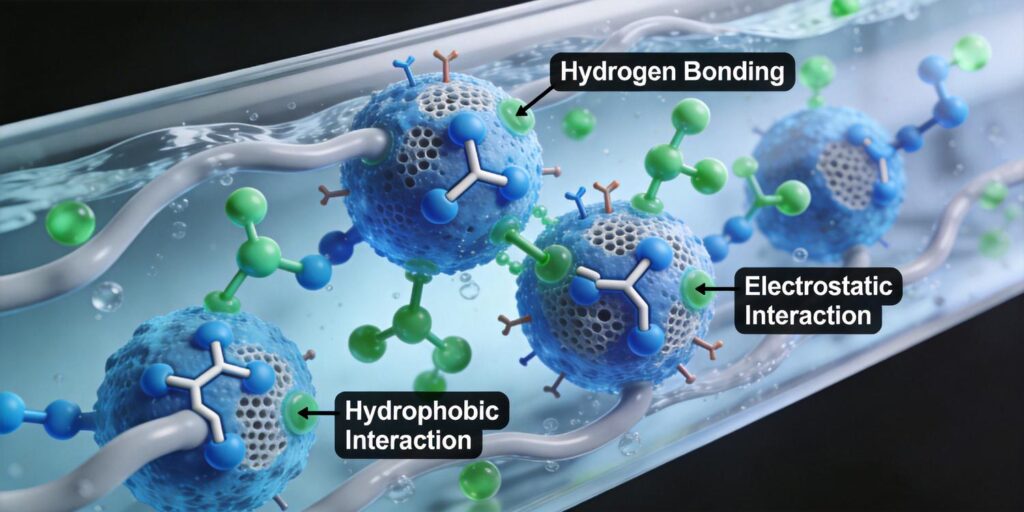
What is Mixed-Mode SPE?
Mixed-mode solid-phase extraction (SPE) represents a sophisticated analytical technique that combines two or more distinct retention mechanisms within a single sorbent material. Unlike conventional SPE cartridges that rely on a single interaction type—such as reversed-phase (hydrophobic) or ion-exchange—mixed-mode sorbents integrate multiple binding mechanisms to achieve superior selectivity and cleanup for complex samples.
As noted in forensic and clinical literature, “Mixed-mode SPE columns are prevalent in drug extractions because they offer multiple binding mechanisms for improved sensitivity and excellent sample cleanup.” This dual-functionality approach has become particularly valuable in pharmaceutical and toxicological analysis where samples often contain analytes with diverse chemical properties.
Interaction Mechanisms in Mixed-Mode SPE
Dual Retention Pathways
Mixed-mode sorbents typically combine reversed-phase interactions with ion-exchange capabilities, creating a versatile platform for analyte retention. The most common configuration in drug analysis involves pairing hydrophobic alkyl chains (C8 or C18) with either cation-exchange (for basic compounds) or anion-exchange (for acidic compounds) functional groups.
According to research on forensic applications, “This mechanism works by providing separation of the acid/neutral drugs using reversed phase C8 functionality; the benzene sulfonic acid mechanism works on basic drugs by cation exchange of the amine functionalities.” This dual-path approach allows for simultaneous retention of compounds with different chemical characteristics.
pH-Dependent Selectivity
The effectiveness of mixed-mode SPE depends heavily on pH control. At appropriate pH levels:
- Basic analytes (pKa > 6) become ionized and are retained primarily through ionic interactions with cation-exchange sites
- Acidic compounds, although partially ionized, are retained along with neutral drugs through hydrophobic, reversed-phase interactions when the application solvent is weakly eluotropic (e.g., water)
- Neutral compounds are retained exclusively through hydrophobic interactions
As described in analytical literature, “When using mixed-mode extractions, the elution solvent must be able to reverse or disrupt all bonding mechanisms simultaneously, so pH, polarity, and solubility must all be considered.”
Advantages for Complex Matrices
Superior Cleanup Capability
Mixed-mode SPE offers significant advantages when dealing with complex biological matrices like plasma, urine, whole blood, and tissues. The combination of retention mechanisms provides:
- Enhanced selectivity: Simultaneous removal of both hydrophobic and ionic interferences
- Improved recovery: Higher analyte recovery rates compared to single-mode SPE
- Reduced matrix effects: Cleaner extracts with minimal endogenous interference
- Broad applicability: Suitable for acidic, basic, and neutral compounds in a single extraction
Research on systematic toxicological analysis confirms that “the resulting SPE eluates are easily amenable to subsequent GC- and HPLC-analysis. The chromatograms show almost no interference from endogenous matrix components.”
Method Development Flexibility
Mixed-mode sorbents provide greater flexibility in method development. As noted in pharmaceutical cream analysis studies, “The hydrophobic and acidic-basic properties of the drug as well as the nature of the excipients constitute critical elements for determining the choice of a reversed-phase or ion-exchange methodology for optimisation of the SPE.” With mixed-mode materials, analysts can address multiple compound classes without switching cartridges.
Examples of MCX and MAX Sorbents
Oasis MCX: Mixed-Mode Cation Exchange
MCX (Mixed-mode Cation eXchange) sorbents combine reversed-phase retention with strong cation-exchange functionality. These materials are specifically designed for basic analytes and offer:
- Tightly controlled ion-exchange capacity: Typically 1 meq/g for consistent performance
- pH stability: Stable across pH 0-14 range
- Silanol-free design: Eliminates secondary interactions that complicate method development
- Water-wettable polymer: Ensures consistent performance with aqueous samples
As documented in product literature, “Oasis MCX: used for basic analytes. Mixed-mode cation exchange with reversed-phase retention sorbent, offering high selectivity and sensitivity for basic drugs.” The sulfonic acid groups provide strong cation-exchange sites that selectively retain protonated basic compounds.
Oasis MAX: Mixed-Mode Anion Exchange
MAX (Mixed-mode Anion eXchange) sorbents combine reversed-phase retention with strong anion-exchange functionality, making them ideal for acidic compounds. Key features include:
- Controlled ion-exchange capacity: Typically 0.25 meq/g for reproducible protocols
- Broad pH stability: Performs consistently from pH 0-14
- Polymeric structure</strong: Water-wettable and free of complicating silanol groups
- Selective retention: Anion-exchange groups specifically retain deprotonated acidic compounds
Product documentation notes that “Oasis MAX sorbent has a tightly controlled ion-exchange capacity of 0.25 meq/g, ensuring reproducible SPE protocols for extraction of acidic compounds and metabolites from biological fluids.”
Application in Drug Analysis
Pharmaceutical Formulations
Mixed-mode SPE has proven particularly valuable in pharmaceutical analysis. Studies on cream formulations demonstrate its effectiveness for diverse drug classes:
- Basic drugs: Promethazine, chlorhexidine, benzydamine
- Acidic drugs: Ketoprofen (pKa ~5.9), ibuprofen (pKa ~5.2)
- Neutral drugs: Hydrocortisone acetate, fentiazac, piroxicam
Research shows that “when the usual, general SPE process was adopted, the conditions were adjusted to induce the interactions matrix-analyte, analyte-sorbent and analyte-eluent.” For basic hydrophobic drugs like promethazine, C-18 sorbents were effective, while for basic hydrophilic drugs like chlorhexidine, SCX packing materials were preferred.
Forensic and Clinical Applications
In forensic toxicology, mixed-mode SPE has become the gold standard for systematic toxicological analysis (STA). The approach allows for:
- Comprehensive drug screening: Simultaneous extraction of acidic, neutral, and basic substances
- High recoveries: From plasma, urine, whole blood, and tissues
- Clean extracts: Minimal matrix interference in subsequent GC or HPLC analysis
As noted in forensic methodology, “In view of our interest in toxicologically relevant substances, we chose a mixed-mode bonded silica cartridge in which the silanol groups were partly derivatized with medium length alkyl chains and partly with cation exchange substituents.” This approach anticipated that at suitable pH, acidic and neutral substances would be retained by hydrophobic interactions while basic substances would interact with cation exchange groups.
Method Optimization Considerations
Successful implementation of mixed-mode SPE requires careful optimization of several parameters:
- pH control: Critical for controlling ionization states of both analytes and sorbent functional groups
- Solvent selection: Must address both hydrophobic and ionic interactions during elution
- Wash optimization: Sequential washes can remove different types of interferences
- Elution strategy: Often requires solvents that disrupt multiple interaction types simultaneously
Research emphasizes that “the elution solvent must be able to reverse or disrupt all bonding mechanisms simultaneously, so pH, polarity, and solubility must all be considered.”
Conclusion
Mixed-mode SPE represents a powerful advancement in sample preparation technology, particularly valuable for complex matrices containing analytes with diverse chemical properties. By combining reversed-phase and ion-exchange mechanisms in a single sorbent, these materials offer superior selectivity, improved recoveries, and cleaner extracts compared to traditional single-mode SPE.
The availability of specialized sorbents like MCX for basic compounds and MAX for acidic compounds has expanded the applicability of mixed-mode SPE across pharmaceutical, forensic, clinical, and environmental analysis. As analytical challenges continue to grow in complexity, mixed-mode SPE provides a versatile and effective solution for demanding sample preparation requirements.
For laboratories dealing with complex matrices or multiple analyte classes, mixed-mode SPE offers a compelling combination of performance benefits that can streamline method development, improve data quality, and enhance overall analytical efficiency.


