
1. Limitations of Silica Sorbents Under Extreme pH Conditions
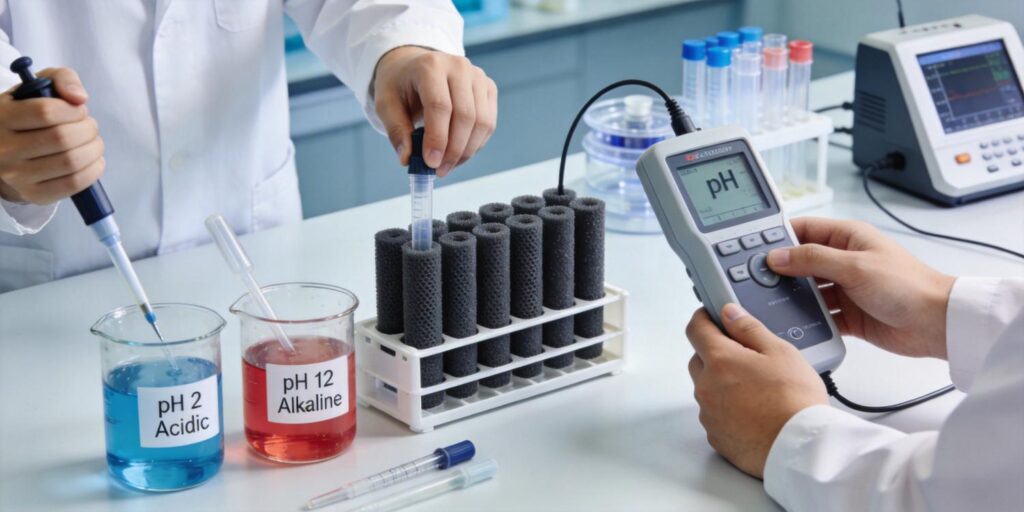
Silica-based solid phase extraction (SPE) sorbents have been the workhorse of sample preparation for decades, accounting for approximately 90% of extraction columns manufactured. However, their performance is severely compromised when operating outside their optimal pH range of 2.0 to 9.0. Below pH 2.0, the Si-C bonds of derivatized silica materials can be cleaved through acid-catalyzed hydrolysis, while above pH 9.0, silica is slowly solubilized into silicate.
The fundamental vulnerability of silica sorbents stems from their siloxane (Si-O-Si) bond structure. Kirkland and coworkers demonstrated that ligands bound to silica surfaces via siloxane bonds are subject to both acid- and base-catalyzed hydrolysis. The velocity of this reaction depends on water concentration, organic solvent type, pH, temperature, ion type, and the nature of the ligand layer. At low pH, ligands are cleaved by hydrolysis, and buffer components such as phosphate and carbonate cause more rapid hydrolysis than acetate, citrate, or borate.
Sterically protected ligands containing groups such as isopropyl and butyl can shield the siloxane bond from hydrolysis and enhance stability up to pH 11. However, even these improved silica sorbents cannot match the chemical stability of polymeric alternatives in extreme pH conditions.
2. Chemical Stability of Polymeric Sorbents
Polymeric SPE sorbents, particularly polystyrene divinyl benzene (PSDVB) and related copolymers, offer superior chemical stability across a much broader pH range. The main advantage of polymeric materials lies in their ability to withstand pH extremes not achievable with silica-based sorbents. These synthetic polymers include polystyrene divinyl benzene (PSDVB), polystyrene divinyl pyrrolidone (PSPVP), and dimethyacryloxymethyl naphthalene divinyl benzene (DMN-DVB), with mixtures of these compounds used to obtain desired characteristics.
The chemical stability of polymeric sorbents stems from their carbon-carbon backbone structure, which is inherently more resistant to hydrolysis than the siloxane bonds in silica. While silica-based sorbents have a safe working pH range of 2.0-9.0, polymeric sorbents can typically operate from pH 0-14 without significant degradation. This broad pH compatibility makes them ideal for applications requiring aggressive sample preparation conditions.
Modern polymeric sorbents have evolved significantly, with novel functionalized polymer materials introduced since 1995 offering modified non-polar properties. These include water-wettable copolymers like Oasis HLB that are stable from pH 0-14 and can be used without the conditioning and equilibration steps required by other polymeric and silica-based sorbents.
3. Effects of pH on Analyte Retention Mechanisms
pH plays a critical role in determining analyte retention mechanisms in SPE, and polymeric sorbents maintain consistent performance across wider pH ranges. For reversed-phase extractions, pH affects the ionization state of analytes, with un-ionized compounds favoring retention. In most cases, the pH of the sample and that of the sorbent should be equivalent for optimal binding.
For ion-exchange applications, pH is even more critical. Ionic bonds are strong enough to allow analytes to remain bound while interferences are washed away, but the pH must remain 2 pH units from the relevant pKa of both analyte and sorbent for ionic retention to occur. With silica-based sorbents, pH extremes can compromise the sorbent itself, while polymeric sorbents maintain their functional integrity.
Mixed-mode sorbents, which employ both reversed-phase and ion-exchange functionality, are particularly sensitive to pH conditions. These sorbents allow maximum selectivity for extraction of acids, neutrals, and bases, but require stable sorbent chemistry across the required pH range. Polymeric mixed-mode sorbents excel in these applications because they maintain their dual functionality even under extreme pH conditions.
4. Application Examples Requiring Extreme pH Conditions
Several critical applications demand SPE under extreme pH conditions where polymeric sorbents are essential:
Environmental Analysis
Phenol extraction from water samples typically requires acidification to pH 90% for most phenols) with high capacity (up to 320 mg/g for caffeine).
Pharmaceutical Analysis
Basic drug compounds often require alkaline conditions (pH >9) for optimal retention and cleanup. Polymeric mixed-mode sorbents like MCX (Mixed-mode Cation Exchange) provide stable performance for bases at high pH, while silica-based alternatives would dissolve.
Forensic Toxicology
Drug abuse testing frequently involves both acidic and basic conditions during method development. Copolymeric mixed-mode sorbents allow extraction and “back-extraction” on the same column with nothing more than a change of solvents, maintaining stability throughout the pH range.
Biomolecule Purification
Protein and peptide purification often requires extreme pH conditions for elution or cleaning-in-place procedures. Polymeric sorbents maintain their structural integrity during these harsh treatments.
5. Conditioning and Washing Considerations
The superior pH stability of polymeric sorbents simplifies conditioning and washing protocols. Traditional silica-based sorbents require careful pH matching during conditioning to prevent sorbent degradation, but polymeric sorbents can tolerate mismatches without permanent damage.
For reversed-phase polymeric sorbents, conditioning typically involves sequential washing with organic solvent followed by aqueous solution or buffer. The water-wettable nature of modern polymeric sorbents like Oasis HLB allows direct loading of aqueous samples without sacrificing recovery, eliminating the need for precise pH matching during conditioning.
Wash steps can be more aggressive with polymeric sorbents. High organic strength washes (up to 100% organic solvents) can be used to remove interferences while maintaining analyte retention, even under extreme pH conditions. This capability is particularly valuable in mixed-mode applications where both hydrophobic and ionic interactions must be maintained during washing.
6. Comparative Performance Testing
Comparative studies consistently demonstrate the superiority of polymeric sorbents under extreme pH conditions. Research has shown that polymeric sorbents maintain consistent recovery and capacity across broad pH ranges, while silica-based sorbents show significant degradation.
In environmental applications, polymeric PSDVB sorbents have demonstrated higher recovery of polar phenols (>90% for most compounds) compared to silica-based alternatives, particularly under acidic conditions required for sample preservation. The high surface area (600 m²/g) and large particle size (75-150 μm) of modern polymeric sorbents provide both good retention and high flow rates.
For pharmaceutical applications, polymeric mixed-mode sorbents show superior cleanup and recovery for basic compounds under alkaline conditions. Their stability allows for stronger wash conditions, resulting in cleaner extracts with higher signal-to-noise ratios.
7. Recommendations for Method Developers
Based on the superior performance of polymeric SPE cartridges in extreme pH conditions, method developers should consider the following recommendations:
Initial Sorbent Selection
When developing methods involving pH extremes (below 2 or above 9), start with polymeric sorbents rather than silica-based alternatives. Consider water-wettable polymeric sorbents for applications requiring direct aqueous sample loading.
Method Optimization
Take advantage of the pH stability of polymeric sorbents to optimize wash conditions. Use stronger organic washes and broader pH ranges during method development to achieve better cleanup without compromising recovery.
Mixed-Mode Applications
For compounds requiring dual retention mechanisms, select polymeric mixed-mode sorbents (MCX, MAX, WCX, WAX) that maintain both hydrophobic and ionic functionality across the required pH range.
Validation Considerations
When validating methods using polymeric sorbents, include pH robustness testing across the expected operational range. Verify recovery and selectivity at pH extremes to ensure method reliability.
Quality Control
Select polymeric sorbents from manufacturers providing comprehensive quality assurance data, including pH stability testing and batch-to-batch consistency verification.
At Poseidon Scientific, our polymer-based SPE cartridges are engineered to deliver consistent performance across the broadest pH ranges. Whether you’re working with highly acidic environmental samples or alkaline pharmaceutical formulations, our HLB SPE Cartridges, MAX SPE Cartridges, MCX SPE Cartridges, WAX SPE Cartridges, and WCX SPE Cartridges provide the chemical stability needed for demanding applications. For high-throughput needs, our 96-well SPE plates offer the same superior pH stability in automated formats.
The choice between silica and polymeric sorbents ultimately depends on your specific application requirements. However, for methods involving extreme pH conditions, aggressive wash solvents, or demanding cleanup requirements, polymeric SPE cartridges offer undeniable advantages in chemical stability, method robustness, and long-term reliability.


