
What Is Sorbent Bed Mass in SPE Cartridges?
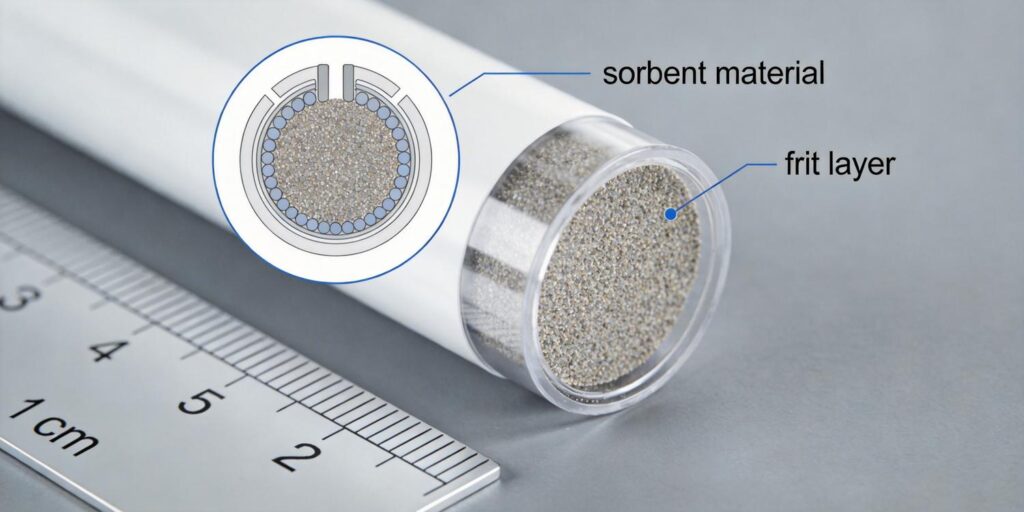
In solid-phase extraction (SPE), the sorbent bed mass refers to the total weight of the stationary phase material packed within a cartridge or column. This parameter is fundamental to SPE performance, as it directly determines the device’s capacity to retain analytes from sample matrices. Commercial SPE cartridges are available with bed masses ranging from as little as 10 mg to over 10 grams, with 200-500 mg being the most common range for laboratory applications.
The sorbent bed is typically contained within a syringe barrel-style housing, held in place by porous polyethylene or PTFE frits. The remaining cartridge volume serves as a reservoir for sample or solvent. The selection of bed mass is primarily controlled by the expected mass of target analytes and interfering contaminants in the sample that will be extracted during the SPE process.
Capacity Considerations: How Much Can Your Cartridge Hold?
SPE cartridge capacity refers to the maximum amount of analyte that can be quantitatively retained by the sorbent bed. This is distinct from recovery, which represents the actual amount of analyte retained and retrieved from the matrix. The optimal situation occurs when the cartridge capacity significantly exceeds the amount of analyte being extracted, though excessive packing increases both product cost and solvent usage.
For silica-based sorbents, typical capacity values range between 5-50 mg per gram of sorbent, with polymeric SPE materials often exhibiting somewhat higher capacities. A common approximation suggests that the amount of analyte should not exceed about 5% of the sorbent weight, though this figure should be considered an extreme approximation at best.
Several factors influence capacity:
- Sorbent Type: C18 phases generally demonstrate higher capacity for non-polar compounds than C8 phases
- Pore Size Distribution: Broader pore distributions (60-500 Å) can accommodate larger molecules
- Surface Area: Higher surface area typically correlates with increased capacity
- Competitive Binding: High concentrations of matrix components can reduce effective capacity for target analytes
As noted in SPE literature, “The capacity of the SPE device is strongly influenced by the sorbent that is packed into it. We can make qualitative statements about the capacity of the sorbent in terms of the nature of the bonded phase – for example, that C18 is more retentive than C8 for many non-polar species.”
Breakthrough Volume: The Critical Performance Parameter
Breakthrough volume (Vb) represents the maximum sample volume that can be processed through an SPE cartridge without significant loss of analyte. This is defined as the volume at which the analyte concentration at the cartridge outlet reaches 1% of the concentration at the inlet. For sample volumes less than Vb, recovery after elution should theoretically be 100% in the absence of irreversible sorbent interactions.
The breakthrough volume is directly related to bed mass through the equation:
Vb = Vr + 2σv
Where Vr is the retention volume and σv is the standard deviation depending on axial dispersion along the sorbent bed. From frontal chromatography theory, breakthrough volume is roughly directly proportional to bed mass, while elution volume is roughly inversely proportional.
Several key factors affect breakthrough volume:
- Retention Factor (k’): Stronger analyte-sorbent interactions increase Vb
- Bed Efficiency (N): Higher theoretical plate numbers improve Vb
- Flow Rate: Lower linear velocities reduce premature breakthrough
- Particle Size: Smaller particles (8-10 μm) can improve efficiency but increase backpressure
Research indicates that “when the analyte is not tightly adsorbed on the sorbent, the mass of sorbent must be increased to maintain the desired sample volume. As the strength of the interaction between the sorbent and the analyte increases, the required sorbent mass decreases, and the sample volume that can be passed over the sorbent before reaching breakthrough increases.”
Selecting the Appropriate Cartridge Size
Choosing the correct SPE cartridge size involves balancing several competing factors:
Sample Volume Considerations
For large volume samples (e.g., environmental water samples), larger bed masses (1-10 g) are typically required to handle the volume without breakthrough. Smaller cartridges (10-100 mg) are suitable for limited sample volumes such as biological fluids.
Analyte Concentration and Matrix Complexity
High analyte concentrations or complex matrices with competing components may require larger bed masses to ensure quantitative recovery. The presence of proteins in biological samples or humic matter in environmental samples at high concentrations compared to analytes can significantly reduce effective capacity.
Flow Rate Requirements
Larger cartridges with greater cross-sectional areas can process samples at higher flow rates while maintaining acceptable linear velocities. For example, 47 mm disc-shaped sorbent beds can process up to 200 mL per minute without analyte breakthrough due to their favorable geometry.
Elution Volume Optimization
While larger bed masses allow processing of larger sample volumes, they typically require larger elution volumes. This can negate concentration benefits if evaporation is subsequently required. The goal should be to maximize the ratio of sample volume to sorbent mass.
Practical Selection Guidelines
- Estimate total analyte mass in the sample
- Apply the 5% rule as a starting point (analyte mass ≤ 5% of sorbent mass)
- Consider matrix effects and potential competitive binding
- Evaluate required sample processing time and flow rates
- Balance elution volume against concentration requirements
Practical Examples and Applications
Example 1: Environmental Water Analysis
For pesticide analysis in drinking water where sample volumes of 1 liter are common, a 500 mg C18 cartridge might be selected. Assuming a breakthrough capacity of 5% (25 mg total capacity) and typical pesticide concentrations in the ng/mL range, this provides substantial safety margin while allowing reasonable flow rates (20-30 mL/min under vacuum).
Example 2: Pharmaceutical Analysis in Serum
For drug monitoring in 1 mL serum samples, a 100 mg mixed-mode cartridge (such as MCX or MAX) would typically be sufficient. The smaller bed mass minimizes elution volumes (often 1-2 mL), facilitating direct injection into LC-MS systems without evaporation.
Example 3: High-Throughput Clinical Screening
In 96-well SPE plate formats, bed masses of 10-30 mg per well are common for processing 100-200 μL samples. The reduced bed height and increased cross-sectional area maintain adequate capacity while enabling rapid processing under vacuum or positive pressure.
Example 4: Capacity Testing Procedure
A practical method for determining appropriate bed mass involves:
- Preparing analyte solutions at known concentrations
- Conditioning SPE cartridges of different bed masses
- Passing incremental sample volumes through each cartridge
- Analyzing effluent to determine breakthrough point
- Calculating specific capacity (mg analyte/g sorbent)
Example 5: Disc vs. Cartridge Comparison
Consider a conventional 500 mg C18 cartridge (15 mm bed depth, 12 mm diameter) versus a disc containing 35 mg of the same sorbent (1 mm depth, 12 mm diameter). Assuming 5% breakthrough capacity, the cartridge capacity is 25 mg while the disc capacity is 1.75 mg. Both are adequate for most trace analyses, but the disc format offers reduced channeling and potentially better flow characteristics.
Conclusion: Optimizing Bed Mass for Maximum Recovery
SPE cartridge bed mass represents a critical parameter that directly impacts method performance through its effects on capacity, breakthrough volume, flow characteristics, and elution requirements. Successful method development requires careful consideration of:
- Sample volume and analyte concentration
- Matrix complexity and competitive binding effects
- Required throughput and processing time
- Downstream analytical requirements
By understanding the fundamental relationships between bed mass and performance parameters, analysts can select optimal cartridge sizes that balance recovery, efficiency, and cost-effectiveness. As with all SPE method development, empirical testing with representative samples remains essential for confirming theoretical predictions and ensuring robust analytical performance.
For further information on SPE cartridge selection and optimization, explore our comprehensive product lines including HLB SPE cartridges, MAX SPE cartridges, MCX SPE cartridges, and 96-well SPE plates.


