The Vacuum Brazing Process in Aerospace Component Manufacturing
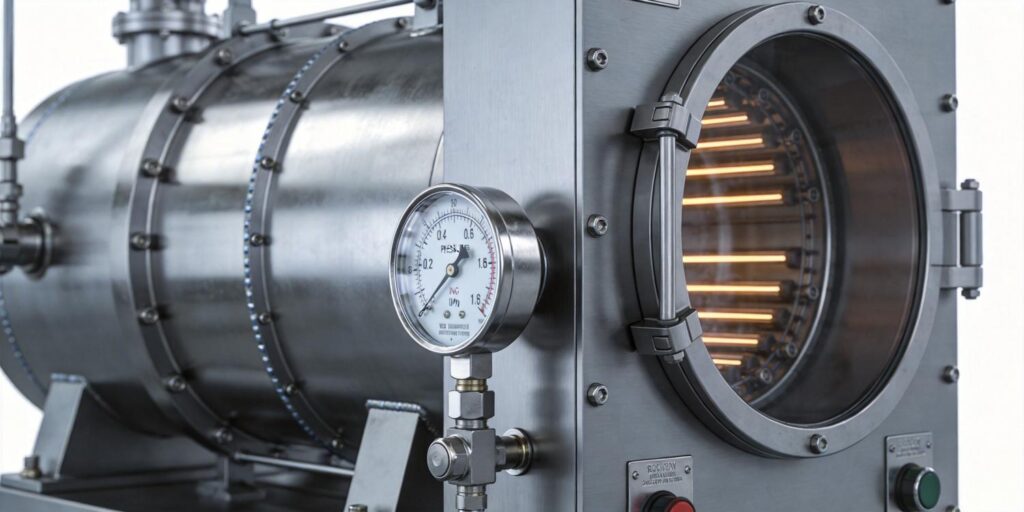
Vacuum brazing stands as a cornerstone joining technique for high-performance aerospace components, including turbine blades, heat exchangers, honeycomb structures, and engine assemblies. Unlike traditional torch or furnace brazing in air or inert gas, the process occurs in a controlled, oxygen-free vacuum environment that eliminates oxidation, prevents contamination, and produces exceptionally clean, high-strength metallurgical bonds.
The workflow begins with precise joint preparation: parent materials (often titanium alloys, nickel superalloys such as Inconel or Hastelloy, or stainless steels) are cleaned, fixtured with braze alloy preforms or paste, and loaded into a vacuum furnace. The chamber is evacuated while a programmed thermal cycle ramps temperature to the filler metal’s melting point—typically 890–1175°C—allowing capillary flow into tight gaps (usually <0.1 mm). Controlled cooling follows, solidifying the joint without flux residues or distortion common in atmospheric processes.
This fluxless approach yields oxide-free surfaces, minimal thermal stress, and the ability to join dissimilar materials simultaneously in a single cycle. In aerospace manufacturing, where every joint must withstand extreme thermal, mechanical, and fatigue loads, vacuum brazing delivers the repeatability and integrity demanded by flight-critical hardware.
Required Vacuum Levels for Reliable Aerospace Brazing
Achieving and maintaining the correct vacuum level is non-negotiable for successful brazing. Industry practice calls for working vacuum levels of 10⁻³ Pa (approximately 7.5 × 10⁻³ Torr) for standard metals, while reactive alloys used in aerospace—titanium, nickel superalloys, and active ceramics—demand 10⁻⁴ Pa or better (roughly 7.5 × 10⁻⁴ Torr) to suppress oxide formation and ensure proper wetting.
High-end aerospace applications frequently target sustained pressures in the 10⁻⁵ to 10⁻⁶ Torr range during the critical hold and cooling phases. These ultra-clean conditions vaporize high-vapor-pressure contaminants and prevent re-oxidation at elevated temperatures. Partial-pressure techniques using inert gases (nitrogen or argon) are sometimes introduced above 10⁻⁴ Torr to suppress filler-metal evaporation, but the baseline vacuum must remain tight enough to meet NADCAP and customer specifications.
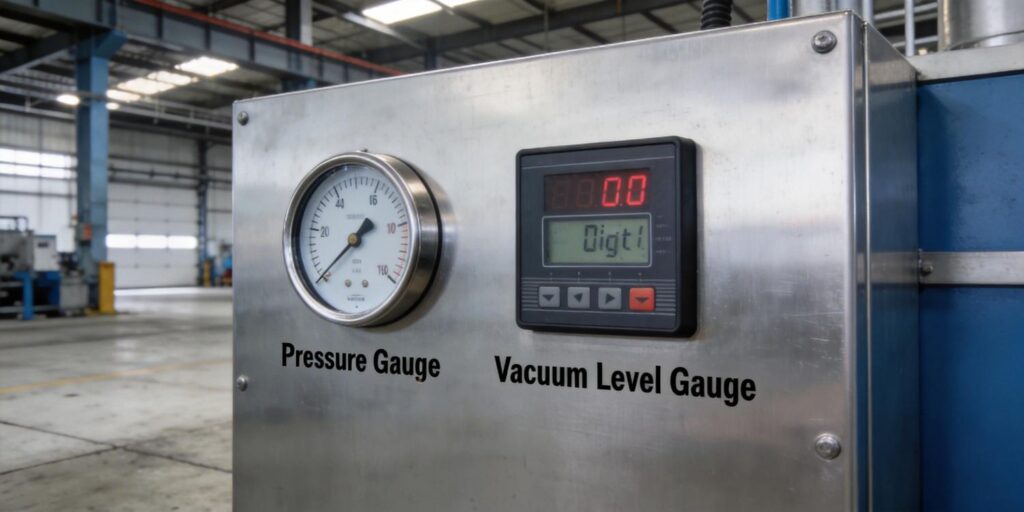
Failure to hold these levels results in porous joints, reduced fatigue life, or outright rejection during non-destructive testing. Continuous, accurate pressure monitoring across the full range—from initial pump-down through peak temperature—is therefore essential.
Leak Sensitivity and Its Impact on Process Integrity
Even microscopic leaks can compromise an entire brazing cycle. Real leaks introduce atmospheric gases that raise oxygen partial pressure and trigger oxidation, while virtual leaks (trapped volumes in welds, blind holes, or surface porosity) release adsorbed gases during heating, causing pressure spikes.
Modern vacuum gauges detect these anomalies through pressure-rise testing and real-time trend monitoring. A stable gauge reading that fails to reach target vacuum—or exhibits unexpected rise rates—signals the need for helium leak detection follow-up (sensitivities down to 10⁻⁹–10⁻¹² mbar·L/s). In aerospace, where leak rates must often stay below 10⁻⁹ Torr·L/s for flight hardware, gauge sensitivity directly correlates with first-pass yield.
Poseidon Scientific’s VG-SP205 Pirani and VG-SM225 Cold Cathode gauges provide the resolution needed for early leak identification. The Pirani excels at rough-vacuum leak detection during initial evacuation, while the cold cathode’s ion-current response pinpoints high-vacuum anomalies with minimal hysteresis when properly maintained.
Monitoring Vacuum During Heat Cycles: Challenges and Solutions
Thermal cycles introduce dynamic pressure behavior. Outgassing from chamber walls, fixturing, and components peaks during ramp-up, creating transient pressure excursions that must be monitored and controlled to prevent joint contamination. Temperature compensation becomes critical because gauge readings can drift outside the 15–50°C operating window without proper circuitry and firmware algorithms.
During the hold phase at brazing temperature, the gauge must deliver stable, repeatable data despite elevated chamber heat (often isolated via extended KF flanges or radiation shields). Cooling phases introduce condensation risks and virtual-leak release that can mask true process vacuum.
Effective monitoring requires dual-gauge architectures that cover the entire pressure spectrum without gaps or excessive overlap uncertainty. Fast response times—sub-second for the Pirani in rough vacuum and rapid ion-current stabilization for the cold cathode once discharge is established—allow closed-loop furnace control systems to adjust pumping speed or introduce partial pressure in real time.
Recommended Gauge Configuration for Aerospace Vacuum Brazing
For aerospace vacuum brazing furnaces, Poseidon Scientific recommends a complementary Pirani–cold cathode pair installed directly on the process chamber or via KF16/KF25 flanges for optimal conductance.
- VG-SP205 Pirani Vacuum Transmitter: Handles atmosphere to 10⁻³ Torr with ±50% accuracy at range extremes and high linearity from 10 to 10⁻² Torr. Its platinum filament offers excellent contamination resistance and a 3–5 year maintenance-free life in clean environments.
- VG-SM225 Cold Cathode Vacuum Gauge: Covers 10⁻³ to 10⁻⁷ Torr using a traditional Penning discharge with positive magnetron geometry. The removable electrode design allows quick cleaning with 500-mesh sandpaper, restoring performance without full disassembly or seal breach.
Both transmitters output industry-standard 0–10 V analog signals (effective 2–8 V range) plus customizable RS232 digital protocols, enabling seamless PLC or SCADA integration. Operating temperature range of 15–50°C, combined with dual circuit/algorithm compensation, ensures stability throughout the thermal cycle. The compact footprint and low-cost design (3000–3500 RMB self-manufactured) make them ideal for OEM furnace builders and retrofit programs seeking to reduce imported sensor dependency.
Installation guidelines include arbitrary orientation tolerance, software-driven high-voltage shutdown above 10⁻³ Torr on the cold cathode to prevent contamination, and optional temperature isolation for hot-zone proximity.
Case Example: Turbine Blade Manufacturer Achieves Zero-Defect Brazing
A major North American aerospace supplier brazing Inconel 625 turbine blade assemblies experienced intermittent joint porosity traced to vacuum excursions during heat-up. Legacy single-gauge systems provided inadequate resolution at the 10⁻⁴–10⁻⁵ Torr transition and suffered frequent calibration drift.
After installing the VG-SP205/VG-SM225 combination with customized RS232 protocol matching their existing PLC, the manufacturer recorded pressure stability within ±3% of setpoint throughout 1050°C cycles. Outgassing peaks were identified and managed within seconds, reducing scrap rate from 8% to under 0.5%. Electrode cleaning intervals extended to 12–18 months in their clean process environment, and overall furnace uptime increased by 22%. The low-cost, maintainable design also lowered annual sensor replacement expenses by 45% versus previous imported units.
Compliance Considerations: NADCAP, AMS 2750, and AS9100
Aerospace vacuum brazing operations fall under stringent quality frameworks. NADCAP AC7102 heat-treat accreditation requires documented calibration of vacuum instruments, flowmeters, and related master gauges. AMS 2750 pyrometry standards mandate vacuum gauge certification when processes operate at or below one micron (10⁻³ Torr), with periodic temperature uniformity surveys (TUS) performed at production vacuum levels—including partial-pressure conditions when applicable.
AS9100 and customer-specific prime specifications further demand traceable, repeatable pressure data with audit-ready records. Poseidon gauges ship with factory calibration certificates traceable to national standards and support on-site verification protocols. Their digital outputs simplify data logging for statistical process control (SPC), while the cleanable cold cathode design aids compliance with contamination-control clauses common in aerospace brazing specifications.
Conclusion: Elevate Aerospace Brazing Reliability with Precision Vacuum Monitoring
In aerospace component manufacturing, vacuum brazing success hinges on maintaining the exact pressure profile demanded by reactive alloys and flight-critical joints. Accurate, fast-response gauges that span rough to high vacuum, resist contamination, and integrate effortlessly into automated controls are no longer optional—they are competitive necessities.
Poseidon Scientific’s VG-SP205 Pirani Vacuum Transmitter and VG-SM225 Cold Cathode Vacuum Gauge deliver the performance, durability, and customization aerospace engineers require—at a fraction of the cost of traditional imported solutions. Their proven track record in vacuum heat-treatment applications makes them the logical choice for new furnace builds, retrofits, and process qualification programs.
Discover the VG-SP205 Pirani Vacuum Transmitter or explore the VG-SM225 Cold Cathode Vacuum Gauge.
Ready to optimize your vacuum brazing process? Contact our applications engineering team today for a no-obligation aerospace vacuum system evaluation. We’ll review your furnace configuration, recommend the ideal gauge placement and protocol, and demonstrate how precise pressure monitoring can reduce defects, shorten cycles, and strengthen your NADCAP compliance posture.