Common Veterinary Drugs Monitored in Food
Veterinary drug residue testing in food products represents a critical component of food safety programs worldwide. The monitoring encompasses several classes of drugs that are commonly administered to food-producing animals for therapeutic, prophylactic, or growth-promoting purposes. According to established literature and regulatory frameworks, the primary drug classes monitored include:
Antibacterial Agents
Sulfonamides represent one of the most extensively monitored drug classes in veterinary residue testing. Studies by Takatsuki and Kikuchi (1990) demonstrated gas chromatographic-mass spectrometric determination of six sulfonamide residues in eggs and animal tissues, while Unruh et al. (1990) developed solid-phase extraction methods for sulfamethazine in milk with quantitation at low ppb levels. Other antibacterial drugs frequently monitored include tetracyclines, β-lactams, and macrolides, with Walsh et al. (1992) describing HPLC methods for tetracycline determination in bovine and porcine muscle using solid-phase extraction.
Anthelmintics
Benzimidazole anthelmintics are routinely monitored in animal tissues. Barker et al. (1990) developed methodology for analyzing benzimidazole anthelmintics as drug residues in animal tissues, while Long et al. (1990e) established matrix solid phase dispersion (MSPD) isolation and liquid chromatographic determination of five benzimidazole anthelmintics in pork muscle tissue.
Growth Promoters and Hormones
Anabolic steroids and β-agonists are strictly regulated due to their potential health effects. Arts et al. (1991) developed control systems for detecting illegal use of naturally occurring steroids in calves, while Boyd et al. (1994) applied matrix solid phase dispersion as a multiresidue extraction technique for β-agonists in bovine liver tissue.
Other Veterinary Drugs
The monitoring scope extends to various therapeutic agents including:
- Corticosteroids (Delahunt et al., 1997)
- Antiprotozoals like furazolidone (Soliman et al., 1991)
- Antimicrobial agents in aquaculture species (Walker et al., 1993)
- Organo-tin compounds in fish (Ono et al., 1997)
Extraction Challenges in Animal Tissues
Animal tissues present unique challenges for veterinary drug residue extraction due to their complex matrix composition. As noted by Simpson and Wynne (2000), adipose or muscle tissue analysis focuses on determining health effects of consumption, requiring specialized extraction approaches.
Matrix Complexity
Animal tissues contain high levels of proteins, lipids, and endogenous compounds that can interfere with analyte recovery and detection. Horie et al. (1991) addressed this by homogenizing fish tissue in metaphosphoric acid/methanol (3:2 v/v) to deproteinize samples before SPE purification. The high protein and lipid content often makes samples prone to emulsification during liquid-liquid extraction, making SPE particularly valuable for handling such matrices.
Sample Preparation Requirements
Traditional SPE requires samples to be liquefied or at least have analytes solubilized and stripped from bulk matrix solids. Hansen-Møller (1992) extracted compounds responsible for “boar taint” from pig fat using acetone-tris buffer, then defatted the extract by passing it through a C18 column prior to HPLC analysis. This two-step approach highlights the complexity of tissue sample preparation.
Alternative Approaches
Matrix Solid Phase Dispersion (MSPD) has emerged as a valuable alternative to traditional SPE for solid samples. Barker et al. (1989) pioneered MSPD for isolating drug residues from tissues, demonstrating that bonded silicas could not only macerate or dehydrate samples but also achieve multiple sample manipulations in a single simple step. This technique has proven particularly effective for veterinary drug residue analysis in complex matrices.
SPE Sorbent Choices for Multi-Residue Methods
Selecting appropriate SPE sorbents is crucial for developing effective multi-residue methods for veterinary drug analysis. The choice depends on the chemical properties of target analytes and the complexity of the sample matrix.
Mixed-Mode Sorbents
Mixed-mode sorbents combining ion-exchange and reversed-phase mechanisms have proven particularly effective for veterinary drug analysis. As described by Wynne (2000), mixed-mode (SCX/non-polar) cartridges allow rapid recovery of diverse drug groups including β-blockers, β-agonists, opiates, narcotic analgesics, alkaloidal drugs, and basic diuretics. These sorbents enable isolation of bases from urine at neutral pH, allowing extraction of compounds that might otherwise be unstable under extreme pH conditions.
C18 and Other Reversed-Phase Sorbents
Traditional reversed-phase sorbents remain valuable for many applications. Busto et al. (1994) used C18 cartridges for extracting dansyl derivatives of biogenic amines from wines, achieving 50-fold concentration effects. For tissue samples, C18 columns have been used for defatting extracts prior to analysis, as demonstrated by Hansen-Møller (1992) in boar taint analysis.
Specialized Sorbents for Specific Applications
Certain applications require specialized sorbent choices:
- SCX sorbents for basic drug extraction (Wynne, 2000)
- Silica-based sorbents for steroid isolation (Wynne, 2000)
- Polymeric sorbents for organo-tin compounds (Ono et al., 1997)
- Immunoaffinity sorbents for specific compound classes (Beaumier et al., 1996)
Sorbent Selection Considerations
When selecting SPE sorbents for veterinary drug residue analysis, several factors must be considered:
- Analyte properties: pKa, log P, functional groups
- Matrix characteristics: fat content, protein levels, pH
- Detection requirements: sensitivity, selectivity, compatibility with analytical instrumentation
- Regulatory compliance: method validation requirements, detection limits
Example Protocol for Tissue Extraction and SPE Purification
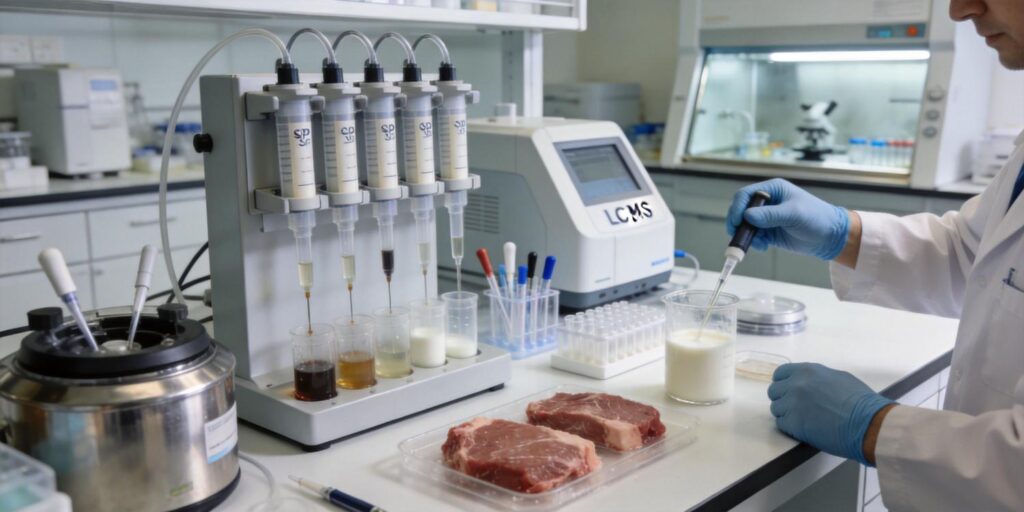
Based on established literature, here is a comprehensive protocol for veterinary drug residue extraction from animal tissues using SPE purification:
Sample Preparation
Step 1: Tissue Homogenization
Homogenize 5g of tissue sample with 20mL of metaphosphoric acid/methanol (3:2 v/v) using a high-speed blender. This deproteinization step follows the approach described by Horie et al. (1991) for antibacterial drug extraction from fish tissue.
Step 2: Filtration and Concentration
Filter the homogenate through Whatman No. 1 filter paper. Concentrate the filtrate to approximately 5mL using rotary evaporation at 40°C under reduced pressure.
SPE Purification
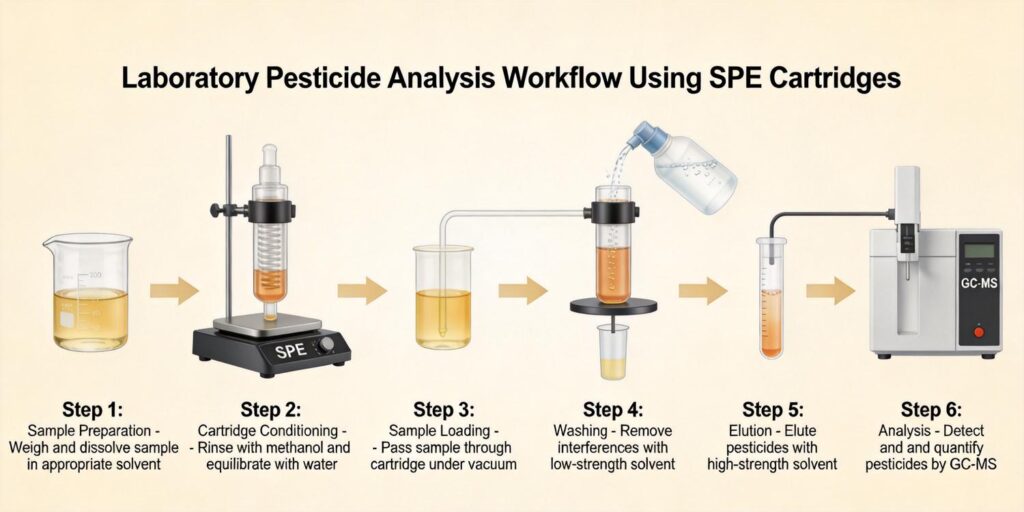
Step 3: Cartridge Conditioning
Condition a mixed-mode SPE cartridge (e.g., Certify® or equivalent) with 3mL methanol followed by 3mL deionized water. Do not allow the sorbent to dry completely.
Step 4: Sample Application
Apply the concentrated tissue extract to the conditioned cartridge at a flow rate of approximately 1-2mL/min. Collect the effluent for potential re-extraction if needed.
Step 5: Washing Steps
Wash the cartridge sequentially with:
1. 3mL deionized water
2. 3mL 0.1M acetate buffer (pH 4.5)
3. 3mL methanol:water (20:80 v/v)
Discard all wash fractions.
Step 6: Drying and Elution
Dry the cartridge under vacuum for 5 minutes to remove residual water. Elute analytes with 3mL of methanol:ammonium hydroxide (98:2 v/v) into a clean collection tube.
Step 7: Concentration and Reconstitution
Evaporate the eluate to dryness under a gentle stream of nitrogen at 40°C. Reconstitute the residue in 1mL of mobile phase compatible with subsequent LC-MS/MS analysis.
Quality Control Measures
Include appropriate quality control samples:
- Method blanks (extraction solvent only)
- Fortified samples at relevant concentration levels
- Certified reference materials when available
- Internal standards for quantification
LC-MS/MS Detection Methods
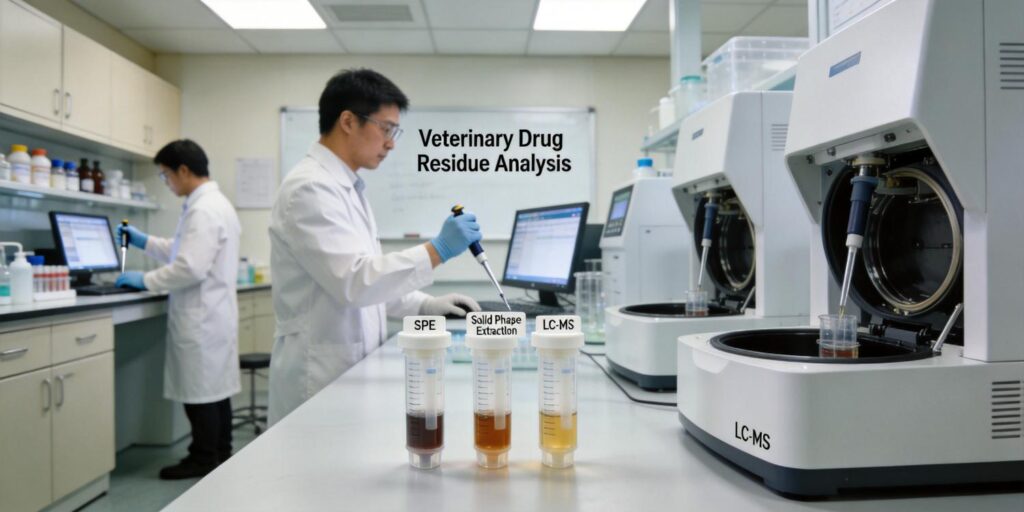
Liquid chromatography-tandem mass spectrometry (LC-MS/MS) has become the gold standard for veterinary drug residue analysis due to its superior sensitivity, selectivity, and ability to analyze multiple compounds simultaneously.
Instrumentation Considerations
As noted in veterinary drug abuse applications (Wynne, 2000), mass spectrometry provides the “fingerprint” of digitized mass spectra that offers more definitive identification than other techniques. The number of informative bits in a mass spectrum is only exceeded by NMR spectroscopy, but LC-MS/MS offers superior sensitivity for trace-level analysis.
Chromatographic Conditions
Typical LC conditions for veterinary drug multi-residue analysis include:
- Column: C18 or equivalent, 100 × 2.1 mm, 1.7-3.0 μm particle size
- Mobile Phase: Gradient elution with water and methanol or acetonitrile, both containing 0.1% formic acid
- Flow Rate: 0.2-0.4 mL/min
- Column Temperature: 40°C
- Injection Volume: 5-20 μL
Mass Spectrometric Parameters
MS/MS detection typically employs:
- Ionization Mode: Electrospray ionization (ESI) in positive or negative mode depending on analyte properties
- Source Temperature: 150-500°C
- Ion Spray Voltage: 1500-5500 V
- Collision Energy: Optimized for each compound
- Detection Mode: Multiple reaction monitoring (MRM) with 2-3 transitions per compound
Method Validation Parameters
LC-MS/MS methods for veterinary drug residue analysis should be validated for:
- Selectivity: Absence of interference at retention times of target analytes
- Linearity: Correlation coefficient ≥0.99 over relevant concentration range
- Accuracy: 70-120% recovery at all validation levels
- Precision: RSD ≤20% for repeatability and intermediate precision
- Limit of Detection (LOD): Typically 0.1-10 μg/kg depending on compound and matrix
- Limit of Quantification (LOQ): Typically 0.5-50 μg/kg
- Matrix Effects: Evaluation of suppression/enhancement using post-extraction addition
Regulatory Validation Guidelines
Veterinary drug residue methods must comply with established regulatory guidelines to ensure data quality and legal defensibility.
International Standards
Several organizations provide guidance for veterinary drug residue method validation:
- Codex Alimentarius: Guidelines for the design and implementation of national regulatory food safety assurance programmes
- European Union: Commission Decision 2002/657/EC on performance criteria for analytical methods
- U.S. Food and Drug Administration: Guidelines for method validation in the Center for Veterinary Medicine
- AOAC International: Official Methods of Analysis for veterinary drug residues
Validation Requirements
According to EU Decision 2002/657/EC, veterinary drug residue methods must be validated for:
Identification Criteria
For LC-MS/MS methods, identification requires:
- Minimum of 3 identification points (1 precursor + 2 product ions = 4 points)
- Ion ratio tolerance of ±20-25% (relative) or ±10% (absolute)
- Retention time match within ±2.5% of reference standard
Performance Characteristics
Method validation must demonstrate:
- Specificity/Selectivity: Ability to distinguish target analytes from interfering substances
- Trueness: Expressed as recovery, typically 70-120%
- Precision: Repeatability and within-laboratory reproducibility
- Decision Limit (CCα): Limit at which method distinguishes compliant from non-compliant samples
- Detection Capability (CCβ): Smallest content that can be detected with specified error probabilities
- Ruggedness: Method robustness under normal laboratory variations
Ongoing Quality Assurance
Regulatory compliance requires ongoing quality assurance measures:
- Proficiency Testing: Regular participation in interlaboratory comparisons
- Internal Quality Control: Analysis of control samples with each batch
- Instrument Calibration: Regular calibration and performance verification
- Documentation: Complete records of all analytical procedures and results
- Staff Competency: Regular training and competency assessment
Emerging Trends
Recent developments in veterinary drug residue analysis include:
- High-Resolution Mass Spectrometry: For non-target screening and retrospective analysis
- Automated Sample Preparation: Increasing throughput and reproducibility
- Multi-Class Methods: Simultaneous analysis of 100+ veterinary drugs
- Rapid Screening Methods: Immunoassays and biosensors for initial screening
- Data Integrity: Enhanced focus on electronic data management and audit trails
The field of veterinary drug residue testing continues to evolve with technological advancements and regulatory developments. Proper SPE method selection and validation remain critical components of reliable analytical programs that ensure food safety and regulatory compliance.