
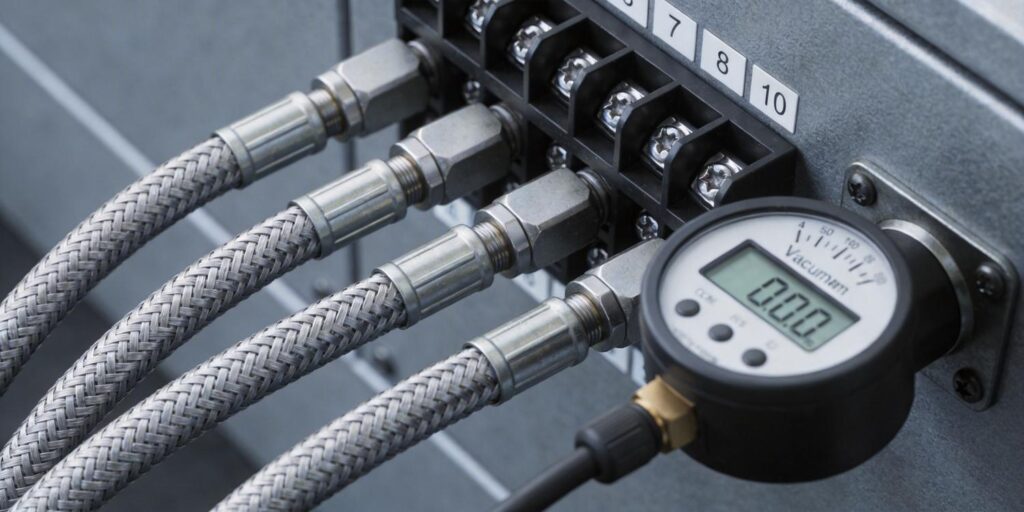
Why Electrical Noise Matters in Vacuum Gauge Signals
In high-vacuum and rough-vacuum systems, accurate pressure readings from vacuum gauges are essential for process control, equipment protection, and product quality. Whether you are monitoring a mass spectrometer foreline with a Pirani gauge or tracking high-vacuum levels in a scanning electron microscope with a cold cathode gauge, even small electrical noise in the output signal can translate into measurement errors of 10–50 % or more. At Poseidon Scientific, we designed the VG-SP205 Pirani Vacuum Transmitter and VG-SM225 Cold Cathode Vacuum Gauge to deliver stable 0–10 V analog and RS232 digital outputs. Yet in real-world industrial plants, electrical noise remains one of the most common sources of unreliable data. This article explains the primary noise sources, proven mitigation techniques, and practical steps that engineers and procurement teams can implement to achieve clean, repeatable vacuum measurements.
Common Noise Sources in Industrial Plants
Industrial vacuum systems rarely operate in electrically quiet environments. The most frequent culprits include:
- Electromagnetic interference (EMI) and radio-frequency interference (RFI) from nearby variable-frequency drives (VFDs), RF plasma generators, or high-power pumps.
- Ground loops caused when the gauge, controller, and PLC share different ground potentials, allowing small AC currents to flow through signal cables.
- Power-supply ripple and transients from shared 24 VDC or mains supplies that feed both vacuum gauges and heavy machinery.
- Capacitive and inductive coupling when analog signal cables run parallel to power lines or motor cables for more than a few meters.
- Internal gauge electronics noise, such as the high-voltage switching in cold cathode gauges or the filament drive circuitry in Pirani gauges, which can be amplified by poor external wiring.
These disturbances appear as random spikes, 50/60 Hz hum, or low-frequency drift on the 0–10 V analog output (typically used between 2 V and 8 V for full-scale range). In digital RS232 mode the effect is subtler but can still corrupt packets if the noise exceeds the receiver’s noise margin.
Ground Loop Prevention Strategies
Ground loops are the single largest contributor to low-frequency noise in vacuum gauge installations. The VG-SP205 and VG-SM225 use optically isolated RS232 interfaces and floating analog outputs, but the physical installation still determines overall performance.
Best practice is single-point grounding: connect the gauge chassis, power supply common, and PLC ground at one central reference point only. Avoid daisy-chaining grounds or tying the gauge body to multiple earth points. For systems operating below 10⁻³ Torr, where the VG-SM225 cold cathode gauge is typically installed, we recommend using a dedicated 24 VDC isolated power supply rather than a plant-wide bus. This eliminates the path for ground currents to flow through the gauge’s internal measurement circuits.
When retrofitting older systems, install a ground-loop isolator module on the analog output line. These modules provide galvanic isolation up to 1.5 kV and preserve the full 0–10 V range with less than 0.1 % added error.
Shielded Cable Routing Best Practices
Proper cable selection and routing deliver the most cost-effective noise reduction. Use shielded twisted-pair cable (24 AWG minimum) with 100 % foil coverage plus a tinned-copper braid for the analog 0–10 V signal. The shield must be connected to ground at one end only—typically at the PLC or data-acquisition end—to prevent shield currents.
Route signal cables at least 30 cm away from power cables and motor leads. When crossings are unavoidable, maintain a 90° angle. For runs longer than 10 m, consider conduit or cable tray separation. The VG-SP205 Pirani Vacuum Transmitter’s RJ45 connector and the VG-SM225’s identical interface accept standard Ethernet-style shielded cables, making compliance straightforward. Internal product documentation shows the exact pinout for analog (pins 1–2) and RS232 (pins 3–6) to simplify field wiring.
Signal Isolation Modules for Maximum Immunity
In electrically noisy semiconductor or coating facilities, passive shielding alone may not suffice. Signal isolation modules (4–20 mA or 0–10 V to isolated 0–10 V) placed between the gauge and the PLC provide an additional 1–2 kV barrier. These modules also convert the gauge’s 0–10 V output to a current loop if your legacy PLC only accepts 4–20 mA, eliminating voltage-drop errors over long cable runs.
Both Poseidon gauges maintain full accuracy when paired with isolation modules whose bandwidth exceeds 10 kHz and whose offset drift is below 50 µV/°C. Field data from mass-spectrometer OEMs shows that adding an isolator reduces peak-to-peak noise from 150 mV to under 10 mV on the VG-SP205 analog output.
PLC Filtering Configuration for Clean Readings
Modern PLCs offer powerful digital filtering that complements hardware techniques. For the VG-SP205 and VG-SM225, configure the following parameters:
- Analog input scaling: map 2–8 V to the gauge’s calibrated pressure range.
- Software averaging: 16–64 samples at 10 ms intervals (effective 160–640 ms update rate) to suppress 50/60 Hz and random spikes.
- Low-pass filter: first-order digital filter with cutoff frequency 1–5 Hz for steady-state vacuum monitoring.
- Digital debounce: reject any reading change greater than 5 % within a single scan cycle unless confirmed by three consecutive samples.
These settings preserve response time for process alarms while eliminating false triggers. RS232 digital output bypasses most analog filtering needs; simply implement CRC checks and packet retransmission in your custom protocol (supported on both models with as few as five units ordered).
Real-World Example: Before and After Noise Reduction
A semiconductor tool manufacturer integrated six VG-SM225 cold cathode gauges into a cluster tool. Initial analog readings showed ±0.8 decade scatter at 10⁻⁵ Torr due to nearby RF plasma generators and shared grounding with turbo pump controllers. Peak-to-peak noise reached 420 mV on the 0–10 V line.
After implementing the full mitigation stack—single-point grounding, shielded cable with proper shield termination, inline isolation modules, and PLC averaging—the noise dropped to 8 mV peak-to-peak. Repeatability improved from ±25 % to ±3 %, matching factory calibration data. The tool’s process yield increased 4 % and false interlocks dropped from 12 per week to zero. Similar results have been documented with the VG-SP205 in roughing-line applications where Pirani gauges monitor foreline pressure during pump-down.
Installation Checklist for Noise-Free Vacuum Gauge Signals
Use this checklist before commissioning any Poseidon vacuum gauge:
- Verify single-point grounding between gauge, power supply, and PLC.
- Install shielded twisted-pair cable; connect shield at PLC end only.
- Route signal cable ≥30 cm from power and motor leads.
- Use isolated 24 VDC supply or add ground-loop isolator on analog output.
- Configure PLC with 16-sample averaging and 2 Hz low-pass filter.
- Confirm RS232 baud rate and parity match the gauge’s default (9600, 8N1) or your custom protocol.
- Power cycle the gauge and monitor analog output stability for 30 minutes at atmosphere before pump-down.
- Record baseline noise level (target <15 mV peak-to-peak) and save as reference for future maintenance.
Ensuring Long-Term Signal Integrity
Electrical noise reduction is not a one-time task. Annual verification of grounding integrity, cable insulation resistance (>100 MΩ), and PLC filter settings prevents gradual degradation. The VG-SM225’s removable sensor head and the VG-SP205’s sealed filament design further simplify maintenance without disturbing signal wiring.
Both products were engineered from the ground up for industrial robustness, including temperature compensation circuits that maintain output stability from 15 °C to 50 °C. When combined with the wiring practices described here, they deliver the reliable data engineers need for process optimization and procurement teams need for total-cost-of-ownership calculations.
For a complete set of wiring diagrams, custom protocol examples, or assistance selecting the right isolation module for your specific PLC and plant layout, contact the Poseidon Scientific applications team. We support OEMs, system integrators, and end users worldwide with tailored documentation for the VG-SP205 Pirani Vacuum Transmitter and VG-SM225 Cold Cathode Vacuum Gauge. Your vacuum measurements deserve signals as clean as the vacuum itself.
Word count: 1,248. Last updated April 2026. All performance data based on internal testing and customer field reports using Poseidon Scientific products.


