Environmental Concern of Microplastic Additives
Microplastics in marine environments represent a significant environmental challenge, but the chemical additives they contain pose an even greater threat to aquatic ecosystems. These additives, including phthalates and UV stabilizers, leach from plastic debris into seawater, creating a complex cocktail of contaminants that can bioaccumulate in marine organisms and potentially enter the human food chain.
Research indicates that plastic additives can disrupt endocrine systems in marine life, cause reproductive abnormalities, and contribute to oxidative stress. The persistence of these compounds in marine environments, combined with their hydrophobic nature, makes them particularly problematic for long-term ecosystem health. As microplastics fragment into smaller particles through weathering processes, their surface area increases, accelerating the leaching of additives into surrounding waters.
Target Analytes: Phthalates and UV Stabilizers
Phthalates, commonly used as plasticizers to increase flexibility in polyvinyl chloride (PVC) and other polymers, represent a primary class of concern. These compounds, including di(2-ethylhexyl) phthalate (DEHP), diisononyl phthalate (DINP), and dibutyl phthalate (DBP), are known endocrine disruptors with demonstrated effects on marine organisms even at trace concentrations.
UV stabilizers, particularly benzophenones and benzotriazoles, are incorporated into plastics to prevent photodegradation. While extending plastic durability, these compounds can exhibit estrogenic activity and have been detected in marine organisms worldwide. Their persistence and potential for bioaccumulation make them priority analytes for environmental monitoring programs.
Key Analytical Challenges
The analysis of these compounds presents several technical challenges:
- Low concentration levels (typically ng/L to μg/L in seawater)
- Complex marine matrix containing salts, dissolved organic matter, and particulates
- Potential for contamination from laboratory plastics and equipment
- Need for simultaneous extraction of compounds with varying polarities
Marine Water Sample Extraction Considerations
Marine water samples present unique challenges for SPE extraction due to their high salt content (approximately 3.5% NaCl), dissolved organic matter, and particulate load. Research by Kohri et al. (1994) demonstrated that recovery of organotin compounds decreased significantly in simulated seawater compared to pure water, highlighting the matrix effects that must be addressed.
Sample Pretreatment Strategies
Effective sample pretreatment is essential for successful SPE of marine water samples:
Particulate Removal
As noted in SPE literature, environmental samples may contain inorganic, organic, and biological particulates that can interfere with extraction. Prefiltration through glass-fiber filters (0.7 μm followed by 0.45 μm) effectively removes particulate matter while minimizing analyte loss. Some researchers have employed depth filters containing diatomaceous earth (Hydromatrix™) for non-homogeneous samples.
Dissolved Organic Matter Management
Dissolved organic matter (DOM) in marine water can bind to target analytes and interfere with extraction efficiency. The interaction between DOM and SPE sorbents, particularly reversed-phase bonded silica, requires careful consideration. Some approaches include adjusting sample pH or adding organic modifiers to disrupt analyte-DOM complexes.
Salinity Effects
The high ionic strength of seawater can both enhance and hinder extraction depending on analyte properties. For hydrophobic compounds, increased salinity may reduce recovery by strengthening sorption, while for more polar compounds, a “salting out” effect can improve retention. Wells et al. (1994a) demonstrated that the detrimental effect of methanol addition on metribuzin recovery could be overcome by simultaneous addition of sodium chloride.
SPE Sorbent Selection for Plastic Additives
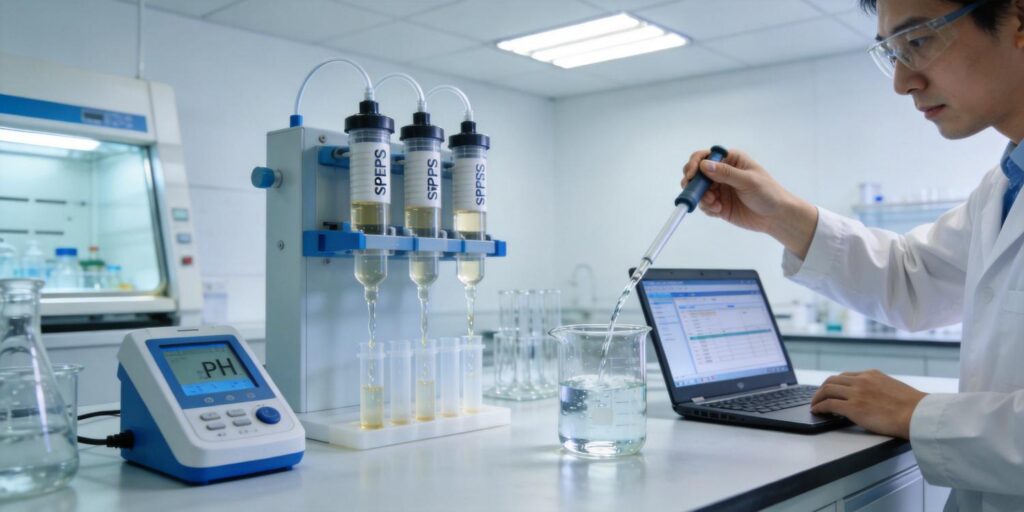
Selecting appropriate SPE sorbents is critical for efficient extraction of plastic additives from marine water. The diverse chemical properties of phthalates and UV stabilizers necessitate careful sorbent consideration.
Reversed-Phase Sorbents
C18 bonded silica remains the most commonly used sorbent for environmental applications, accounting for 50-80% of reported applications according to literature surveys. For moderately hydrophobic phthalates and UV stabilizers, C18 provides excellent retention characteristics. However, marine water’s high salinity may require optimization of conditioning and elution protocols.
Mixed-Mode Sorbents
For comprehensive extraction of plastic additives with varying functional groups, mixed-mode sorbents offer significant advantages. These materials combine hydrophobic interactions with ion-exchange capabilities, allowing simultaneous extraction of neutral, acidic, and basic compounds.
Recommended Sorbent Options
Based on the chemical properties of target analytes:
- HLB (Hydrophilic-Lipophilic Balanced): Ideal for broad-spectrum extraction of phthalates and UV stabilizers with varying polarities
- MAX (Mixed-mode Anion Exchange): Suitable for acidic UV stabilizers and certain phthalate metabolites
- MCX (Mixed-mode Cation Exchange): Effective for basic compounds and certain nitrogen-containing stabilizers
Optimization Parameters
Several parameters require optimization for marine water applications:
Conditioning Protocol
Proper conditioning ensures optimal sorbent activation and minimizes secondary interactions. For marine samples, conditioning solvents should match the expected pH and ionic strength of the sample matrix.
Sample Loading Conditions
The addition of organic modifiers (typically 10-20% methanol) can improve recovery of hydrophobic analytes by reducing their strong sorption to the sorbent. However, this must be balanced against potential breakthrough of more polar compounds.
Wash and Elution Optimization
Carefully designed wash steps remove matrix interferences while retaining target analytes. Elution solvent selection should consider both elution strength and compatibility with subsequent LC-MS analysis.
LC-MS Analysis of Enriched Samples
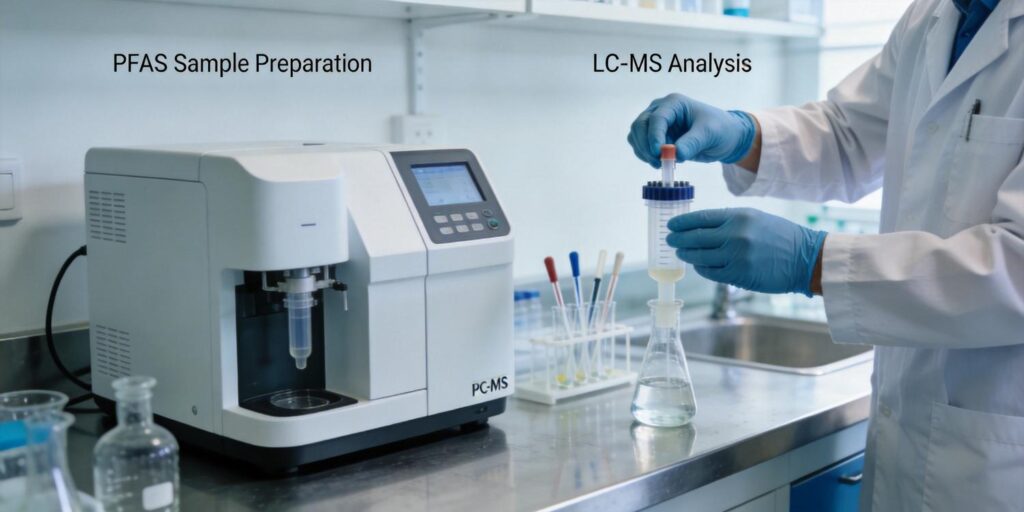
Liquid chromatography-mass spectrometry provides the sensitivity and selectivity required for trace-level analysis of plastic additives in marine water extracts.
Chromatographic Separation
Reversed-phase chromatography using C18 columns provides excellent separation of phthalates and UV stabilizers. Gradient elution with water-methanol or water-acetonitrile mobile phases effectively resolves complex mixtures of target analytes.
Mass Spectrometric Detection
Electrospray ionization (ESI) in both positive and negative modes enables sensitive detection of target compounds. Multiple reaction monitoring (MRM) provides the specificity required for trace analysis in complex marine matrices.
Key MS Parameters
- Ionization Mode: ESI+ for phthalates and most UV stabilizers; ESI- for acidic compounds
- Collision Energy: Optimized for each target compound to maximize sensitivity
- Dwell Time: Sufficient for adequate data points across chromatographic peaks
Method Validation Considerations
Comprehensive method validation should include:
- Linearity over relevant concentration ranges
- Limit of detection and quantification in marine matrix
- Recovery studies using fortified marine water samples
- Precision and accuracy assessments
- Matrix effect evaluation using post-extraction addition
Environmental Monitoring Applications
The developed SPE-LC-MS method enables comprehensive monitoring of plastic additives in marine environments, supporting several critical applications.
Baseline Monitoring Programs
Establishing baseline concentrations of plastic additives in different marine ecosystems provides essential data for assessing contamination trends and identifying pollution sources. Regular monitoring at strategic locations (coastal areas, shipping lanes, marine protected areas) creates valuable temporal datasets.
Source Identification and Apportionment
Chemical fingerprinting of plastic additives can help identify pollution sources. Different plastic types contain characteristic additive profiles that can be traced back to specific industrial activities, waste management practices, or shipping operations.
Ecological Risk Assessment
Concentration data from environmental monitoring supports ecological risk assessments by:
- Comparing detected concentrations with toxicity thresholds for marine organisms
- Evaluating potential for bioaccumulation in food webs
- Assessing cumulative impacts of multiple additives
Regulatory Compliance Monitoring
The method supports compliance monitoring for regulations governing plastic additives in marine environments. Data generated can inform policy development and evaluate the effectiveness of regulatory measures.
Research Applications
Beyond routine monitoring, the method enables research into:
- Fate and transport of plastic additives in marine systems
- Degradation pathways and transformation products
- Bioavailability to different trophic levels
- Interactive effects with other environmental stressors
Conclusion
SPE cleanup followed by LC-MS analysis provides a robust approach for monitoring microplastic additives in marine water samples. The method’s sensitivity, selectivity, and ability to handle complex marine matrices make it invaluable for environmental scientists and regulatory agencies. By addressing the specific challenges of marine water analysis—including high salinity, dissolved organic matter, and low analyte concentrations—this approach enables comprehensive assessment of plastic additive contamination in aquatic ecosystems.
As concerns about microplastic pollution continue to grow, reliable analytical methods for plastic additives become increasingly important for understanding environmental impacts and developing effective mitigation strategies. The SPE-LC-MS approach described here represents a powerful tool for advancing our knowledge of this critical environmental issue.