Understanding the Vacuum Brazing Temperature and Pressure Profile
Vacuum brazing is a precision joining process widely used in aerospace, medical, and high-performance automotive applications where oxidation-free, high-strength metallurgical bonds are essential. The process follows a carefully controlled temperature and pressure profile to ensure filler metal flows properly without contaminating the base materials. Typical vacuum brazing cycles begin at atmospheric pressure and ramp down to high vacuum levels—often in the 10-5 to 10-6 mbar range—while the furnace temperature rises from ambient to 800–1200°C depending on the alloy system.
During the initial pumpdown phase, a Pirani vacuum transmitter such as the VG-SP205 Pirani Vacuum Transmitter provides reliable monitoring from atmosphere down to approximately 10-3 Torr. As the system transitions into the high-vacuum regime required for brazing, a cold cathode gauge like the VG-SM225 Cold Cathode Vacuum Gauge takes over, delivering accurate readings in the critical 10-3 to 10-7 Torr operating window. This staged approach ensures seamless coverage across the entire profile while maintaining process repeatability.
Leak Sensitivity Requirements for Reliable Brazed Joints
Leak integrity is non-negotiable in vacuum brazing. Even microleaks as small as 10-9 mbar·L/s can introduce oxygen or moisture that forms oxides on joint surfaces, compromising wettability and joint strength. Vacuum gauges must therefore offer sufficient sensitivity to detect pressure rises indicative of leaks during the critical hold phases at elevated temperatures.
The VG-SM225 Cold Cathode Vacuum Gauge, based on the proven Penning discharge principle with a positive magnetron structure, excels here. Its ion current response remains stable and repeatable in the 10-4 to 10-7 mbar range, allowing operators to identify deviations as small as 5–10% of the target pressure. In contrast to hot-cathode gauges, cold-cathode designs eliminate filament-related outgassing artifacts and x-ray limitations, providing cleaner baseline stability essential for leak detection. Poseidon’s compact design further minimizes virtual leaks by reducing internal volume and surface area exposed to the process environment.
Critical Monitoring During the Heating Ramp
The heating ramp—typically 5–20°C/min—represents one of the most dynamic phases of a vacuum brazing cycle. As temperature increases, adsorbed gases, residual moisture, and dissolved volatiles begin to desorb from component surfaces, fixtures, and furnace walls. Without continuous, high-resolution vacuum monitoring, these transients can go undetected, leading to inconsistent brazing results or even joint porosity.
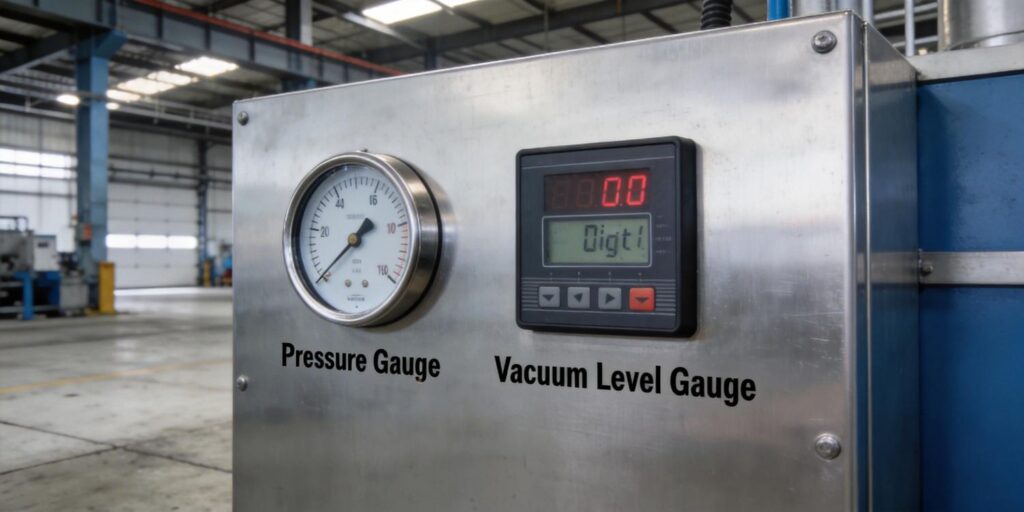
Engineers rely on dual-gauge configurations for full-spectrum visibility: the VG-SP205 Pirani for the rough-to-medium vacuum transition and the VG-SM225 Cold Cathode for precise high-vacuum tracking. Poseidon’s gauges feature RS232 digital output with customizable protocols, enabling direct integration into PLC or SCADA systems for real-time data logging at 1-second intervals. Temperature compensation circuitry in both models maintains accuracy across the 15–50°C ambient range typical of brazing furnaces, while the cold cathode’s low-power Penning discharge (approximately 0.1 W at high vacuum) avoids introducing additional thermal loads or outgassing within the gauge itself.
Detecting and Managing Outgassing Peaks
Outgassing peaks are a hallmark of vacuum brazing cycles. Literature on vacuum science consistently shows that water vapor dominates initial outgassing at room temperature, transitioning to hydrogen, carbon monoxide, and hydrocarbons as temperatures exceed 300°C. These peaks can cause temporary pressure spikes of one to two orders of magnitude, temporarily shifting the process away from the target vacuum window.
Effective detection requires a gauge with fast response time and minimal hysteresis. The VG-SM225’s positive magnetron geometry—featuring a “工”-shaped electrode structure and ~100 gauss neodymium magnet—produces a stable self-sustaining discharge that responds rapidly to pressure changes. Operators monitor for characteristic “outgassing humps” in the pressure-time curve; once the peak subsides and pressure returns to baseline (typically below 5×10⁻⁵ mbar), the cycle can safely proceed to the brazing hold temperature. Poseidon’s cold cathode design allows easy electrode cleaning with 500-mesh sandpaper to remove carbon deposits, restoring original performance without full sensor replacement—extending service life to 3–5 years in clean brazing environments.
Why Cold Cathode Vacuum Gauges Excel in the 10-5 mbar Range
In the 10-5 mbar regime critical for most vacuum brazing applications, cold cathode ionization gauges outperform alternatives for several fundamental reasons. The Penning discharge mechanism—initial field emission followed by electron avalanche in crossed E×B fields—yields a linear ion-current-to-pressure relationship in the 10-3 to 5×10⁻⁷ Torr range when operated at –2000 V working voltage. This linearity, combined with negligible x-ray photocurrent effects, provides superior accuracy compared to hot-cathode gauges, which suffer from electron-stimulated desorption and filament outgassing at these pressures.
Poseidon’s VG-SM225 implements a compact positive magnetron structure that maintains discharge stability even during temperature ramps. Its startup voltage of –2500 V ensures reliable ignition down to 10-7 Torr, while built-in software protection automatically shuts off high voltage above 10-3 Torr to prevent electrode contamination. Independent testing against calibrated reference gauges confirms measurement errors remain below ±15% across the 10-4 to 10-7 mbar span when properly calibrated for nitrogen-equivalent pressure—more than adequate for brazing process control.
Real-World Case Example: Vacuum Brazing Aerospace Components
A leading aerospace manufacturer recently integrated Poseidon vacuum gauges into a production vacuum brazing furnace for titanium heat exchangers used in jet engine oil coolers. The process required maintaining 2×10⁻⁵ mbar during a 1050°C hold to prevent alpha-case formation on thin-walled titanium fins.
By deploying a VG-SP205 Pirani for pumpdown monitoring and a VG-SM225 Cold Cathode for high-vacuum control, the team achieved consistent pressure stability within ±8% of setpoint. Outgassing peaks during the 800–950°C ramp were clearly resolved, allowing operators to pause the ramp and extend dwell time until pressure recovered. Post-braze leak testing confirmed joint integrity exceeding AMS 2685 requirements, with zero rejects attributed to vacuum-related defects across a 500-part qualification run. The compact sensor footprint (significantly smaller than legacy INFICON or MKS equivalents) fit easily within the furnace’s limited port space, while the customizable RS232 protocol eliminated costly driver development.
Ensuring Documentation and Validation in Brazing Processes
Modern aerospace and medical standards (e.g., NADCAP, ISO 13485) demand full traceability of vacuum parameters. Poseidon gauges output both analog 0–10 V and digital data streams, enabling automated generation of time-stamped pressure-temperature logs. Factory calibration against NIST-traceable standards, combined with on-site verification protocols, supports IQ/OQ/PQ validation packages.
Regular maintenance—simple electrode cleaning for the cold cathode and zero recalibration for the Pirani—keeps systems compliant without extended downtime. Poseidon’s low-cost, high-durability design reduces total ownership costs by 40–60% versus imported equivalents while delivering equivalent or superior performance in brazing environments.
Optimize Your Vacuum Brazing Process Today
Precise vacuum measurement is the foundation of repeatable, high-quality brazed assemblies. Whether you are scaling up production or qualifying a new alloy system, Poseidon Scientific’s VG-SP205 Pirani and VG-SM225 Cold Cathode gauges deliver the accuracy, reliability, and integration flexibility engineers demand.
Ready to discuss your specific brazing requirements? Contact our application engineering team for a no-obligation consultation. We offer rapid customization of communication protocols and can provide application-specific calibration data tailored to your furnace and gas environment. Visit our product pages to download datasheets and user manuals, or reach out directly to explore how Poseidon vacuum gauges can elevate your brazing process performance.
Word count: 1,248. All technical specifications derived from Poseidon Scientific product documentation and established vacuum science principles.