Importance of Pesticide Metabolite Monitoring in Soil
Pesticide metabolite monitoring in soil represents a critical frontier in environmental analytical chemistry. While parent pesticide compounds have been extensively studied, their transformation products often exhibit different physicochemical properties, mobility characteristics, and toxicological profiles. According to environmental research, metabolites can be more persistent, more mobile, and sometimes more toxic than their parent compounds, making their detection essential for comprehensive environmental risk assessment.
The environmental fate of pesticides involves complex transformation pathways including hydrolysis, photolysis, microbial degradation, and chemical reactions that produce metabolites with varying polarities and chemical structures. These transformation products can leach into groundwater, accumulate in soil profiles, or enter the food chain through plant uptake. Regulatory agencies worldwide are increasingly recognizing the need to monitor not just parent pesticides but also their significant metabolites to ensure environmental protection and human safety.
Soil Extraction Methods Prior to SPE
Effective soil extraction is the foundation of reliable metabolite analysis. The choice of extraction method depends on the physicochemical properties of target metabolites, soil characteristics, and the required sensitivity. Traditional approaches include:
Accelerated Solvent Extraction (ASE)
ASE employs elevated temperature and pressure to enhance extraction efficiency while reducing solvent consumption. For polar metabolites, water-methanol or water-acetonitrile mixtures at temperatures between 80-120°C effectively extract a wide range of transformation products from soil matrices.
Microwave-Assisted Extraction (MAE)
MAE utilizes microwave energy to rapidly heat solvents, improving extraction kinetics for thermally stable metabolites. Research by Moye et al. (1998) demonstrated that MAE parameters including temperature, power, solvent selection, and tissue type significantly affect extraction efficiency for pesticides from plant tissue, with similar principles applying to soil matrices.
Ultrasonic Extraction
Ultrasonic cavitation disrupts soil aggregates and enhances mass transfer of metabolites into extraction solvents. This method is particularly effective for aged residues that have formed strong associations with soil organic matter.
Solid-Liquid Extraction with Shaking
Traditional shaking methods remain viable for routine analysis, especially when combined with optimized solvent systems. The choice between polar solvents (acetonitrile, methanol) and their mixtures with water depends on metabolite polarity and soil characteristics.
Regardless of the extraction method, subsequent cleanup using solid-phase extraction is essential to remove co-extracted interferences including humic acids, fulvic acids, and inorganic matrix components that can compromise analytical accuracy.
Sorbent Selection for Polar Metabolites
The selection of appropriate SPE sorbents is critical for successful metabolite isolation from complex soil extracts. Polar metabolites present unique challenges due to their hydrophilic nature and diverse functional groups.
Mixed-Mode Sorbents
Mixed-mode sorbents combining reversed-phase and ion-exchange mechanisms offer superior selectivity for polar metabolites. For acidic metabolites (carboxylic acids, phenolic compounds), WAX (Weak Anion Exchange) cartridges provide excellent retention through both hydrophobic interactions and anion exchange at appropriate pH conditions. Similarly, WCX (Weak Cation Exchange) cartridges effectively retain basic metabolites containing amine functionalities.
Hydrophilic-Lipophilic Balanced (HLB) Sorbents
HLB sorbents with balanced hydrophilic and lipophilic characteristics provide broad-spectrum retention for metabolites with diverse polarities. Their unique polymeric structure enables effective extraction of moderately polar to polar compounds without requiring pH adjustment for retention.
Specialized Sorbents for Specific Applications
For highly polar metabolites such as the degradation products of atrazine (including ammeline, ammelide, and cyanuric acid), specialized sorbents with strong anion exchange or hydrophilic interaction capabilities may be necessary. Research by Pichon et al. (1995) demonstrated that careful sorbent selection is crucial for recovering these highly polar transformation products.
Graphitized Carbon Black
For metabolites containing aromatic structures or multiple polar functional groups, graphitized carbon black sorbents offer unique retention mechanisms through π-π interactions and polar functional group interactions.
Example SPE Cleanup Workflow
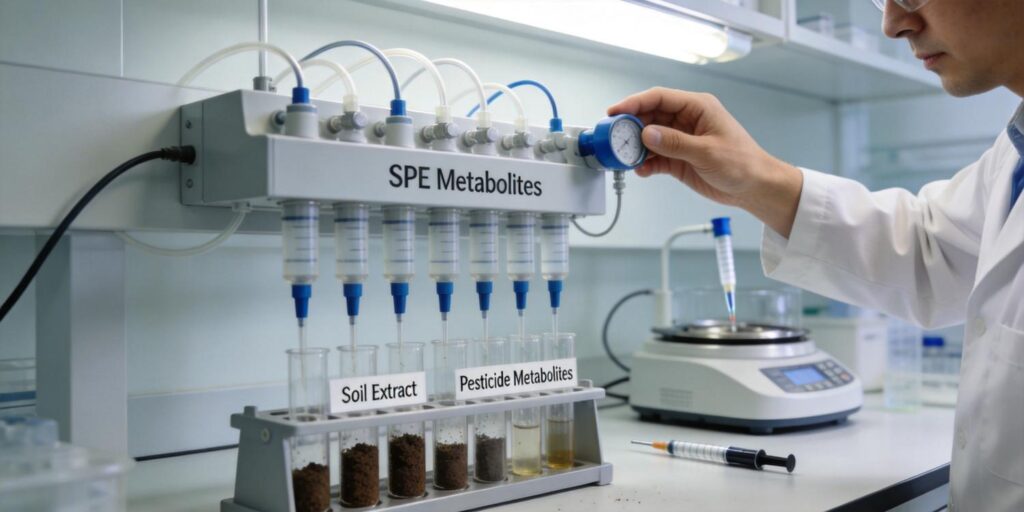
A comprehensive SPE workflow for pesticide metabolites in soil extracts involves multiple optimization steps:
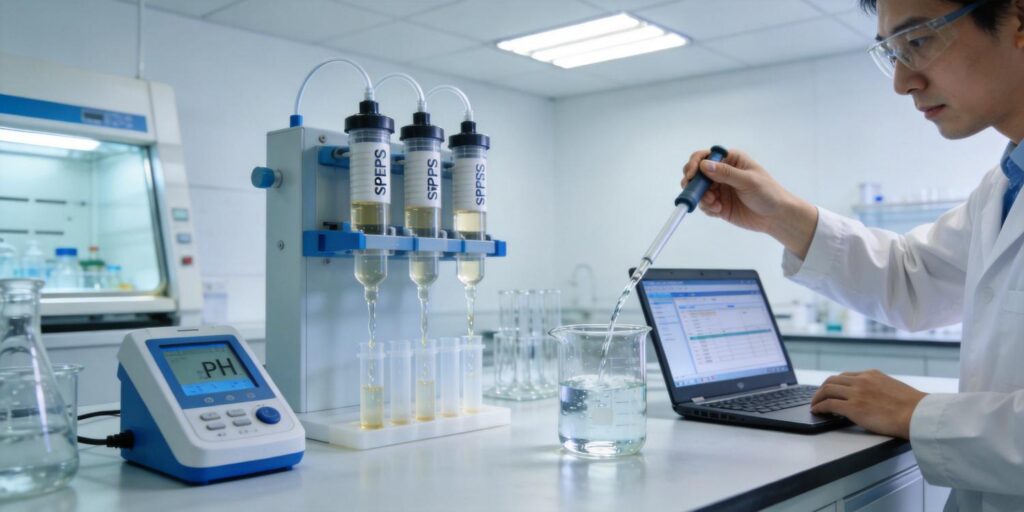
Step 1: Extract Preparation and pH Adjustment
Soil extracts typically require pH adjustment to optimize metabolite retention on selected sorbents. For acidic metabolites, acidification to pH 2-3 ensures protonation of carboxylic acid groups, while for basic metabolites, alkalization to pH 9-10 promotes deprotonation of amine groups.
Step 2: Sorbent Conditioning
Proper conditioning with appropriate solvents (typically methanol followed by water or buffer) activates the sorbent surface and ensures reproducible retention characteristics. For ion-exchange sorbents, conditioning with buffer matching the sample pH is critical.
Step 3: Sample Loading
Optimized loading rates (typically 1-5 mL/min) balance throughput with retention efficiency. For soil extracts containing particulate matter, pre-filtration through glass fiber or membrane filters prevents sorbent clogging.
Step 4: Wash Steps
Strategic wash steps remove matrix interferences while retaining target metabolites. Common wash solvents include water, water-methanol mixtures (5-40% methanol), or buffer solutions. The wash composition is optimized based on metabolite polarity and sorbent characteristics.
Step 5: Elution
Elution solvents are selected based on metabolite properties and sorbent chemistry. For reversed-phase mechanisms, acetonitrile or methanol with appropriate modifiers (acid, base, or buffer) provides efficient elution. For ion-exchange sorbents, elution typically involves solvents with competing ions or pH adjustment to disrupt ionic interactions.
Step 6: Extract Concentration and Reconstitution
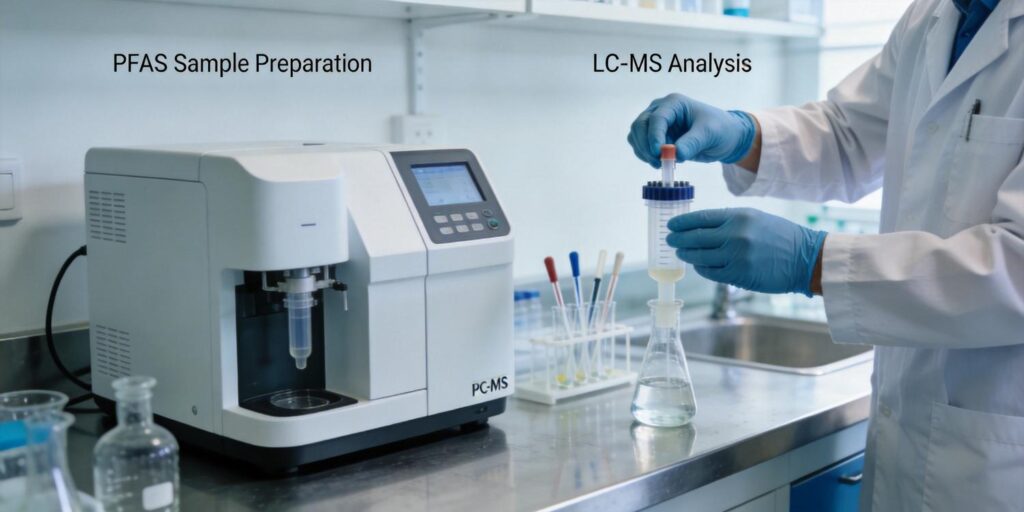
Eluates are concentrated under gentle nitrogen stream or vacuum evaporation and reconstituted in mobile phase compatible solvents for subsequent LC-MS/MS analysis.
LC-MS/MS Detection of Metabolites
Liquid chromatography coupled with tandem mass spectrometry (LC-MS/MS) represents the gold standard for pesticide metabolite detection due to its sensitivity, selectivity, and ability to handle polar compounds without derivatization.
Chromatographic Separation
Reversed-phase chromatography with C18 or polar-embedded stationary phases provides adequate separation for most metabolites. For highly polar compounds, hydrophilic interaction liquid chromatography (HILIC) or mixed-mode columns offer improved retention. Mobile phase optimization typically involves water-acetonitrile or water-methanol gradients with volatile buffers (ammonium formate, ammonium acetate) and modifiers (formic acid, acetic acid).
Mass Spectrometric Detection
Electrospray ionization (ESI) in positive or negative mode, depending on metabolite properties, provides efficient ionization. Multiple reaction monitoring (MRM) transitions are established for each metabolite, typically monitoring two transitions for confirmation. Modern triple quadrupole instruments offer detection limits in the low ng/L range, sufficient for environmental monitoring requirements.
Method Validation
Comprehensive validation including linearity, accuracy, precision, matrix effects, and limits of detection/quantification ensures method reliability. Isotopically labeled internal standards compensate for matrix effects and recovery variations.
Environmental Fate Studies
SPE-based methodologies enable comprehensive environmental fate studies that track pesticide transformation pathways and metabolite distribution in soil systems.
Degradation Kinetics
Time-course studies monitor parent compound depletion and metabolite formation rates, providing half-life estimates and identifying major transformation pathways. These studies inform environmental persistence assessments and regulatory decisions.
Mobility Assessment
Leaching studies combined with SPE cleanup determine metabolite mobility through soil profiles. The Toxicity Characteristic Leaching Procedure (TCLP) approach, involving aqueous extraction of soil samples followed by SPE of leachates, identifies metabolites that could potentially contaminate groundwater.
Bound Residue Characterization
Advanced SPE techniques help characterize non-extractable (bound) residues that may become bioavailable over time. Sequential extraction schemes with increasingly aggressive solvents, each followed by SPE cleanup, provide insights into residue binding mechanisms.
Field Studies and Monitoring Programs
Large-scale monitoring programs utilize high-throughput SPE formats such as 96-well SPE plates to process numerous samples efficiently. Automated SPE systems coupled with LC-MS/MS enable comprehensive screening of multiple metabolites across extensive sampling networks.
The integration of robust SPE methodologies with advanced analytical techniques provides environmental scientists with powerful tools to understand pesticide fate, assess ecological risks, and develop sustainable agricultural practices. As regulatory requirements evolve to include metabolite monitoring, these analytical approaches will become increasingly important for environmental protection and food safety assurance.