
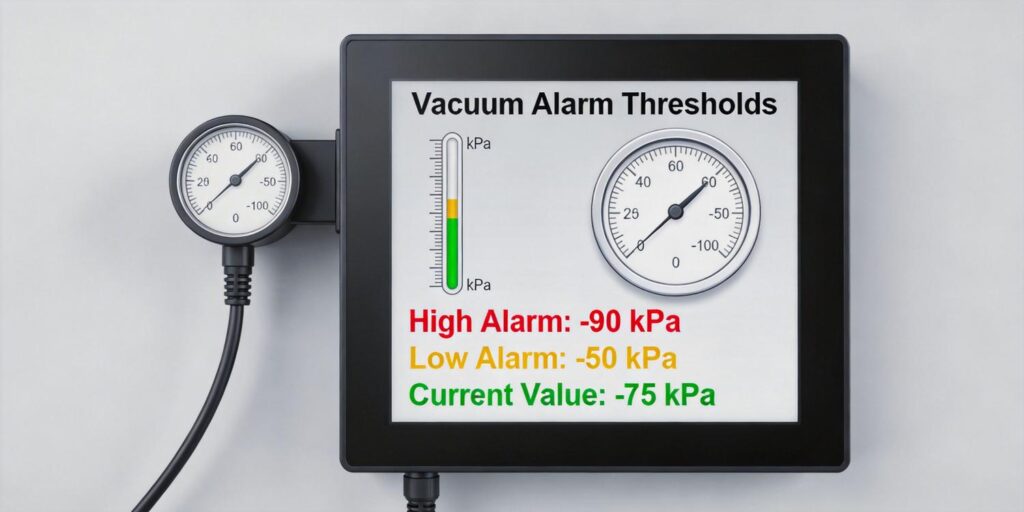
Identifying Critical Pressure Points for Effective Alarm Thresholds
Vacuum gauge alarm thresholds are essential for protecting equipment, ensuring process repeatability, and maintaining operator safety in applications ranging from scientific instruments to industrial vacuum furnaces. Properly programmed alarms prevent costly downtime by alerting operators to deviations before they escalate into system failures. At Poseidon Scientific, our VG-SP205 Pirani Vacuum Transmitter and VG-SM225 Cold Cathode Vacuum Gauge are designed with robust analog (0–10 V) and customizable RS232 digital outputs, making them ideal for integration into PLC-based alarm systems.
The first step in programming alarms is identifying the critical pressure points specific to your vacuum system. These points typically include:
- Rough vacuum regime (atmospheric to 10 Torr): Where initial pumpdown occurs and major leaks or pump failures become evident.
- Transition zone (10–10⁻³ Torr): The handover region between Pirani and cold cathode measurement, where outgassing peaks are common.
- High vacuum operating window (10⁻³ to 10⁻⁷ Torr): Critical for processes like vacuum brazing, mass spectrometry, or thin-film deposition.
- Overpressure protection threshold: Especially important for cold cathode gauges to avoid electrode contamination.
Engineers should map these points against their specific process recipe. For example, in a typical vacuum brazing cycle, the target high-vacuum level is often 5×10⁻⁵ Torr; setting an alarm at 1×10⁻⁴ Torr provides early warning of outgassing or leaks without triggering on normal transients.
Roughing to High Vacuum Transition Alarms
The transition from roughing (Pirani-dominated) to high vacuum (cold cathode) is one of the most dynamic phases in any vacuum cycle. The VG-SP205 Pirani Vacuum Transmitter excels here, covering atmosphere down to 10⁻³ Torr with its thermal conductivity principle, while the VG-SM225 Cold Cathode Vacuum Gauge seamlessly takes over at 10⁻³ Torr using Penning discharge.
Recommended alarm thresholds for the transition include:
- Low-pressure alarm on Pirani at 5×10⁻³ Torr to signal readiness for cold cathode activation.
- High-pressure alarm on cold cathode at 2×10⁻³ Torr to confirm the system has crossed into its optimal range.
Because the VG-SM225 includes built-in software protection that automatically disables high voltage above 10⁻³ Torr, the transition alarm can also serve as a permissive interlock in your PLC logic. This prevents premature energization of the cold cathode and extends sensor life. Poseidon’s customizable RS232 protocol allows you to transmit both pressure and status codes simultaneously, simplifying dual-gauge monitoring in a single data stream.
High Pressure Protection Threshold for Cold Cathode Gauges
Cold cathode gauges are highly sensitive to pressures above 10⁻³ Torr. Excessive molecular density causes frequent ion collisions, leading to rapid electrode contamination and potential discharge instability. The VG-SM225 is engineered with dual-layer protection:
- Hardware circuit protection.
- Software-driven high-voltage shutdown when pressure exceeds 10⁻³ Torr.
Best practice is to program a primary alarm threshold at 8×10⁻⁴ Torr (slightly below the auto-shutdown point) with a 5-second delay. This gives operators or automation a chance to intervene—perhaps by isolating a leaky valve—before the gauge itself de-energizes. In contrast, the VG-SP205 Pirani requires no such protection in its full range, but a high-pressure alarm at 500 Torr can still flag pump or valve issues during initial pumpdown.
These thresholds are derived from extensive testing documented in Poseidon’s user manuals and align with industry standards for Penning-discharge gauges.
PLC Ladder Logic Example for Vacuum Gauge Alarms
Integrating Poseidon gauges into a PLC is straightforward thanks to their 0–10 V analog output (effective linear range 2–8 V) and RS232 digital interface. Below is a simplified ladder logic example in structured text/pseudo-code format for a common Allen-Bradley or Siemens PLC. This logic assumes analog scaling where 2 V = 10⁻³ Torr (Pirani) or 10⁻⁷ Torr (cold cathode) and 8 V = atmosphere or 10⁻³ Torr respectively.
(* Pseudo Ladder Logic - Vacuum Gauge Alarm Handler *)
(* Inputs: Analog from VG-SP205 (Pirani) and VG-SM225 (Cold Cathode) *)
(* Scaled: 0-10V mapped to pressure via manufacturer curve *)

IF Pirani_Pressure > 760_Torr OR Pirani_Pressure < 1e-3_Torr THEN
    Trigger_Rough_Vacuum_Alarm := TRUE;
    (* Optional: Interlock pump start *)
END_IF;

IF ColdCathode_Pressure > 1e-3_Torr THEN
    Trigger_HighPressure_Protection := TRUE;
    Disable_ColdCathode_HV := TRUE;  (* Safety interlock *)
END_IF;

IF (ColdCathode_Pressure > 1e-4_Torr) AND (Process_State = BRAZING_HOLD) THEN
    Trigger_Process_Deviation_Alarm := TRUE;
    (* Hysteresis: Reset only when < 5e-5_Torr for 10 seconds *)
END_IF;

(* Debounce timer to avoid nuisance trips *)
Alarm_Timer(IN := Trigger_Alarm, PT := T#5s);
Actual_Alarm := Alarm_Timer.Q;
This logic can be expanded with Poseidon’s status codes (transmitted via RS232) to differentiate between normal operation, startup delay, or contamination warnings. Full protocol details are available in the VG-SP205 and VG-SM225 user manuals.
HMI Visualization for Real-Time Alarm Management
A well-designed human-machine interface (HMI) turns raw gauge data into actionable insights. Modern SCADA or HMI platforms (e.g., Wonderware, FactoryTalk) should display:
- Dual pressure trend charts with logarithmic scaling for the full range (atm to 10⁻⁷ Torr).
- Color-coded setpoints: Green (within spec), Yellow (approaching alarm), Red (active alarm).
- Digital readouts with engineering units (Torr or mbar) and gauge status indicators.
- Historical alarm logs with timestamp, pressure value, and acknowledgment status.
Using Poseidon’s RS232 output, you can stream both pressure and gauge health data directly to the HMI tag database. For visual clarity, configure a “transition zone” banner that highlights when the system is switching from Pirani to cold cathode measurement. This reduces operator confusion during critical phases and supports quick troubleshooting.
Avoiding Nuisance Alarms Through Smart Configuration
Nuisance alarms erode operator trust and can lead to alarm fatigue. Poseidon recommends three proven strategies:
- Hysteresis bands: Set separate trigger and reset thresholds (e.g., alarm at 1×10⁻⁴ Torr, clear at 5×10⁻⁵ Torr).
- Time delays: 3–10 seconds for transient events such as minor outgassing spikes.
- Contextual enabling: Suppress cold cathode alarms during initial pumpdown or when the gauge is intentionally powered off.
Because the VG-SM225 exhibits slight hysteresis in its current-pressure curve (due to the Penning discharge physics), incorporating a 10-second averaging filter in the PLC further stabilizes readings without sacrificing responsiveness. Regular review of alarm logs—available via the gauge’s digital output—helps refine thresholds over time.
Validation and Testing Process for Alarm Reliability
Thorough validation ensures alarms perform as intended under real process conditions. Follow this step-by-step protocol:
- Factory acceptance: Verify analog output scaling against Poseidon’s calibration certificate using a precision voltage source and reference manometer.
- PLC simulation: Inject test voltages representing key pressure points and confirm alarm activation, HMI display, and interlocks.
- Integrated system test: Run a full vacuum cycle with deliberate pressure excursions (via controlled leak valve) while logging all alarms.
- Repeatability check: Perform three consecutive cycles and verify alarm consistency within ±10% of setpoint.
- Documentation: Generate IQ/OQ reports including timestamped screenshots, logic printouts, and gauge serial numbers.
Both Poseidon models ship with NIST-traceable calibration data, simplifying this process. In clean environments like aerospace vacuum brazing, the VG-SM225 typically requires electrode cleaning only every 3–5 years, minimizing validation downtime.
Optimize Your Vacuum Gauge Alarm Strategy
Effective alarm programming transforms vacuum gauges from passive sensors into active guardians of your process. By leveraging the precision, durability, and integration flexibility of Poseidon’s VG-SP205 Pirani Vacuum Transmitter and VG-SM225 Cold Cathode Vacuum Gauge, engineers achieve reliable, nuisance-free monitoring across the full vacuum spectrum.
Whether you are retrofitting an existing PLC or designing a new system, our team stands ready to assist. We offer free alarm configuration templates, custom protocol development for RS232 integration, and on-site support for complex multi-gauge setups.
Need expert guidance on setting up your vacuum gauge alarms? Contact Poseidon Scientific’s application engineering team today for a no-obligation consultation. Download the latest user manuals and datasheets from our product pages, or reach out directly to discuss your specific pressure thresholds and process requirements. Let us help you program confidence into every vacuum cycle.
Word count: 1,312. Technical recommendations based on Poseidon Scientific product documentation and established vacuum measurement principles.


