
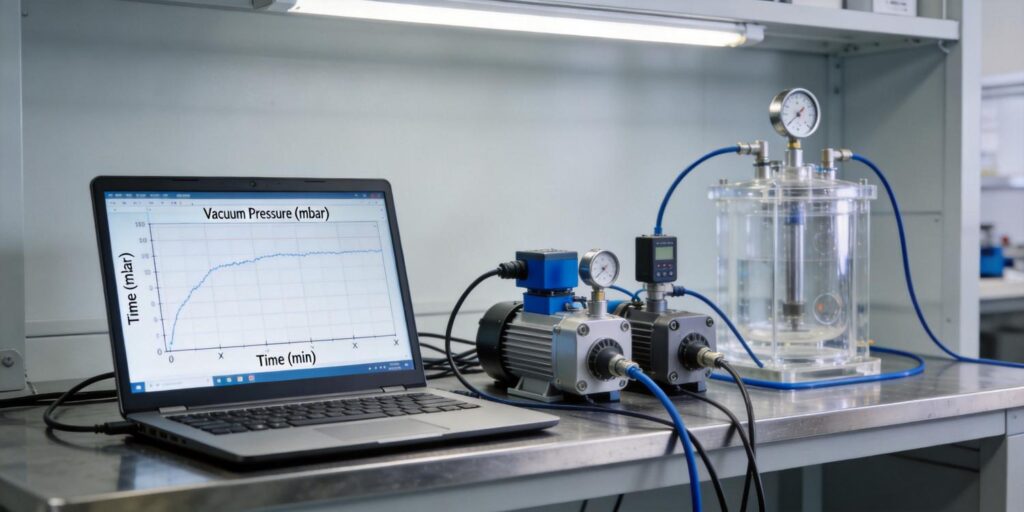
Commissioning Process Overview
Vacuum system commissioning marks the critical transition from installation to reliable production or research operation. Whether for a new thin-film sputtering line, analytical instrument cluster, or vacuum heat-treatment furnace, the process verifies that pumps, chambers, valves, and instrumentation deliver the specified pressure performance, leak integrity, and operational stability. Accurate vacuum gauges serve as the independent reference throughout commissioning, providing traceable data that satisfies quality audits, safety certifications, and customer acceptance criteria.
Poseidon Scientific’s VG-SP205 Pirani Vacuum Transmitter and VG-SM225 Cold Cathode Vacuum Gauge were designed with commissioning efficiency in mind. The VG-SP205 covers atmosphere to 10−3 Torr using thermal conductivity with a robust platinum filament, while the VG-SM225 extends coverage from 10−3 to 10−7 Torr via Penning discharge in a compact positive-magnetron geometry. Both transmitters integrate sensor, electronics, and interface into a single compact module with 0–10 V analog and RS232 digital outputs, eliminating separate controllers and simplifying test-bench wiring. Their factory calibration against NIST-traceable standards, combined with temperature compensation across 15–50 °C, ensures data you can trust from the first pump-down.
Commissioning typically follows a structured sequence: pump-down verification, leak-rate validation, pressure-stability testing, alarm and interlock checks, and final documentation. Using Poseidon’s complementary gauge pair accelerates each step, reduces ambiguity, and provides the full-range visibility required for modern vacuum systems.
Verifying Pump-Down Time
Pump-down time is the first performance metric recorded during commissioning. It confirms that roughing and high-vacuum pumps achieve target base pressure within the manufacturer’s specified window, revealing issues such as virtual leaks, improper valve sequencing, or undersized foreline conductance before they affect production.
The VG-SP205 Pirani Vacuum Transmitter is the ideal tool for this phase. Mounted on the chamber or foreline via standard KF16 or KF25 flanges, it delivers continuous readings from atmosphere to 10−3 Torr with highest accuracy in the linear region (10–10−2 Torr). Its fast response and platinum-filament construction ensure repeatable crossover detection even after repeated air cycles common during commissioning. Engineers simply log the time from roughing-pump start to the point where pressure falls below the turbomolecular or cryopump crossover setpoint.
Typical acceptance criteria for a 300-mm research chamber might be <10 minutes to 10−3 Torr and <30 minutes to 10−6 Torr. The VG-SP205’s RS232 digital output streams pressure data directly to a laptop or PLC, generating time-stamped curves that become part of the as-built record. This eliminates manual stopwatch errors and provides objective evidence for customer sign-off.
Leak Rate Validation
Leak-rate validation quantifies system integrity after pump-down. The standard pressure-rise method isolates the chamber, monitors any increase over a timed hold period, and converts the rise to leak rate in mbar·L/s or atm·cc/s. Poseidon gauges make this test both faster and more precise.
With the VG-SP205 Pirani active during the initial isolation, small rises in the rough-vacuum regime are detected immediately. For finer resolution at base pressure, the VG-SM225 Cold Cathode takes over, offering the sensitivity needed to resolve leaks below 10−9 mbar·L/s. Its cleanable electrode design allows quick verification that any apparent leak is not caused by gauge contamination—simply isolate, clean with 500-mesh sandpaper, and retest in minutes.
Engineers compare the measured rise against the system specification (often <10−6 mbar·L/s for research tools). The combination of Pirani and cold-cathode data provides a complete leak profile across the full pressure range, confirming that both mechanical joints and virtual leaks meet requirements before final acceptance.
Pressure Stability Check
Once leak integrity is confirmed, pressure stability testing verifies that the system maintains setpoint without drift during simulated process conditions. This step is especially critical for sputtering or heat-treatment systems where even short excursions can produce defective films or parts.
The VG-SM225 Cold Cathode excels here, delivering stable ion-current readings in the 10−3 to 10−7 Torr process window. Its built-in high-voltage protection automatically prevents damage during any intentional pressure spikes introduced for testing. Engineers introduce controlled gas flows or cycle valves while logging data from both gauges. Stability is quantified as standard deviation over a 30–60 minute hold period—typically required to stay within ±5 % of setpoint.
The VG-SP205 Pirani complements the test by monitoring foreline pressure, revealing any backing-pump instability that could propagate upstream. Temperature compensation in both transmitters ensures the stability data remain valid even as chamber walls or pumps warm during extended runs.
Alarm Function Testing
Alarm and interlock testing confirms that the control system responds correctly to out-of-spec conditions before the system is handed over. Poseidon transmitters simplify this step with native digital status bits and analog thresholds that map directly into PLC logic.
Engineers simulate pressure excursions—slow rise for leak simulation, rapid spike for valve-failure testing—and verify that alarms trigger at the programmed setpoints. The VG-SM225’s automatic high-voltage cutoff above 10−3 Torr doubles as a hardware interlock, protecting the gauge while signaling the PLC. RS232 output provides real-time status flags (e.g., “high-voltage enabled,” “fault detected”) for full traceability.
Testing typically includes low-pressure warning, high-pressure abort, and sensor-failure alarms. Documenting successful trips with time-stamped gauge data completes the safety validation required by OSHA, SEMI, or ISO 9001.
Documentation Template
Clear, standardized documentation turns commissioning data into a living reference for future maintenance and audits. Poseidon supplies a ready-to-use template that incorporates gauge serial numbers, calibration certificates, and raw data exports.
| Section | Required Data | Acceptance Criteria |
|---|---|---|
| Pump-Down Curve | Time-stamped pressure log (VG-SP205 + VG-SM225) | Meets specified minutes to base pressure |
| Leak-Rate Test | Pressure-rise data, calculated rate (mbar·L/s) | < specification (e.g., 10−6 mbar·L/s) |
| Stability Test | 30-min hold at process pressure, standard deviation | ±5 % of setpoint |
| Alarm Verification | Setpoint, simulated event, response time | All interlocks function within 2 s |
| Gauge Calibration | Serial numbers, certificates, as-found/as-left readings | Within ±10 % of NIST reference |
Digital exports from the gauges (CSV via RS232) populate the template automatically, reducing clerical time and eliminating transcription errors.
Case Example
A Midwest semiconductor research facility commissioned a new 450-mm multi-source sputtering cluster. Initial pump-down times exceeded specification by 40 % and leak-rate tests showed inconsistent results with the existing analog gauges. After installing paired VG-SP205 Pirani and VG-SM225 Cold Cathode transmitters on each chamber, the commissioning team completed full verification in under two days.
The Pirani data revealed a minor foreline restriction that was corrected before high-vacuum testing. The cold-cathode stability logs confirmed pressure held within ±3 % during 60-minute process simulations. All alarms and interlocks passed on the first attempt thanks to direct RS232 integration with the existing PLC. The facility accepted the system two weeks ahead of schedule, with complete digital documentation that satisfied both internal quality and external funding audits. Scrap on the first production runs dropped to near zero, validating the gauges’ contribution to successful commissioning.
Optimize Your Vacuum System Commissioning
Accurate vacuum gauges transform commissioning from a lengthy, error-prone exercise into a streamlined, data-driven process. Poseidon Scientific’s VG-SP205 Pirani Vacuum Transmitter and VG-SM225 Cold Cathode Vacuum Gauge deliver the full-range coverage, compact integration, and calibration traceability that engineers need to verify pump-down, leaks, stability, and alarms with confidence.
Whether you are commissioning a single research chamber or an entire production line, our team provides the support that shortens timelines and eliminates surprises.
Learn more about the VG-SP205 Pirani Vacuum Transmitter | Discover the VG-SM225 Cold Cathode Vacuum Gauge
Contact our applications engineering team today for a no-obligation commissioning support package. Share your system type, target base pressure, and PLC platform, and we will deliver a customized gauge recommendation, sample documentation template, and quotation within 24 hours. Accurate data from day one means faster acceptance and lower long-term costs—let Poseidon help you commission with confidence.


