Role of Antioxidants in Food Chemistry
Antioxidants represent a critical class of compounds in food chemistry, serving as natural defense mechanisms against oxidative degradation. These compounds, primarily phenolic acids, flavonoids, tocopherols, and carotenoids, play dual roles in food systems: they preserve food quality by preventing lipid oxidation and rancidity, while also contributing to human health benefits through their free radical scavenging capabilities. The preservation of antioxidant content during food processing and storage has become a key quality parameter, driving analytical methodologies for their accurate quantification.
From a chemical perspective, antioxidants function by donating hydrogen atoms or electrons to reactive oxygen species, thereby terminating chain reactions that lead to food deterioration. Their effectiveness depends on chemical structure, concentration, and interaction with other food components. The growing consumer demand for natural antioxidants over synthetic alternatives has intensified research into extraction and analysis methods that preserve these delicate compounds.
Extraction Challenges in Complex Food Matrices
Food matrices present formidable challenges for antioxidant extraction due to their heterogeneous composition and the presence of interfering compounds. Common obstacles include:
- Lipid interference: High-fat foods like oils, dairy products, and nuts contain triglycerides and fatty acids that co-extract with antioxidants, requiring careful separation strategies
- Protein binding: Many antioxidants form complexes with proteins, necessitating disruption of these interactions during extraction
- Carbohydrate matrices: Sugars and polysaccharides can trap antioxidant compounds, reducing extraction efficiency
- pH sensitivity: Many phenolic antioxidants exhibit pH-dependent stability and solubility
- Thermal lability: Some antioxidants degrade under heat, limiting extraction temperature options
As noted in food analysis literature, “The high or variable water and fat contents of citrus fruit, berries and nuts can present capacity problems” during extraction processes. Traditional liquid-liquid extraction often proves inadequate for these complex matrices, leading to poor recovery and reproducibility.
SPE Sorbent Selection for Antioxidant Compounds
Selecting appropriate solid-phase extraction sorbents is crucial for successful antioxidant isolation. The choice depends on the chemical properties of target antioxidants and the specific food matrix:
Reversed-Phase Sorbents (C18, C8, HLB)
For moderately polar to non-polar antioxidants like tocopherols, carotenoids, and certain flavonoids, reversed-phase sorbents offer excellent retention. The HLB (Hydrophilic-Lipophilic Balance) cartridges are particularly effective for broad-spectrum antioxidant extraction due to their water-wettable polymeric structure that retains compounds across a wide polarity range.
Mixed-Mode and Ion-Exchange Sorbents
For acidic antioxidants like phenolic acids (gallic, caffeic, ferulic acids), mixed-mode sorbents combining reversed-phase and ion-exchange mechanisms provide superior selectivity. The WAX (Weak Anion Exchange) and WCX (Weak Cation Exchange) cartridges enable pH-controlled extraction of ionizable antioxidants.
Specialized Sorbents for Specific Applications
Research demonstrates that “solid-phase extraction on a C18 bonded phase to extract pigments (anthocyanins), leaving sugars in the effluent” effectively separates antioxidant compounds from carbohydrate-rich matrices. For complex samples, sequential SPE using different sorbents can achieve comprehensive antioxidant profiling.
Example Sample Preparation Workflow
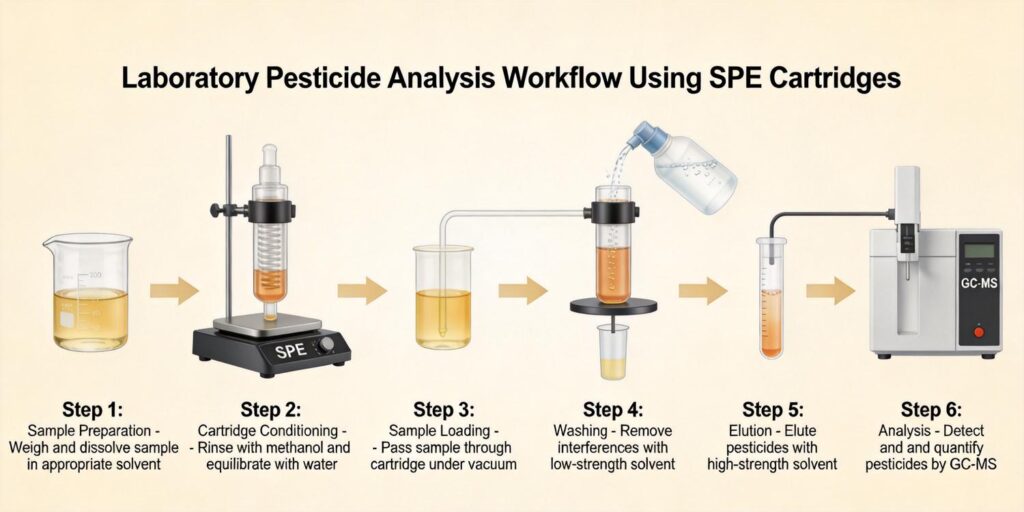
A robust SPE workflow for antioxidant extraction typically follows these steps:
- Sample homogenization: Food samples are homogenized in appropriate solvent (often methanol-water or acetone-water mixtures)
- Centrifugation/filtration: Removal of particulate matter to prevent SPE cartridge clogging
- SPE cartridge conditioning: Sequential conditioning with methanol followed by water or buffer
- Sample loading: Application at controlled flow rates (typically 1-3 mL/min)
- Washing: Removal of interfering compounds with appropriate solvents
- Elution: Recovery of antioxidants using optimized solvent combinations
- Concentration/reconstitution: Solvent evaporation and reconstitution in analysis-compatible solvents
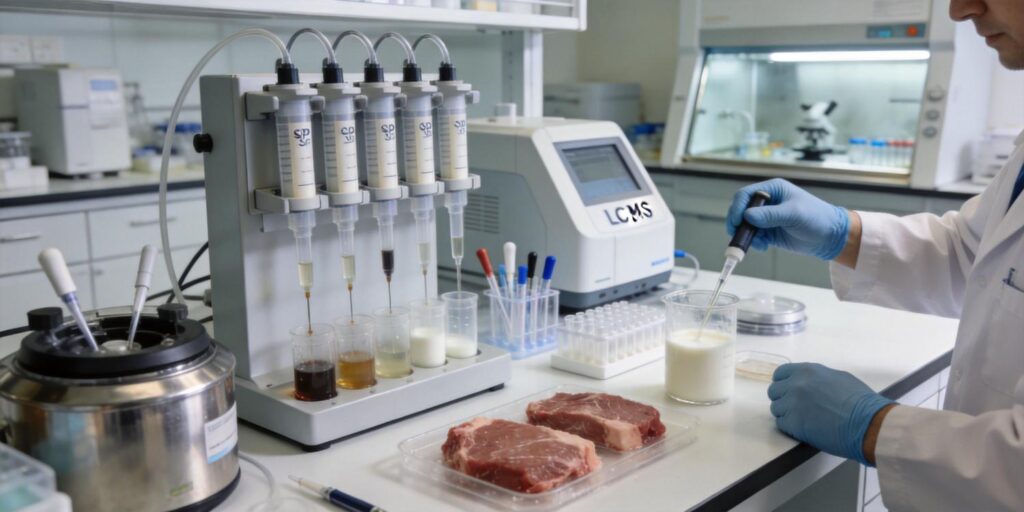
For high-throughput applications, 96-well SPE plates enable parallel processing of multiple samples, significantly improving laboratory efficiency.
HPLC or LC-MS Analysis Methods
Following SPE cleanup, antioxidant analysis typically employs chromatographic techniques:
High-Performance Liquid Chromatography (HPLC)
Reversed-phase HPLC with UV-Vis or photodiode array detection remains the workhorse for antioxidant analysis. Common conditions include:
- Column: C18 stationary phase (150-250 mm × 4.6 mm, 5 μm)
- Mobile phase: Gradient elution with water-acetonitrile or water-methanol, often with acid modifiers (formic or acetic acid)
- Detection: UV at specific wavelengths (280 nm for phenolic compounds, 450 nm for carotenoids)
Liquid Chromatography-Mass Spectrometry (LC-MS)
For comprehensive antioxidant profiling and identification, LC-MS provides superior sensitivity and specificity. Electrospray ionization (ESI) in negative mode effectively detects phenolic acids and flavonoids, while atmospheric pressure chemical ionization (APCI) suits less polar antioxidants like tocopherols.
The literature confirms that “solid-phase extraction and high-performance liquid chromatography” represents a standard approach for antioxidant determination in various food matrices, with SPE providing the necessary cleanup for reliable chromatographic analysis.
Applications in Nutritional Research
SPE-based antioxidant extraction supports numerous applications in food science and nutrition:
Quality Control and Authentication
Antioxidant profiles serve as chemical fingerprints for food authentication and quality assessment. Olive oil analysis, for example, employs SPE to isolate phenolic compounds that indicate quality and geographical origin.
Bioavailability Studies
Understanding antioxidant absorption and metabolism requires precise quantification in biological matrices. SPE enables cleanup of complex samples like plasma and urine for pharmacokinetic studies.
Functional Food Development
As food manufacturers develop antioxidant-enriched products, SPE methods quantify fortification levels and monitor stability during processing and storage.
Dietary Assessment
Epidemiological studies correlating antioxidant intake with health outcomes rely on accurate food composition data generated through validated SPE-HPLC methods.
The continued evolution of SPE technologies, including improved sorbent chemistries and automation platforms, ensures that antioxidant analysis will remain at the forefront of food chemistry research. By providing clean extracts free from matrix interferences, SPE enables the accurate quantification necessary for understanding the complex roles antioxidants play in food systems and human health.