
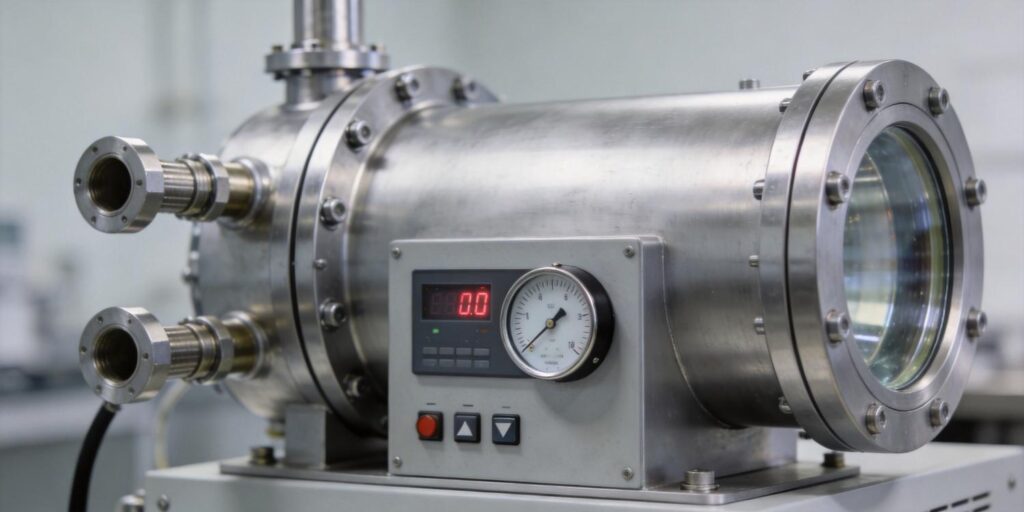
Research Sputtering Chamber Overview
Research sputtering systems form the backbone of thin-film development in university labs, national research institutes, and corporate R&D centers. These compact vacuum chambers—typically 12–24 inches in diameter—enable precise deposition of metals, oxides, nitrides, and complex multilayer stacks for applications ranging from photovoltaics and sensors to quantum materials and biomedical coatings. A typical research setup includes a load-lock for quick sample exchange, a main process chamber with multiple magnetron sources, substrate heating and biasing, and gas delivery for reactive sputtering with argon, oxygen, or nitrogen.
Process pressures must be tightly controlled: base pressures below 10−6 Torr ensure clean interfaces, while working pressures of 1–10 mTorr sustain stable plasma and reproducible deposition rates. Any deviation in vacuum level directly affects film stoichiometry, crystallinity, and defect density. For researchers balancing experimental flexibility with budget constraints, selecting the right vacuum gauges is critical. Poseidon Scientific’s VG-SP205 Pirani Vacuum Transmitter and VG-SM225 Cold Cathode Vacuum Gauge were engineered specifically for these demanding research environments, combining full-range coverage, compact size, and customizable digital integration at a fraction of the cost of legacy instrumentation.
Required Pressure Resolution
Research sputtering demands pressure resolution sufficient to detect changes as small as 5–10 % of setpoint, because even minor fluctuations alter ion energy, mean free path, and target poisoning behavior. In the roughing and transition regime (atmosphere to 10−3 Torr), ±15 % accuracy is typically adequate for pump-down monitoring. In the process regime (10−3 to 10−6 Torr), resolution of ±5 % or better ensures repeatable film properties across multiple runs.
Poseidon’s dual-gauge approach meets these requirements without compromise. The VG-SP205 Pirani delivers high linearity in the 10–10−2 Torr region where most pump-down and initial plasma ignition occur. The VG-SM225 Cold Cathode provides the necessary sensitivity in the high-vacuum process window, with ion-current output proportional to gas density across 10−3 to 10−7 Torr. Both transmitters incorporate active temperature compensation (15–50 °C), eliminating drift that plagues uncompensated gauges during long experimental campaigns or when chamber temperature varies with substrate heaters.
This level of resolution supports advanced techniques such as co-sputtering, pulsed DC, or HiPIMS, where precise pressure feedback directly correlates with published results in peer-reviewed literature.
Pirani During Pump Down
The initial pump-down phase—from atmosphere to crossover pressure (typically 10−3 Torr)—is where most research chambers spend the majority of their cycle time. The VG-SP205 Pirani Vacuum Transmitter is purpose-built for this stage. Operating on the thermal conductivity principle with a platinum filament, it measures gas heat loss to provide fast, reliable readings across the full rough-vacuum range.
Platinum’s high temperature-resistance coefficient and chemical stability ensure consistent performance even after repeated exposure to residual process gases or brief air cycles common in research labs. The transmitter’s 0–10 V analog output (effective 2–8 V) and RS232 digital interface allow direct connection to lab data-acquisition systems or simple PLCs for automated pump sequencing. Its compact sensor head minimizes conductance losses on small research chambers, while factory calibration against NIST-traceable standards guarantees repeatable crossover detection every run.
Maintenance-free operation—rated 3–5 years under typical research duty cycles—means researchers spend less time on calibration and more time on experiments.
Cold Cathode for Process Control
Once base pressure is achieved and sputtering begins, the VG-SM225 Cold Cathode Vacuum Gauge becomes the primary process monitor. Its Penning-discharge design (–2000 V working voltage, ~100 Gauss magnetic field) generates a stable ion current directly proportional to pressure in the 10−3 to 10−7 Torr range. The positive magnetron (“工”-shaped) electrode geometry offers excellent startup characteristics and tolerance to mild contamination while keeping the sensor head exceptionally compact.
Built-in high-voltage protection automatically disables the discharge above 10−3 Torr, preventing electrode damage during any unexpected pressure excursions. The removable electrode assembly allows on-site cleaning with 500-mesh sandpaper in under 10 minutes—restoring performance without breaking chamber vacuum or returning the unit to the factory. This cleanability is especially valuable in research labs where multiple users and varied gas chemistries are the norm.
Real-time pressure feedback from the VG-SM225 enables closed-loop gas flow control, substrate bias adjustment, and plasma power regulation—key to achieving the sub-nanometer thickness control demanded by today’s advanced materials research.
Data Logging for Experiments
Reproducible research requires complete vacuum history for every deposition run. Poseidon transmitters support both analog and digital outputs that integrate seamlessly with common lab platforms such as LabVIEW, Python scripts, or Arduino-based loggers. The RS232 interface transmits pressure, status, runtime hours, and event flags at user-defined intervals; for 5–10 unit orders, the protocol can be fully customized to match existing data-acquisition software.
Digital logging eliminates analog noise and provides timestamped records that satisfy funding-agency documentation requirements or journal reproducibility standards. Researchers can export pressure curves alongside thickness, resistivity, or XRD data for direct correlation analysis. The VG-SP205 and VG-SM225’s low power draw and single RJ45 connector simplify multi-gauge arrays on complex research chambers without adding clutter or power supply burden.
Compact Design Considerations
Research chambers are space-constrained by design, often featuring multiple viewports, feedthroughs, and source assemblies. Traditional gauge controllers and bulky sensor heads compete for valuable real estate. Poseidon’s transmitters integrate the sensor, electronics, and interface into a single compact module that mounts directly via standard KF16 or KF25 flanges—no separate controller box required.
The VG-SP205 Pirani and VG-SM225 Cold Cathode both weigh under 500 grams and occupy minimal chamber volume, preserving conductance and reducing virtual leaks. Their RJ45 connectivity (field-changeable to DB9/DB15) further simplifies wiring in crowded setups. This compact footprint has been validated across dozens of university sputtering systems, where every cubic centimeter of chamber space counts for sample size or additional diagnostics.
Example Lab Configuration
A typical university research sputtering chamber (300 mm diameter, turbomolecular pumped) uses the following Poseidon configuration:
- VG-SP205 Pirani mounted on the foreline or load-lock for pump-down monitoring and crossover interlock.
- VG-SM225 Cold Cathode mounted directly on the main process chamber for active sputtering control.
- Both units connected via RJ45 to a single USB-to-RS232 adapter feeding a LabVIEW VI or Python logger.
- Analog 0–10 V outputs paralleled to a DAQ card for redundant high-speed sampling during plasma ignition.
Total installed cost for the pair remains under $700, with full-range coverage, digital logging, and cleanable high-vacuum sensing. The setup has been deployed successfully in similar configurations for CIGS, perovskite, and 2D-material research, delivering stable pressure control and publication-ready data logs with minimal maintenance.
Optimize Your Research Sputtering Setup
Selecting the right vacuum gauges for research sputtering systems need not involve trade-offs between performance, size, and budget. Poseidon Scientific’s VG-SP205 Pirani Vacuum Transmitter and VG-SM225 Cold Cathode Vacuum Gauge deliver the resolution, integration ease, and long-term reliability that university and R&D labs require—backed by in-house design, rigorous calibration, and full customization support for small research quantities.
Whether you are building a new chamber, upgrading an existing system, or replacing aging gauges, our team understands the unique pressure, data, and space constraints of academic sputtering research.
Learn more about the VG-SP205 Pirani Vacuum Transmitter | Discover the VG-SM225 Cold Cathode Vacuum Gauge
Contact our research applications engineers today for a no-obligation configuration review. Share your chamber size, target base pressure, data-acquisition platform, and number of sources, and we will return a tailored gauge recommendation—including scaling tables, sample LabVIEW code, and quotation—within 24 hours. Reliable vacuum control is the foundation of reproducible thin-film research; let Poseidon help you get it right from the first pump-down.


