Importance of Monitoring Pesticides in Honey
Honey represents a unique challenge in food safety monitoring due to its complex composition and the potential for pesticide contamination from agricultural practices. As a natural product consumed worldwide, honey serves as an important indicator of environmental quality and agricultural chemical usage. Pesticide residues in honey can originate from various sources including direct application to flowering plants, environmental contamination, and beekeeping practices. The monitoring of these residues is crucial for several reasons:
First, honey consumption spans across all age groups, including vulnerable populations such as infants and children. Chronic exposure to pesticide residues, even at low levels, can pose significant health risks including neurological effects, developmental disorders, and potential carcinogenic effects. Second, honey serves as a valuable export commodity for many countries, and compliance with international food safety standards is essential for market access. Third, honey quality directly impacts consumer trust and the reputation of producers and distributors.
From an analytical perspective, honey presents particular challenges due to its high sugar content (approximately 80% fructose and glucose) and the presence of wax residues, pigments, and other natural compounds that can interfere with pesticide detection. The complexity of this matrix necessitates sophisticated sample preparation techniques to ensure accurate quantification of pesticide residues at trace levels.
Matrix Complexity: Sugars and Wax Residues
The composition of honey creates significant analytical challenges for pesticide residue analysis. The primary matrix components include:
High Sugar Content
Honey typically contains 70-80% sugars, primarily fructose and glucose, with smaller amounts of sucrose, maltose, and other oligosaccharides. These sugars can cause several analytical issues:
- Interference with chromatographic separation
- Column fouling and reduced column lifetime
- Matrix effects in mass spectrometry detection
- Difficulty in achieving clean extracts for sensitive detection methods
Wax Residues and Lipidic Components
Natural waxes from honeycomb and bee secretions present additional challenges. As noted in the literature, “Elimination of co-extracted waxes, which are often problematic in the analysis of fruit such as apples, may sometimes be achieved post-extraction by careful selection of solvents for reconstitution. As the waxes are typically insoluble in methanol, the solvent can be used to redissolve an SPE eluate after evaporation with the resultant precipitation of the waxes.” This approach can be adapted for honey analysis, where wax precipitation can help clean up extracts before analysis.
Other Matrix Components
Honey also contains proteins, enzymes, organic acids, vitamins, minerals, and phenolic compounds that can interfere with pesticide analysis. These components vary depending on floral source, geographical origin, and processing methods, adding to the complexity of method development.
SPE Sorbent Selection for Pesticide Classes
The selection of appropriate solid-phase extraction sorbents is critical for successful honey analysis. Different pesticide classes require specific sorbent chemistries for optimal recovery and clean-up:
Reversed-Phase Sorbents (C18, C8, HLB)
For non-polar and moderately polar pesticides, reversed-phase sorbents provide excellent retention. The HLB (Hydrophilic-Lipophilic Balance) sorbent, with its unique polymeric structure, offers superior performance for a wide range of pesticide classes. As demonstrated in environmental water analysis, “SPE allows extraction under mild conditions of pH, thereby limiting the incidence of decomposition or rearrangement of labile compounds.” This advantage is particularly important for honey analysis where pH-sensitive pesticides might degrade during sample preparation.
Mixed-Mode Sorbents (MCX, MAX, WCX, WAX)
For pesticides with ionizable functional groups, mixed-mode sorbents combining reversed-phase and ion-exchange mechanisms provide superior selectivity. MCX (Mixed-mode Cation Exchange) and MAX (Mixed-mode Anion Exchange) sorbents are particularly effective for basic and acidic pesticides, respectively. These sorbents allow for more specific retention and cleaner extracts by exploiting both hydrophobic and ionic interactions.
Normal-Phase and Specialized Sorbents
For specific pesticide classes or particular clean-up requirements, normal-phase sorbents like silica, Florisil, or alumina may be employed. Florisil has been successfully used for organochlorine pesticide clean-up in food matrices, as demonstrated in studies where “Florisil Solid-Phase Extraction Cartridges for Cleanup of Organochlorine Pesticide Residues in Foods” showed excellent performance.
Sorbent Selection Strategy
The choice of sorbent should consider:
- Pesticide polarity and solubility
- Ionization state at sample pH
- Matrix interference removal requirements
- Compatibility with subsequent analytical techniques
Example Honey Extraction and Cleanup Workflow
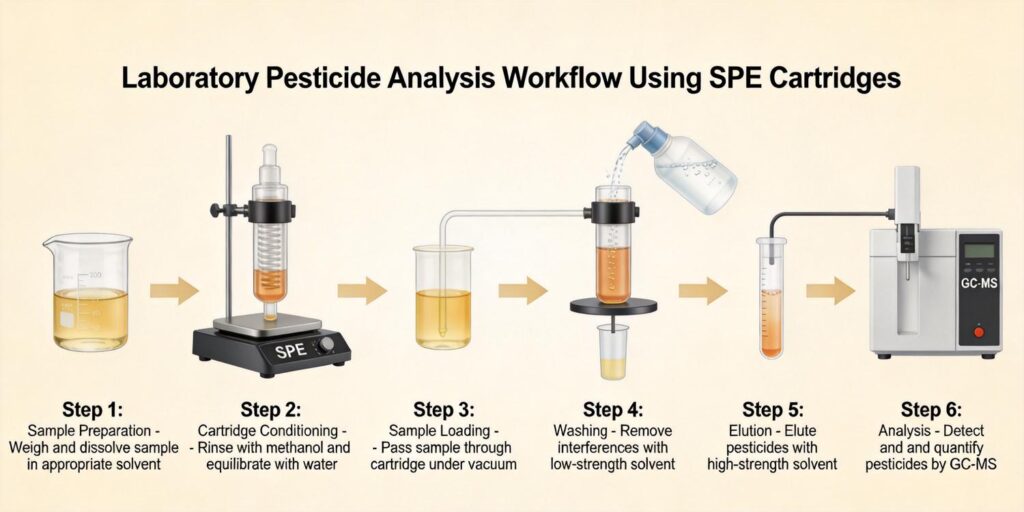
A comprehensive SPE workflow for honey pesticide analysis typically involves the following steps:
Sample Preparation
- Honey Dissolution: Weigh 5-10g of honey into a centrifuge tube and dissolve in 20-30mL of water or aqueous buffer. For better dissolution, gentle heating (40-50°C) and vortex mixing can be employed.
- pH Adjustment: Adjust the sample pH according to target pesticide properties. For acidic pesticides, pH should be below their pKa values; for basic pesticides, pH should be above their pKa values.
- Filtration: Filter the solution through a 0.45μm membrane to remove particulate matter.
SPE Procedure
- Cartridge Conditioning: Condition the selected SPE cartridge (typically 500mg sorbent mass) with 5-10mL of methanol followed by 5-10mL of water or buffer matching the sample pH.
- Sample Loading: Load the honey solution at a controlled flow rate (1-5mL/min) to ensure optimal retention. For high-throughput applications, 96-well SPE plates can be used.
- Washing: Wash the cartridge with 5-10mL of water or aqueous buffer containing 5-10% methanol to remove sugars and other polar interferences while retaining pesticides.
- Drying: Apply vacuum or positive pressure to dry the cartridge completely (15-30 minutes) to remove residual water.
- Elution: Elute pesticides with appropriate organic solvent(s). Common elution solvents include methanol, acetonitrile, ethyl acetate, or mixtures with modifiers. For mixed-mode sorbents, elution typically requires solvents with pH adjustment to disrupt ionic interactions.
Post-SPE Treatment
- Concentration: Evaporate the eluate to near dryness under gentle nitrogen stream at 30-40°C.
- Reconstitution: Reconstitute in appropriate solvent compatible with the analytical method (typically 100-500μL of methanol-water or acetonitrile-water mixtures).
- Filtration: Filter through a 0.2μm syringe filter before analysis.
LC-MS/MS Detection Strategies
Liquid chromatography coupled with tandem mass spectrometry (LC-MS/MS) has become the gold standard for pesticide residue analysis in complex matrices like honey. The following strategies optimize detection:
Chromatographic Separation
Reverse-phase chromatography using C18 or equivalent columns provides adequate separation for most pesticides. Gradient elution with water and methanol or acetonitrile (both containing 0.1% formic acid or ammonium formate) allows separation of pesticides with diverse polarities. The addition of buffer salts can improve peak shape for certain pesticide classes.
Mass Spectrometry Parameters
Electrospray ionization (ESI) in positive or negative mode, depending on pesticide properties, provides optimal sensitivity. Multiple Reaction Monitoring (MRM) transitions should be optimized for each target pesticide, including at least two transitions for confirmation. The use of scheduled MRM improves sensitivity and reduces data file sizes.
Matrix Effects Management
Matrix effects, particularly ion suppression or enhancement, are significant challenges in honey analysis. Strategies to mitigate matrix effects include:
- Use of matrix-matched calibration standards
- Standard addition method
- Post-column infusion for matrix effect assessment
- Dilution of extracts when sensitivity allows
- Use of isotope-labeled internal standards
Quality Control Measures
Implement comprehensive quality control including method blanks, fortified samples, duplicate analyses, and participation in proficiency testing programs. The inclusion of surrogate standards added before extraction monitors extraction efficiency throughout the analytical process.
Food Safety Monitoring and Regulatory Compliance
Effective pesticide residue monitoring in honey requires integration of analytical methods with food safety management systems:
Regulatory Framework
Maximum Residue Limits (MRLs) for pesticides in honey vary by country and region. The European Union, Codex Alimentarius, and national authorities establish specific limits that laboratories must meet. Analytical methods must demonstrate adequate sensitivity (typically 0.01-0.05 mg/kg) and selectivity to ensure compliance monitoring.
Monitoring Programs
National and international monitoring programs systematically analyze honey samples for pesticide residues. These programs help identify contamination sources, track trends, and inform regulatory decisions. The data generated also supports risk assessment and management activities.
Method Validation
All analytical methods for pesticide residue analysis in honey must undergo rigorous validation according to international guidelines (e.g., SANTE/11312/2021). Validation parameters include:
- Linearity and working range
- Limit of detection and quantification
- Accuracy (recovery)
- Precision (repeatability and reproducibility)
- Selectivity/specificity
- Robustness
Future Trends
The field of pesticide residue analysis in honey continues to evolve with several emerging trends:
- High-resolution mass spectrometry for non-target screening
- Automated sample preparation systems
- Miniaturized extraction techniques
- Increased use of multi-residue methods covering hundreds of pesticides
- Integration of data management systems for improved traceability
As analytical capabilities advance, so too does our ability to ensure honey safety and quality. The combination of optimized SPE techniques with sensitive detection methods provides laboratories with powerful tools for protecting consumer health and supporting sustainable beekeeping practices.
For laboratories seeking reliable SPE solutions for honey analysis, Poseidon Scientific offers a comprehensive range of HLB SPE cartridges, MAX SPE cartridges, MCX SPE cartridges, WAX SPE cartridges, WCX SPE cartridges, and 96-well SPE plates designed to meet the specific challenges of complex food matrices.