
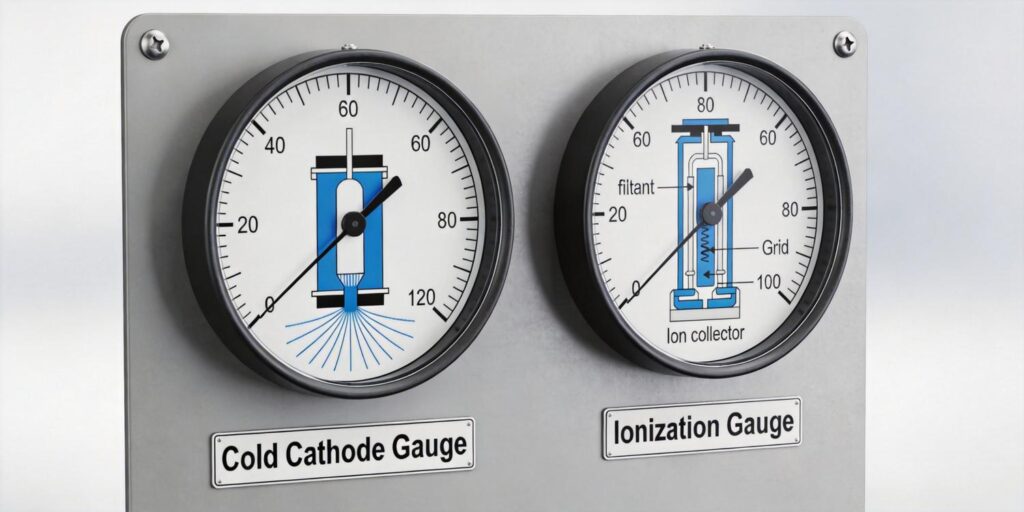
Measurement Principle Comparison
Understanding the fundamental operating physics of vacuum gauges is essential for selecting the right instrument for high-vacuum applications. Cold cathode gauges, such as Poseidon Scientific’s VG-SM225, rely on the Penning discharge (or magnetron discharge) principle. A high voltage (typically −2000 V after startup at −2500 V) applied between a cylindrical anode and axial cathode, combined with an axial magnetic field of approximately 100 gauss from a neodymium magnet, causes electrons to follow extended spiral trajectories. These electrons collide with residual gas molecules, generating positive ions through avalanche ionization. The resulting ion current collected at the cathode is proportional to gas density (and thus pressure) once the self-sustaining discharge is established.
In contrast, hot cathode ionization gauges (commonly referred to simply as “ionization gauges”) use thermionic emission from a heated filament (typically tungsten or thoriated iridium) to produce electrons. These electrons are accelerated toward a grid anode, ionizing gas molecules along their path. The positive ions are collected on a negatively biased electrode, and the ion current is again proportional to pressure. The classic Bayard-Alpert design adds a fine wire collector to minimize X-ray-induced photoelectrons that limit low-pressure performance.
The key distinction is energy source: cold cathode gauges use field emission and crossed E×B fields with no heated component, while hot cathode gauges depend on a continuously powered filament operating at 1000–2000 °C. This fundamental difference drives downstream variations in reliability, contamination sensitivity, and measurement behavior.
Pressure Range Overlap and Practical Limits
Both technologies cover the high-vacuum regime, but their usable ranges and accuracy bands differ significantly. Poseidon Scientific’s VG-SM225 Cold Cathode Gauge is optimized for 10⁻³ Torr down to 10⁻⁷ Torr, with best linearity and repeatability in the 10⁻⁴ to 10⁻⁶ Torr band. Below 10⁻³ Torr the discharge becomes unstable without software protection; above this threshold, excessive ion bombardment leads to rapid electrode contamination.
Hot cathode ionization gauges typically span 10⁻² Torr to 10⁻¹⁰ Torr or lower, with the Bayard-Alpert type achieving reliable measurements down to the 10⁻¹¹ Torr region before the X-ray limit becomes dominant. In the overlapping 10⁻³ to 10⁻⁷ Torr window—common in analytical instruments, vacuum coating, and high-vacuum furnaces—both can be used, but cold cathode gauges offer simpler operation without filament lifetime concerns, while hot cathode units provide potentially higher resolution when properly degassed and shielded from light.
For most industrial and OEM applications in this range, the cold cathode’s robust discharge stability outweighs the marginal precision advantage of hot cathode designs, especially when cost and uptime are prioritized.
Cost and Complexity Differences
Cost and system integration complexity strongly favor cold cathode technology for OEM applications. A typical hot cathode ionization gauge system requires a stable filament power supply (often 40–100 W), precise emission current regulation, and additional electronics to compensate for X-ray and electron-stimulated desorption effects. Total ownership cost is elevated by frequent filament replacements and more elaborate vacuum interlocks.
The VG-SM225 Cold Cathode Gauge, by contrast, uses a simple high-voltage supply that auto-switches from startup to operating voltage, integrated temperature compensation, and a compact positive-magnetron structure. Poseidon Scientific’s self-developed design achieves volume production costs 40–60% lower than equivalent imported cold cathode or hot cathode units while delivering equivalent performance. The gauge ships with standard 0–10 V analog and customizable RS232 digital outputs, enabling direct PLC integration without additional signal conditioners. This simplicity reduces both initial capital expenditure and ongoing integration engineering time for OEMs.
Maintenance Requirements: Field Serviceability vs. Fragility
Maintenance is where cold cathode gauges demonstrate clear superiority for long-term reliability. Hot cathode gauges suffer from filament burnout (typical life 6–24 months depending on pressure and gas exposure), outgassing from the hot filament itself, and sensitivity to contamination that can shift calibration. Replacing a filament often requires full gauge disassembly, re-calibration, and system bake-out.
The VG-SM225’s modular sensor head can be removed without breaking the vacuum seal on the process side. Electrode cleaning—using 500-mesh or 200-mesh abrasive paper to restore metallic luster—takes minutes in the field and restores performance without factory return. No filament exists to burn out, eliminating the most common failure mode of hot cathode designs. Poseidon recommends annual visual checks via the built-in status LED and electrode polishing every 12–24 months in typical service, extending mean time between interventions far beyond hot cathode norms.
Both technologies require periodic verification against a reference standard, but the cold cathode’s design minimizes downtime and labor, making it the preferred choice for OEM service teams supporting 24/7 production lines.
Application Suitability: Where Each Technology Excels
Application suitability depends on process environment, required uptime, and tolerance for maintenance. Cold cathode gauges like the VG-SM225 are ideal for:
- Scientific instruments (mass spectrometers, SEMs) where compact size and magnetic compatibility matter
- Vacuum heat treatment and annealing furnaces requiring robust operation in moderately contaminated atmospheres
- High-vacuum coating systems tolerant of occasional electrode cleaning
Hot cathode ionization gauges remain preferred in ultra-clean, ultra-high-vacuum research chambers where the lowest possible base pressure (below 10⁻⁹ Torr) and highest resolution are non-negotiable, provided rigorous filament management and frequent bake-outs are feasible.
Poseidon Scientific’s positive-magnetron cold cathode design further differentiates itself with smaller footprint than many inverted-magnetron competitors, making it the practical choice for space-constrained OEM integrations where hot cathode complexity would add unnecessary risk.
Ignition Characteristics and Operational Reliability
Ignition behavior is a critical differentiator at the lowest pressures. Hot cathode gauges ignite instantly once the filament reaches operating temperature. Cold cathode gauges, however, rely on random field emission or cosmic-ray seeding to initiate the Penning discharge. At 10⁻⁶ Torr the VG-SM225 typically starts within 5 minutes; at 10⁻⁷ Torr startup may require up to 30 minutes. The gauge mitigates this with an automatic high-voltage boost during startup, followed by reduction to normal operating voltage to prevent excessive sputtering.
Built-in protection circuitry automatically shuts off high voltage if pressure exceeds 10⁻³ Torr, preventing damage from excessive current. Status LEDs provide immediate visual feedback—steady green for normal operation, flashing for high-voltage off or startup in progress—giving operators clear diagnostics without additional test equipment. These features make cold cathode gauges far more forgiving in production environments where hot cathode filaments could be damaged by sudden pressure spikes or power interruptions.
Selection Matrix: Cold Cathode vs. Hot Cathode Ionization Gauges
| Criterion | Cold Cathode (VG-SM225) | Hot Cathode Ionization Gauge |
|---|---|---|
| Measurement Principle | Penning/magnetron discharge (no filament) | Thermionic emission + ionization |
| Typical Range | 10⁻³ to 10⁻⁷ Torr | 10⁻² to 10⁻¹⁰ Torr (or lower) |
| Repeatability (typical) | ±10% in operating band | ±5% when properly degassed |
| Startup Time at 10⁻⁷ Torr | 5–30 minutes | Instant (after filament warm-up) |
| Maintenance Interval | 12–24 months (electrode clean) | 6–12 months (filament replacement) |
| Cost per Unit (OEM volume) | Low (self-developed) | Higher (filament + power supply) |
| Contamination Tolerance | High (field cleanable) | Low (filament sensitive) |
| Outgassing Contribution | Negligible | Significant from hot filament |
| Best Applications | Industrial, OEM, instrumentation | Ultra-clean UHV research |
Conclusion: Making the Right Choice for High-Vacuum Applications
When comparing cold cathode gauges to traditional hot cathode ionization gauges, the decision hinges on balancing precision, reliability, maintenance burden, and total cost of ownership. For the majority of industrial and OEM high-vacuum applications in the 10⁻³ to 10⁻⁷ Torr range, the cold cathode approach—exemplified by Poseidon Scientific’s VG-SM225—delivers superior uptime, lower lifetime cost, and simpler integration without sacrificing essential measurement performance.
Engineers and procurement teams evaluating vacuum instrumentation benefit from understanding these trade-offs rather than defaulting to legacy hot cathode solutions. The VG-SM225’s compact positive-magnetron design, field-serviceable architecture, and customizable communication protocols make it the modern, cost-effective choice for repeatable high-vacuum monitoring.
Need help selecting the optimal gauge for your specific high-vacuum process? Contact Poseidon Scientific today for a no-obligation application review or high-vacuum consultation. Our team, with direct experience designing both Pirani and cold cathode solutions, will recommend the right combination—whether the VG-SM225 Cold Cathode Vacuum Gauge for your primary high-vacuum needs or the complementary VG-SP205 Pirani Vacuum Transmitter for roughing-stage monitoring.
Explore full specifications of the VG-SM225 Cold Cathode Vacuum Gauge and discover how reliable, low-maintenance high-vacuum measurement can improve your process repeatability and reduce total ownership costs.


