Groundwater Contamination Concerns
Groundwater serves as a primary drinking water source for billions worldwide, making its protection from anthropogenic contaminants a critical public health and environmental priority. The infiltration of pharmaceutical residues into groundwater systems represents a growing concern, as these biologically active compounds can persist and migrate through subsurface aquifers. Unlike industrial pollutants, pharmaceuticals are designed to be stable and bioactive at low concentrations, raising unique challenges for environmental monitoring and risk assessment.
The pathway to contamination typically begins with human and veterinary drug use, followed by incomplete removal during wastewater treatment. Treated effluent discharged to surface waters can infiltrate groundwater, while land application of biosolids or manure provides another contamination route. Once in groundwater, pharmaceutical residues can travel significant distances due to their moderate to high water solubility and resistance to biodegradation in oxygen-limited subsurface environments.
Target Pharmaceutical Residues
Monitoring programs typically focus on pharmaceutical classes with known environmental persistence, high usage volumes, and potential ecological or human health effects. Key target compounds include:
Antibiotics and Antimicrobials
Sulfonamides, tetracyclines, fluoroquinolones, and macrolides are frequently detected due to their extensive use in human medicine and animal agriculture. These compounds raise concerns about promoting antibiotic resistance in environmental bacteria.
Analgesics and Anti-inflammatories
Ibuprofen, diclofenac, naproxen, and acetaminophen are among the most commonly detected pharmaceuticals in groundwater worldwide, reflecting their high consumption rates and incomplete removal during wastewater treatment.
Psychiatric Drugs
Antidepressants (fluoxetine, sertraline), antiepileptics (carbamazepine), and benzodiazepines demonstrate particular persistence in aquatic environments and have been shown to affect aquatic organisms at environmentally relevant concentrations.
Lipid Regulators and Beta-Blockers
Compounds like bezafibrate, clofibric acid, and atenolol are frequently targeted due to their polar nature and resistance to degradation.
Contrast Media and Hormones
Iodinated X-ray contrast media (iopromide, iomeprol) and synthetic hormones (ethinylestradiol) represent particularly challenging analytes due to their high polarity and biological activity at extremely low concentrations.
SPE Enrichment Techniques for Trace Detection
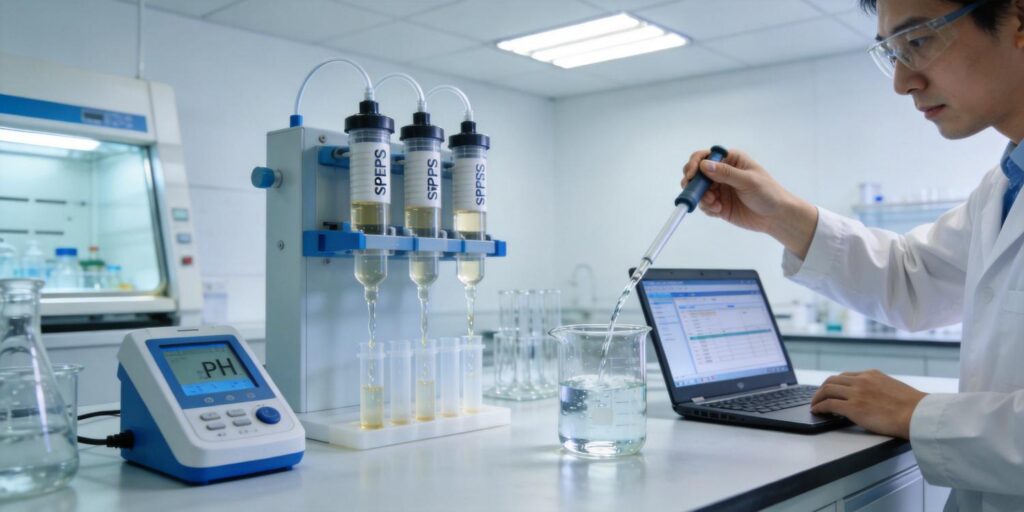
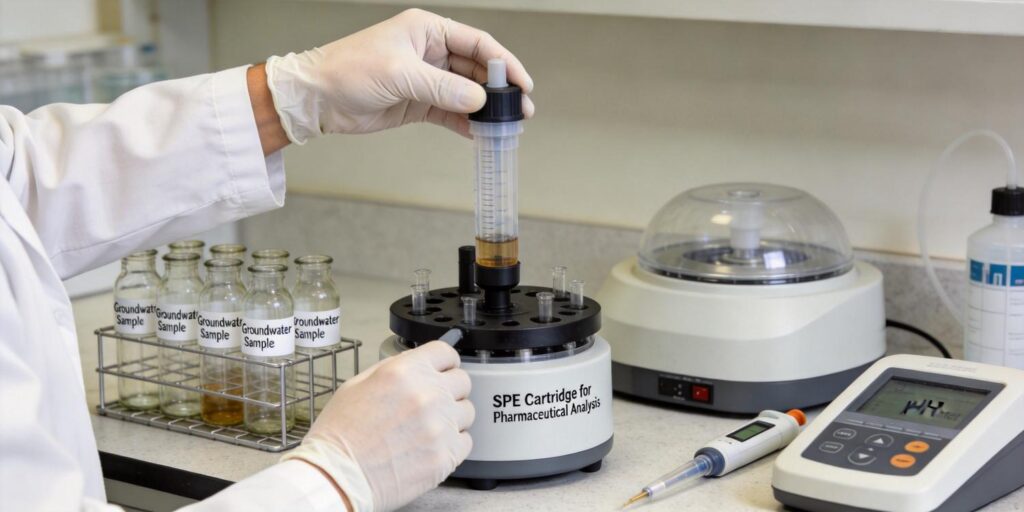
Solid-phase extraction (SPE) has become the cornerstone technique for concentrating trace pharmaceutical residues from large-volume groundwater samples. As noted in SPE literature, “the trace enrichment aspect of SPE lends itself very well to the extraction of liquids, especially clean samples such as drinking water or groundwater” (Simpson, 2000). The fundamental advantage of SPE over traditional liquid-liquid extraction lies in its ability to process large sample volumes (typically 0.5-2 liters) while achieving concentration factors of 1000-fold or greater.
SPE Mode Selection
For pharmaceutical enrichment, analyte adsorption mode is universally employed, where target compounds are retained on the sorbent while matrix components pass through. This approach provides both preconcentration and cleanup benefits, yielding “cleaner extracts” suitable for sensitive analytical detection (Agilent SPE Guide).
Sorbent Chemistry Optimization
The selection of appropriate SPE sorbent chemistry is critical for successful pharmaceutical enrichment:
Reversed-Phase Sorbents (C18, C8, HLB)
Hydrophilic-lipophilic balanced (HLB) polymers have revolutionized pharmaceutical extraction by providing superior retention for both polar and non-polar compounds without requiring pH adjustment. These water-wettable sorbents maintain high capacity even when run dry, making them ideal for large-volume groundwater applications.
Mixed-Mode Sorbents (MCX, MAX, WAX, WCX)
For basic or acidic pharmaceuticals, mixed-mode sorbents combining reversed-phase and ion-exchange mechanisms offer enhanced selectivity. Cation-exchange sorbents (MCX) effectively retain basic drugs like many antidepressants and beta-blockers, while anion-exchange sorbents (MAX, WAX) target acidic compounds such as NSAIDs and some antibiotics.
Specialty Sorbents
For particularly challenging analytes, specialty sorbents including molecularly imprinted polymers (MIPs) and immunosorbents provide exceptional selectivity, though at higher cost and with more limited analyte scope.
Method Development Considerations
Successful SPE method development for groundwater pharmaceuticals requires systematic optimization of several parameters:
Sample pH Adjustment: Controlling sample pH is crucial for maximizing retention of ionizable pharmaceuticals. Basic compounds are typically extracted at pH > pKa + 2, while acidic compounds are extracted at pH < pKa – 2.
Flow Rate Optimization: Maintaining controlled flow rates (typically 5-10 mL/min) ensures adequate contact time between analytes and sorbent, maximizing recovery while minimizing breakthrough.
Wash Solvent Selection: Careful selection of wash solvents (typically 5-10% methanol in water) removes weakly retained matrix components without eluting target analytes.
Elution Optimization: Using minimal volumes of strong elution solvents (methanol, acetonitrile, often acidified or basified) ensures complete analyte recovery while maintaining high concentration factors.
Example Large-Volume Groundwater Extraction Workflow
A robust SPE workflow for pharmaceutical analysis in groundwater typically follows these optimized steps:
1. Sample Collection and Preservation
Collect 1-liter groundwater samples in pre-cleaned amber glass bottles, adding sodium thiosulfate to quench residual chlorine (if present) and adjusting to pH 2-3 with hydrochloric acid to stabilize acid-labile compounds. Store at 4°C and extract within 7 days.
2. SPE Cartridge Preparation
Condition 200 mg HLB or mixed-mode cartridges sequentially with 5 mL methanol and 5 mL acidified water (pH 2-3). Maintain a small solvent head to prevent drying.
3. Sample Loading
Pass 500-1000 mL of filtered (0.45 μm) groundwater through the cartridge at 5-10 mL/min using a vacuum manifold or positive pressure. For particularly clean groundwater, larger volumes may be processed to achieve lower detection limits.
4. Cartridge Washing
Wash with 5-10 mL of 5% methanol in acidified water to remove salts and weakly retained matrix components. Dry cartridges under vacuum for 5-10 minutes to remove residual water.
5. Analyte Elution
Elute pharmaceuticals with 2 × 5 mL aliquots of methanol or acetonitrile, collecting eluate in a calibrated tube. For mixed-mode sorbents, appropriate pH adjustment of elution solvent is critical (e.g., 5% ammonia in methanol for MCX).
6. Extract Concentration
Concentrate eluate to near dryness under gentle nitrogen stream at 30-40°C, then reconstitute in 100-500 μL of initial mobile phase compatible with subsequent LC-MS/MS analysis.
7. Quality Control
Include procedural blanks, matrix spikes, and surrogate standards (deuterated analogs of target analytes) to monitor extraction efficiency and method performance.
LC-MS/MS Analysis
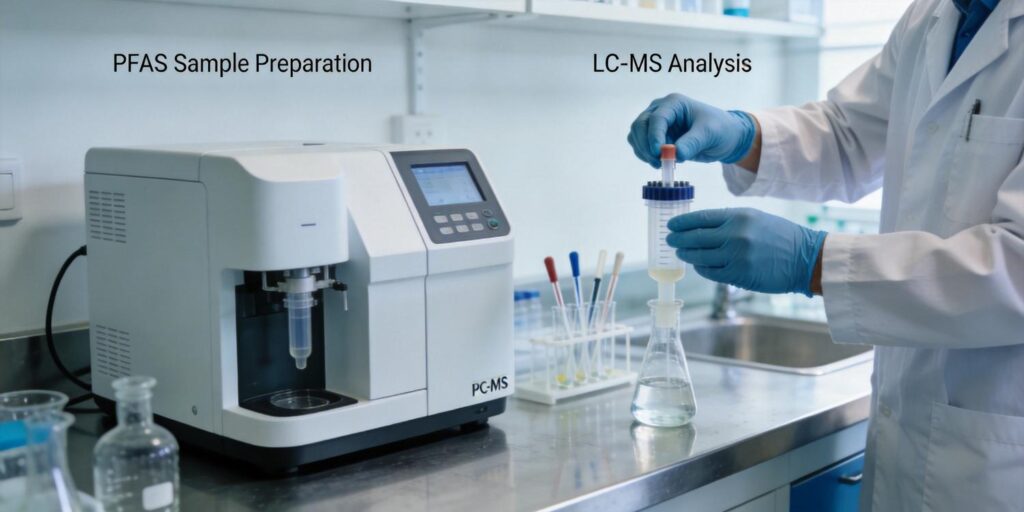
Liquid chromatography coupled with tandem mass spectrometry (LC-MS/MS) represents the gold standard for pharmaceutical analysis in environmental samples, offering the sensitivity, selectivity, and confirmatory power required for trace-level detection.
Chromatographic Separation
Reversed-phase chromatography using C18 or polar-embedded stationary phases provides adequate separation for most pharmaceutical mixtures. Mobile phases typically consist of water and methanol or acetonitrile, with additives such as formic acid or ammonium acetate to enhance ionization.
Mass Spectrometric Detection
Electrospray ionization (ESI) in positive or negative mode, combined with multiple reaction monitoring (MRM), enables detection limits in the low ng/L range. Two or more MRM transitions per compound provide both quantitative data and confirmatory identification.
Method Validation
Comprehensive validation including linearity (typically 1-500 ng/L), accuracy (80-120% recovery), precision (<15% RSD), method detection limits (0.1-10 ng/L), and matrix effects assessment ensures reliable quantitative results.
Environmental Monitoring Implications
The development of sensitive SPE-LC-MS/MS methods for pharmaceutical analysis in groundwater has profound implications for environmental monitoring and regulation:
Early Warning Systems
Routine monitoring of groundwater sources for pharmaceutical residues can serve as an early warning system for wastewater contamination, allowing for timely intervention before widespread aquifer contamination occurs.
Source Tracking
Pharmaceutical “fingerprints” can help identify contamination sources, distinguishing between wastewater effluent, agricultural runoff, and landfill leachate inputs to groundwater systems.
Risk Assessment Refinement
Accurate concentration data enable more realistic environmental risk assessments, considering both individual compounds and potential mixture effects that may occur in contaminated groundwater.
Treatment Optimization
Monitoring data inform the design and optimization of water treatment processes, both at wastewater treatment plants and drinking water facilities, to enhance pharmaceutical removal.
Regulatory Development
As analytical capabilities improve, regulatory frameworks are evolving to address pharmaceutical contaminants in water. The EU Watch List mechanism and US EPA’s Contaminant Candidate List include several pharmaceuticals for monitoring and potential regulation.
The integration of advanced SPE techniques with sensitive LC-MS/MS detection has transformed our ability to monitor pharmaceutical residues in groundwater at environmentally relevant concentrations. As analytical methods continue to improve and monitoring programs expand, we gain increasingly detailed understanding of pharmaceutical fate and transport in subsurface environments, informing both regulatory decisions and remediation strategies to protect this vital resource.
For laboratories implementing groundwater pharmaceutical monitoring, selecting appropriate HLB SPE cartridges for broad-spectrum extraction or MCX mixed-mode cartridges for basic compounds can significantly enhance method performance and reliability. High-throughput applications may benefit from 96-well SPE plates for increased sample processing efficiency.