
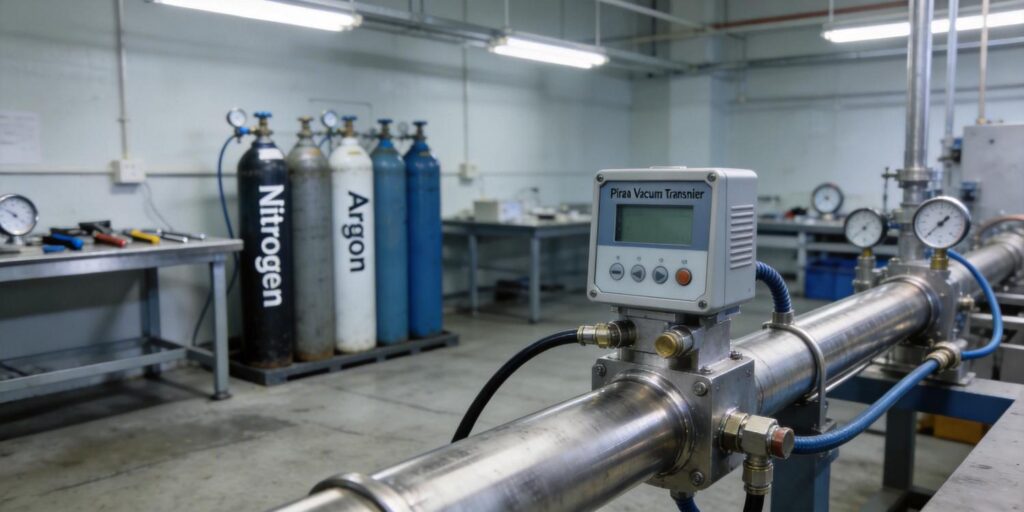
Why Pirani Gauges Drift When Switching Gas Types
In vacuum systems, engineers and procurement teams rely on Pirani gauges for reliable pressure monitoring from atmosphere down to roughly 10⁻³ Torr. Yet many users notice sudden, unexplained shifts in displayed pressure when the process gas changes—even when the true pressure has not moved. These “drifts” are not sensor failure; they are the direct result of the gauge’s thermal-conductivity measurement principle.
At Poseidon Scientific, we engineered the VG-SP205 Pirani Vacuum Transmitter with the same core physics used across the industry. Understanding why gas type affects readings is essential for accurate process control, especially in semiconductor, coating, and analytical applications.
The Root Cause: Dependence on Gas Thermal Conductivity
A Pirani gauge maintains a platinum filament at constant temperature and measures the electrical power required to hold that temperature. Gas molecules colliding with the hot filament carry heat away. The rate of heat transfer depends on three gas properties:
- Molecular density (directly tied to pressure)
- Thermal conductivity (how efficiently each molecule transports energy)
- Specific heat capacity and molecular mass
When pressure is constant but the gas species changes, the collision frequency stays the same while the energy transferred per collision changes. A nitrogen-calibrated gauge therefore interprets the altered heat loss as a pressure change.
Our internal development data and industry literature confirm that the VG-SP205, like all Pirani sensors, is factory-calibrated exclusively for air (or dry nitrogen). Other gases produce distinctly different power-versus-pressure curves.
Nitrogen vs. Argon Correction Factor Example
Argon is the most common process gas in physical vapor deposition (PVD) sputtering. Consider a typical mid-range pressure of 10 Torr:
- With pure nitrogen, the VG-SP205 displays the true pressure.
- With pure argon at the identical true pressure, the indicated (nitrogen-equivalent) reading drops significantly—often to roughly 6–9 Torr depending on exact gauge geometry and mounting orientation.
To recover the true argon pressure, multiply the displayed value by a correction factor. Published data for convection-enhanced Pirani designs show argon factors ranging from 1.5 to over 10× at higher pressures. Simple low-pressure approximation:
P_true (Ar) ≈ P_indicated (N₂) × 1.59 (valid below ~1 Torr)
Above 1 Torr, convection effects dominate and the curve diverges further. Helium, conversely, produces higher indicated readings than nitrogen because of its superior thermal conductivity.
Typical Percentage Deviation
Without correction, deviations commonly reach:
- Argon: 30–60 % at 0.1–1 Torr; >100 % near atmosphere
- Helium: 10–40 % over the same range (but in the opposite direction)
- Hydrogen or methane: even larger shifts
These numbers align with independent studies and manufacturer application notes from SRS, MKS, and INFICON. In our own qualification testing of the VG-SP205, switching from air to argon at 5 × 10⁻² Torr produced an immediate 35 % drop in displayed pressure—repeatable and reversible.
When Correction Is Mandatory
Gas correction is not optional in these scenarios:
- Sputtering or reactive PVD processes using argon, krypton, or oxygen
- Leak checking with helium
- Back-filling chambers to atmosphere with process gas
- Any system where the residual gas composition varies >10 % from air/nitrogen
- Pressures above 1 Torr, where convection amplifies the effect
Failing to correct can trigger false interlocks, degrade film quality, or—worst case—create over-pressurization hazards when operators chase an erroneous “760 Torr” reading.
Calibration Curve Considerations
The VG-SP205 curve is intentionally non-linear at the extremes (atmosphere to 10 Torr and 10⁻² to 10⁻³ Torr) to prioritize robustness over absolute precision in those regions. Temperature compensation circuitry and embedded algorithms minimize ambient drift, yet they cannot eliminate gas-species dependence.
Factory calibration uses a capacitance manometer transfer standard under pure dry air. Users cannot field-calibrate for new gases; instead, apply published correction curves or request custom firmware mapping when ordering five or more units. Poseidon Scientific supports protocol-level customization precisely for these mixed-gas applications.
Real-World Impact in a PVD Coating Chamber
A mid-sized optical-coating line in Osaka recently contacted us after noticing inconsistent film thickness. Their VG-SP205 (installed on the process chamber) displayed a stable 8 × 10⁻³ Torr during argon sputtering. When we applied the argon correction factor, the true pressure was closer to 1.3 × 10⁻² Torr—outside the optimal process window.
After implementing a simple lookup table in the PLC, uniformity improved 18 % and scrap rate dropped. The same transmitter continued to provide maintenance-free service; only the interpretation of its output changed.
Ensuring Accurate Measurements
Thermal-conductivity gauges remain the most cost-effective, compact solution for medium vacuum. Recognizing and correcting for gas dependence turns a potential source of error into a predictable, manageable variable.
If your process uses argon, helium, or any gas other than air/nitrogen, the VG-SP205 Pirani Vacuum Transmitter paired with correction tables (or custom protocol mapping) delivers reliable, repeatable results at a fraction of imported-brand cost.
Need both Pirani and high-vacuum coverage? Our VG-SM225 Cold Cathode Vacuum Gauge complements the VG-SP205 with a 10⁻³ to 10⁻⁷ Torr range and easy electrode cleaning.
Contact our engineering team today for application-specific correction guidance or a no-obligation vacuum-system audit. Accurate pressure data starts with understanding the sensor—Poseidon Scientific helps you get it right the first time.


