Pharmaceutical Contamination in Aquatic Sediments
Pharmaceutical residues in river sediments represent a growing environmental concern with significant implications for ecosystem health. As wastewater treatment plants discharge effluents containing unmetabolized drugs and their transformation products, these compounds accumulate in sediment matrices where they can persist for extended periods. The hydrophobic nature of many pharmaceutical compounds facilitates their adsorption to sediment particles, creating long-term reservoirs of contamination that can impact benthic organisms and potentially re-enter the water column through resuspension events.
Environmental matrices like river sediments present unique analytical challenges due to their complex composition. According to research on environmental applications of SPE, sediment samples contain both particulate matter (PM) and dissolved organic matter (DOM), including humic and fulvic acids that can bind to pharmaceutical residues. This binding affects both the bioavailability of contaminants and their extractability during analytical procedures. The presence of natural organic matter (NOM) is particularly relevant because it can complicate environmental analyses by changing the retention properties of bound analytes compared to free analytes.
Sediment Extraction Methods
Ultrasonic Extraction
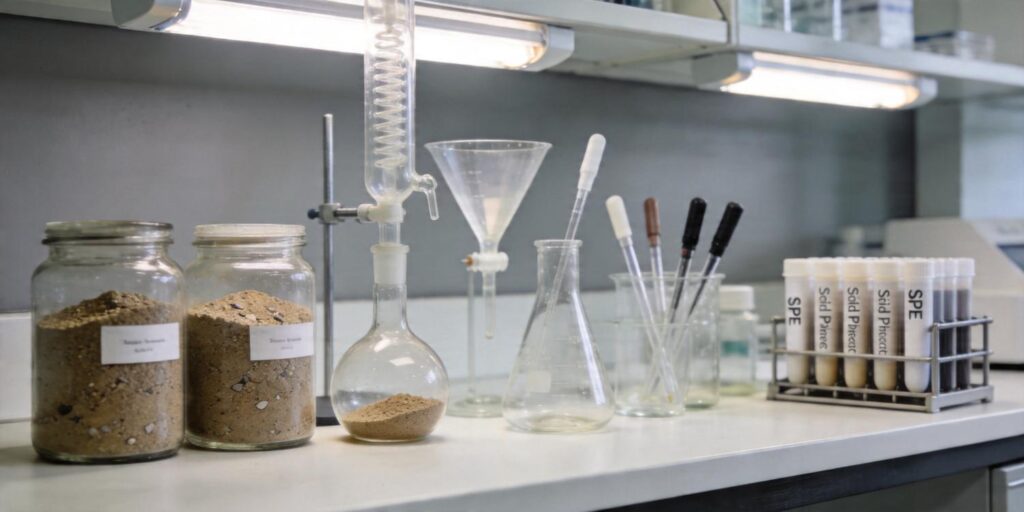
Ultrasonic extraction remains a popular choice for sediment analysis due to its simplicity and effectiveness. This technique utilizes high-frequency sound waves to disrupt sediment particles and release bound pharmaceutical residues into the extraction solvent. The cavitation bubbles generated during sonication create localized high temperatures and pressures that enhance analyte desorption from sediment matrices. Typical extraction solvents include methanol, acetonitrile, or mixtures with water, often acidified to improve recovery of acidic pharmaceuticals.
For optimal results, sediment samples should be dried and homogenized prior to extraction. The extraction efficiency depends on several factors including solvent composition, extraction time, temperature, and sediment-to-solvent ratio. Multiple extraction cycles may be necessary to achieve quantitative recovery of strongly bound residues. However, ultrasonic extraction often co-extracts significant amounts of interfering compounds, necessitating thorough cleanup before analysis.
Accelerated Solvent Extraction (ASE)
Accelerated Solvent Extraction, also known as Pressurized Liquid Extraction (PLE), represents a more sophisticated approach to sediment extraction. ASE operates at elevated temperatures (typically 40-200°C) and pressures (1500-2000 psi), which significantly improves extraction efficiency while reducing solvent consumption and extraction time compared to traditional methods.
The high temperature increases analyte solubility and diffusion rates, while the elevated pressure keeps solvents in liquid state above their normal boiling points. This combination allows for more complete extraction of pharmaceutical residues from sediment matrices. ASE systems can be automated, providing excellent reproducibility and throughput for environmental monitoring programs. The technique is particularly effective for extracting non-polar pharmaceuticals that strongly adsorb to organic matter in sediments.
When applying ASE to sediment samples, careful optimization of parameters is essential. Temperature must be balanced between improved extraction efficiency and potential analyte degradation. Static extraction times typically range from 5-15 minutes, with multiple cycles often employed. The choice of extraction solvent depends on the target pharmaceutical classes, with methanol, acetonitrile, and their mixtures with water being common choices.
SPE Cleanup for Removing Humic Substances
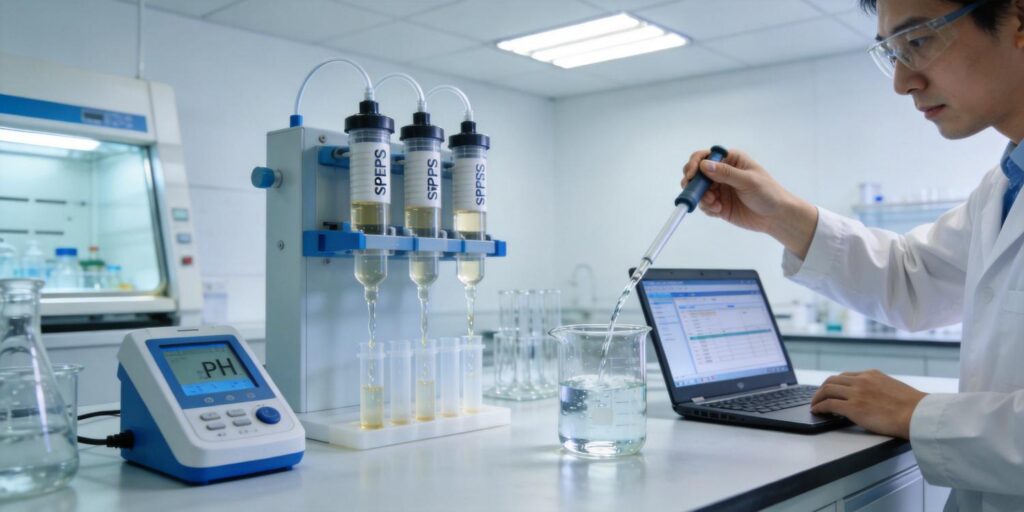
Following sediment extraction, the resulting extracts typically contain significant amounts of co-extracted humic substances that can interfere with subsequent analysis. Solid-phase extraction provides an effective cleanup strategy for removing these matrix interferences. The SPE strategy generally comprises the isolation (and concentration) of the analytes from a complex matrix by adsorption onto an appropriate sorbent, the removal of interfering impurities by washing with a suitable solvent system, and then the selective recovery of the retained analytes with a modified solvent system of suitable elution strength.
Research by Nakamura et al. (1996) established important guidelines for SPE behavior in the presence of humic acid. Their study found that the recovery of chemicals having a log Pow below about 4 when alkyl-bonded silicas were used for SPE, or below 3 when a polystyrene sorbent was used for SPE, were not influenced by the presence of 1 ppm of humic acid. The recoveries of analytes having higher partition coefficients decreased, although the decrease was less remarkable for the polystyrene sorbent.
In addition to reducing recovery, dissolved organic carbon (DOC) may also hamper quantitation by co-extracting with the analytes and by enhancing the “matrix effect” that results in spuriously high signals. Several approaches have been developed to address humic interference:
- Graphitized Carbon Black: Altenbach and Giger (1995) adopted an approach using strongly positively charged, graphitized carbon black for determination of benzene and naphthalene sulfonates in wastewater. By this technique, negatively charged humic substances were permanently retained and found to be almost absent in the final extracts.
- Chemical Oxidation: Bonifazi et al. (1994) approached the problem by destroying humic acids prior to SPE to obtain good recovery of polychlorinated dibenzodioxins (PCDDs) and polychlorinated dibenzofurans (PCDFs). Samples acidified with sulfuric acid were treated with potassium permanganate to oxidize humic substances, with excess permanganate reduced with hydrogen peroxide.
- Mixed-mode Sorbents: Modern SPE cartridges combining reversed-phase and ion-exchange mechanisms can selectively retain pharmaceutical residues while allowing humic substances to pass through during washing steps.
For environmental samples containing particulates, prefiltering samples prior to SPE in a standard manner to remove suspended solids is recommended. Glass-fiber filter discs (0.45 μm) having no organic binders should be used, though the analytes of interest should be tested for their adsorption potential on the selected filter.
Sorbent Selection for Pharmaceutical Compounds
The choice of SPE sorbent is critical for successful pharmaceutical residue analysis from sediment extracts. Different pharmaceutical classes require specific sorbent chemistries based on their physicochemical properties:
Reversed-Phase Sorbents (C18, C8, HLB)
Reversed-phase sorbents are ideal for non-polar to moderately polar pharmaceutical compounds. C18 (octadecylsilane) provides strong retention for hydrophobic pharmaceuticals like steroids, certain antibiotics, and lipid-regulating drugs. For more polar compounds, C8 or mixed-mode sorbents like hydrophilic-lipophilic balanced (HLB) polymers offer better recovery. HLB sorbents, which combine hydrophilic N-vinylpyrrolidone and lipophilic divinylbenzene monomers, provide excellent retention across a wide polarity range without requiring pH adjustment.
According to SPE technology principles, the recovery of analytes from environmental matrices depends significantly on their log Pow values. For alkyl-bonded silica sorbents, analytes with log Pow above 4 may experience reduced recovery in the presence of humic substances, while for polystyrene sorbents, this threshold is approximately log Pow 3.
Ion-Exchange Sorbents (WCX, WAX, SCX, SAX)
Ion-exchange sorbents are essential for pharmaceutical compounds that exist as ions at environmental pH. Weak cation exchange (WCX) and strong cation exchange (SCX) sorbents effectively retain basic pharmaceuticals like antibiotics (fluoroquinolones, macrolides) and β-blockers. Weak anion exchange (WAX) and strong anion exchange (SAX) sorbents target acidic pharmaceuticals including non-steroidal anti-inflammatory drugs (NSAIDs), fibrates, and some antibiotics.
Research demonstrates that ion-exchange methodology proves suitable for cleanup of samples containing hydrophobic, acidic drugs such as Ketoprofen (pKa=5.9) and Ibuprofen (pKa=5.2). The drugs, in the carboxylate form in a basic solvent system, are retained by a SAX sorbent; after appropriate washing to remove excipients, the drugs are recovered by eluting with an acidic solvent system.
Mixed-Mode Sorbents
Mixed-mode sorbents combining reversed-phase and ion-exchange mechanisms offer superior selectivity for pharmaceutical residues in complex matrices like sediment extracts. These sorbents can retain compounds through multiple interaction mechanisms, allowing for more specific cleanup. For basic drugs, mixed-mode sorbents with C8/SCX chemistry provide excellent retention and cleanup, while for acidic compounds, C8/SAX combinations are preferred.
Polymer-based Sorbents
Polymer-based sorbents like polystyrene-divinylbenzene (PS-DVB) offer high surface area and excellent retention for a wide range of pharmaceutical compounds. These sorbents are particularly useful for multi-residue methods targeting pharmaceuticals with diverse physicochemical properties. Their higher capacity compared to silica-based sorbents makes them suitable for sediment extracts with high organic content.
LC-MS/MS Detection Workflow
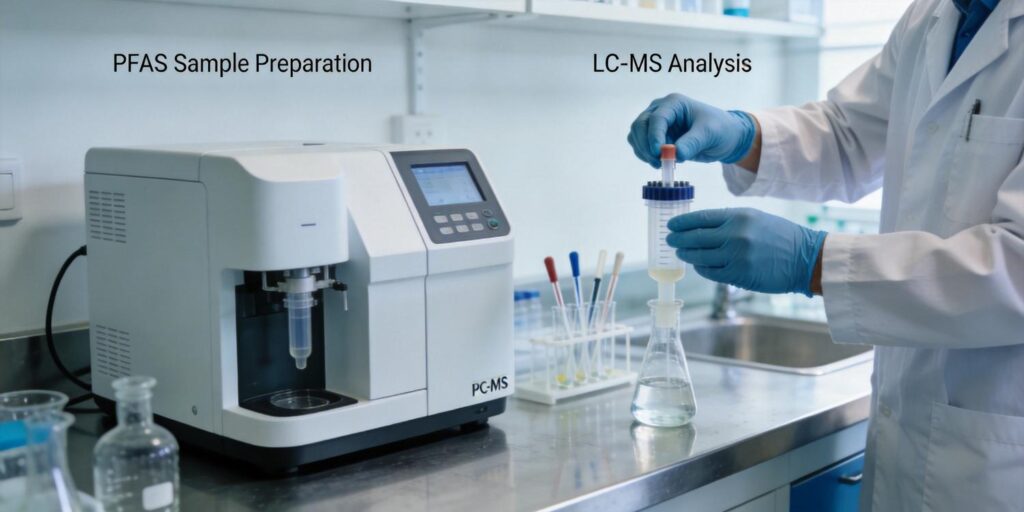
Liquid chromatography coupled with tandem mass spectrometry (LC-MS/MS) represents the gold standard for pharmaceutical residue analysis in environmental samples due to its sensitivity, selectivity, and ability to confirm compound identity.
Chromatographic Separation
Reversed-phase chromatography using C18 or C8 columns remains the most common approach for pharmaceutical separation. Mobile phase typically consists of water and organic solvent (acetonitrile or methanol), often with additives like formic acid or ammonium acetate to improve ionization and separation. Gradient elution is essential for resolving the wide range of pharmaceutical compounds with varying polarities typically targeted in sediment analysis.
For particularly challenging separations, hydrophilic interaction liquid chromatography (HILIC) can be employed for highly polar pharmaceuticals that are poorly retained on reversed-phase columns. HILIC utilizes polar stationary phases (silica, amino, cyano) with aqueous-organic mobile phases rich in acetonitrile.
Mass Spectrometric Detection
Triple quadrupole mass spectrometers operating in multiple reaction monitoring (MRM) mode provide the sensitivity and specificity required for trace-level pharmaceutical detection in sediment extracts. Electrospray ionization (ESI) is most commonly used, with positive mode for basic compounds and negative mode for acidic compounds. Some instruments employ alternating polarity during a single run to cover both classes simultaneously.
Key parameters to optimize include:
- Precursor ion selection: Typically [M+H]+ for basic compounds or [M-H]– for acidic compounds
- Product ions: At least two characteristic fragments for confirmation
- Collision energies: Optimized for each transition
- Dwell times: Sufficient for adequate data points across chromatographic peaks
Quality Control Measures
Robust quality control is essential for reliable pharmaceutical residue analysis. This includes:
- Method blanks: To monitor contamination during sample preparation
- Matrix-matched calibration: To compensate for matrix effects
- Internal standards: Preferably stable isotope-labeled analogs of target analytes
- Recovery experiments: Using spiked samples to validate extraction efficiency
- Continuing calibration verification: Regular checks of calibration curve performance
Environmental Monitoring Applications
The SPE-LC-MS/MS workflow for pharmaceutical residues in river sediments has numerous applications in environmental monitoring and research:
Contamination Assessment
Regular monitoring of sediment pharmaceutical concentrations provides crucial data for assessing contamination levels, identifying hotspots, and evaluating temporal trends. This information supports regulatory decisions regarding wastewater treatment requirements and environmental quality standards.
Ecotoxicological Risk Assessment
Sediment concentration data combined with toxicity information enables risk assessment for benthic organisms. Since many pharmaceuticals can accumulate in sediments and persist for extended periods, they may pose chronic exposure risks to sediment-dwelling organisms even when water concentrations are low.
Source Tracking
Pharmaceutical residue patterns in sediments can help identify contamination sources. Different pharmaceutical profiles may indicate contributions from specific sources such as hospital effluents, residential wastewater, or agricultural runoff. This information supports targeted pollution control measures.
Fate and Transport Studies
Monitoring pharmaceutical residues in sediments contributes to understanding their environmental fate, including degradation rates, transformation pathways, and potential for remobilization. This knowledge informs predictive models and management strategies.
Regulatory Compliance
As regulations evolve to address pharmaceutical contamination, robust analytical methods become essential for compliance monitoring. The SPE-LC-MS/MS approach provides the sensitivity and reliability needed to meet emerging regulatory requirements for sediment quality assessment.
The integration of SPE with LC-MS/MS represents a powerful approach for pharmaceutical residue analysis in river sediments. By combining efficient extraction and cleanup with sensitive and specific detection, this methodology supports comprehensive environmental monitoring programs aimed at protecting aquatic ecosystems from pharmaceutical contamination. As analytical technology continues to advance, further improvements in sensitivity, throughput, and compound coverage will enhance our ability to monitor and manage this important environmental issue.