Regulatory Monitoring of Artificial Food Colorants
Global regulatory bodies like the FDA, EFSA, and Codex Alimentarius have established strict limits for artificial food colorants due to potential health concerns. These synthetic dyes—including Allura Red AC (Red 40), Tartrazine (Yellow 5), Sunset Yellow FCF (Yellow 6), and Brilliant Blue FCF (Blue 1)—require precise monitoring in food products to ensure compliance with maximum permitted levels. Regulatory frameworks mandate analytical methods that can accurately quantify these additives at trace levels, often in complex matrices where interference from natural pigments and other food components presents significant challenges.
Matrix Interference from Sugars and Pigments
Food matrices containing high concentrations of sugars, natural pigments, acids, and other components create substantial analytical challenges. As noted in SPE literature, “Beverages, provided the alcohol or sugar/syrup content is not high or variable, are simpler still to process by SPE” (Simpson and Wynne, 2000). Sugars can cause column overloading and interfere with chromatographic separation, while natural pigments like anthocyanins, carotenoids, and chlorophylls exhibit spectral properties that overlap with synthetic dyes. These matrix components can lead to false positives, reduced method sensitivity, and compromised analytical accuracy without proper sample cleanup.
SPE Sorbent Selection for Dye Compounds
Hydrophobic Interaction-Based Sorbents
C18 and C8 bonded phases provide excellent retention for synthetic dyes through hydrophobic interactions. These reversed-phase sorbents effectively capture dye molecules while allowing polar matrix components like sugars to pass through. For example, studies have demonstrated that “SPE on a CH bonded phase can extract pigments (anthocyanins), leaving sugars in the effluent” (Gelsomini, 1990).
Mixed-Mode and Ion-Exchange Sorbents
Many synthetic dyes contain sulfonic acid groups that make them highly water-soluble and negatively charged at neutral pH. Strong Anion Exchange (SAX) sorbents like our MAX SPE Cartridges provide superior retention for these ionic dyes through electrostatic interactions. Mixed-mode sorbents combining hydrophobic and ion-exchange mechanisms offer enhanced selectivity for complex dye mixtures.
Polymeric Sorbents
Hydrophilic-Lipophilic Balanced (HLB) sorbents, such as our HLB SPE Cartridges, provide excellent retention for both polar and non-polar dyes across a wide pH range. These polymeric materials offer higher capacity and better recovery for dyes with varying chemical properties.
Example Workflow for Beverage or Candy Extracts
Sample Preparation
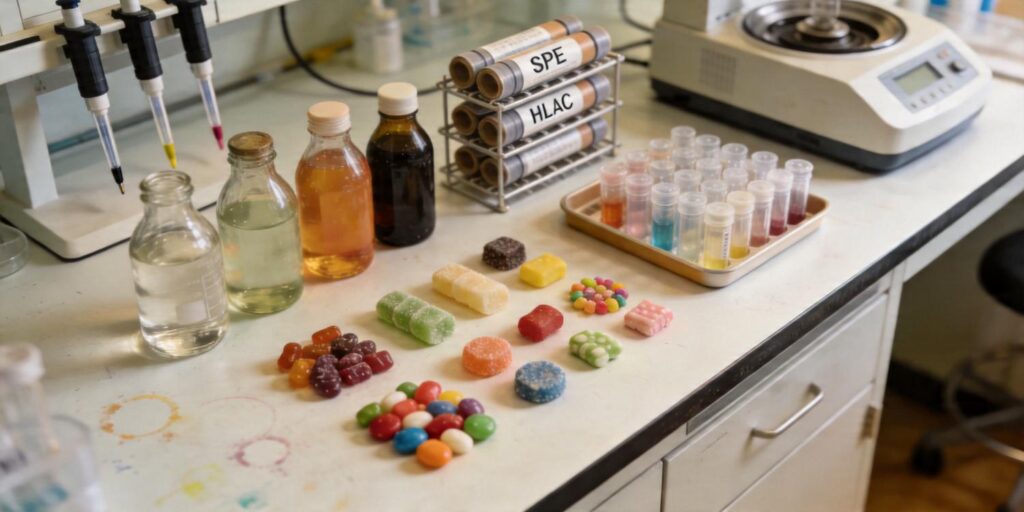
For beverages: Dilute 1:10 with purified water to reduce sugar concentration. For candies and solid foods: Homogenize sample, extract with water or water-methanol mixture (80:20 v/v), and filter through 0.45 μm membrane.
SPE Procedure
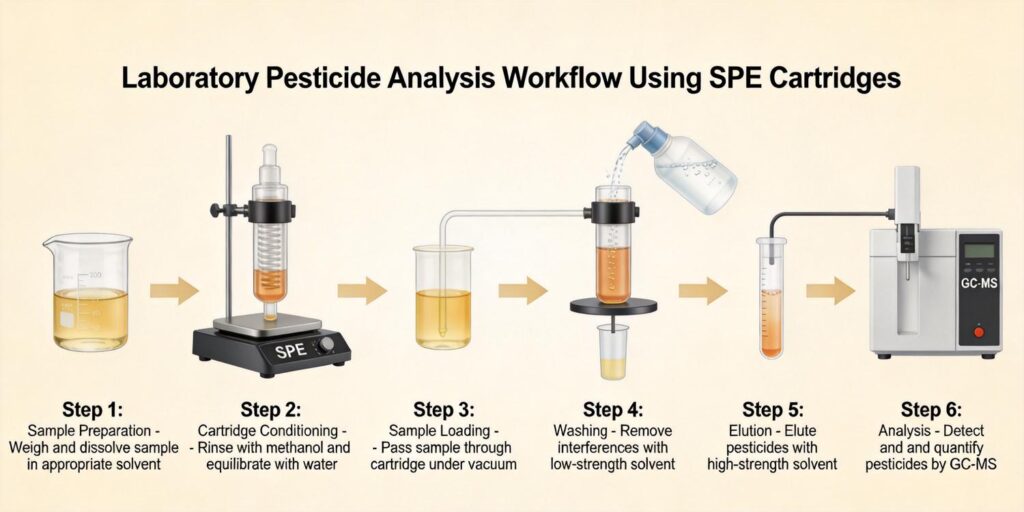
- Conditioning: Activate SAX or mixed-mode cartridge with 6 mL methanol followed by 3 mL purified water.
- Loading: Apply sample extract at controlled flow rate (1-2 mL/min).
- Washing: Remove interfering sugars and neutral compounds with 3-5 mL water or water-methanol (95:5 v/v).
- Elution: Recover dyes using 3-5 mL methanol containing 2% ammonium hydroxide or methanol-acetic acid mixture.
- Concentration: Evaporate eluate under nitrogen stream and reconstitute in mobile phase for analysis.
Two-Cartridge Approach
For complex matrices, a sequential extraction using C8 followed by SCX cartridges has proven effective. As demonstrated by Saito et al. (1989), this approach “removed caffeine, aspartame, sodium benzoate, and caramel and color acids from soft drinks,” providing superior cleanup for challenging samples.
HPLC or LC-MS Detection Methods
HPLC-UV/Vis Analysis
Reverse-phase chromatography with C18 columns and gradient elution using methanol/water or acetonitrile/water buffers provides excellent separation of synthetic dyes. Detection at specific wavelengths (e.g., 254 nm for most dyes, 630 nm for Blue 1) offers good sensitivity with limits of detection typically in the 0.1-1 mg/kg range.
LC-MS/MS Detection
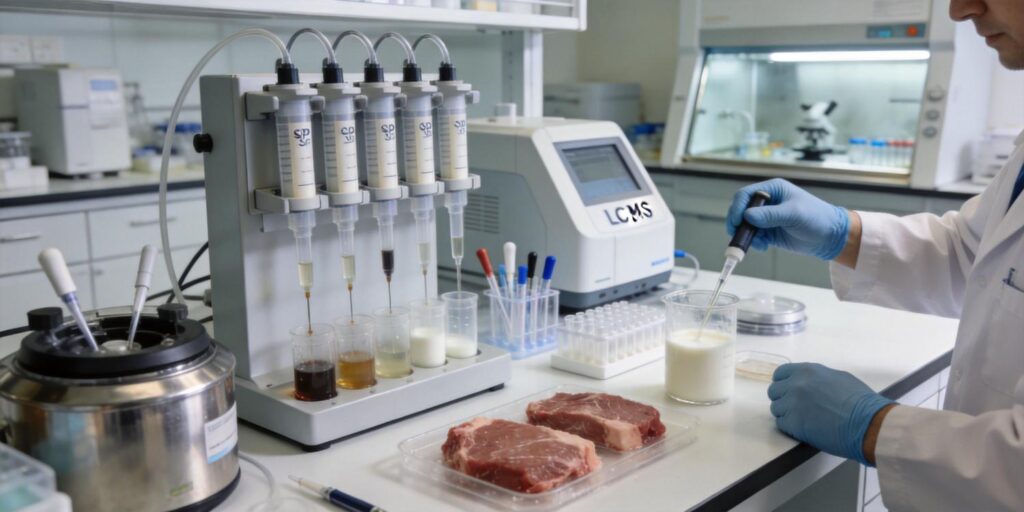
For enhanced selectivity and lower detection limits, LC-MS/MS with electrospray ionization in negative mode provides superior performance. Multiple Reaction Monitoring (MRM) transitions allow specific identification and quantification of individual dyes even in complex matrices. This approach achieves detection limits as low as 0.01 mg/kg, essential for regulatory compliance monitoring.
On-Line SPE-LC Systems
Automated on-line SPE-LC systems, as described in literature, offer high-throughput analysis with improved reproducibility. These systems “provide maximum differentiation in a minimum amount of time and detection must be universal and sensitive” (Simpson, 2000), making them ideal for routine monitoring applications.
Quality Control and Validation Considerations
Method Validation Parameters
Comprehensive validation should include: linearity (R² > 0.995), accuracy (85-115% recovery), precision (RSD < 10%), limit of detection (LOD), limit of quantification (LOQ), specificity, and robustness. Matrix-matched calibration standards are essential for accurate quantification.
Quality Control Measures
Implement routine QC procedures including: analysis of procedural blanks, spiked recovery samples (low, medium, high concentrations), duplicate analyses, and participation in proficiency testing programs. Regular monitoring of SPE cartridge performance through recovery studies ensures consistent results.
SPE Cartridge Performance
Our 96-well SPE Plates offer high-throughput capabilities for routine monitoring laboratories. These plates provide consistent recovery (>90%) and excellent reproducibility (RSD < 5%) when properly conditioned and operated within recommended flow rates.
Documentation and Compliance
Maintain detailed records of SPE cartridge lots, conditioning procedures, elution volumes, and recovery data. For regulatory submissions, include complete method validation data demonstrating the SPE cleanup effectively removes matrix interferences while maintaining dye stability and recovery.
Proper SPE cleanup techniques remain essential for accurate analysis of artificial food colorants. By selecting appropriate sorbents and optimizing cleanup procedures, laboratories can achieve reliable results that meet regulatory requirements while extending instrument lifetime and reducing maintenance costs. The evolution from traditional liquid-liquid extraction to modern SPE methods has significantly improved the reliability and efficiency of food dye analysis, as evidenced by the cleaner extracts and higher recoveries achievable with optimized SPE protocols.