
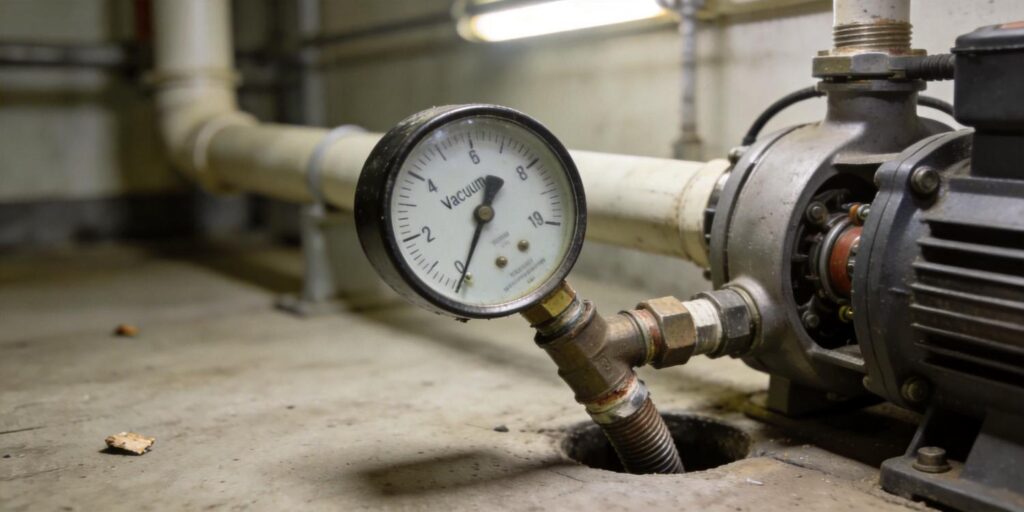
Mounting Near Pump Outlet
One of the most frequent installation errors is placing the vacuum gauge too close to the pump inlet or outlet. Turbulent flow, oil mist (in rotary vane systems), or sudden pressure pulses create local pressure gradients that do not represent true chamber conditions. In practice, readings can be artificially high or unstable by 20–50 % during pump-down or when the pump cycles.
Poseidon Scientific recommends mounting the gauge at least 30–50 cm from any pump port, ideally on a dedicated KF16 or KF25 flange directly on the chamber wall or in a short, high-conductance manifold. The VG-SP205 Pirani Vacuum Transmitter and VG-SM225 Cold Cathode Vacuum Gauge both tolerate any mounting orientation, but distance from high-velocity gas paths is essential for accuracy. This simple relocation alone often restores repeatability without any hardware changes.
Excessive Vibration
Vacuum systems with mechanical pumps, turbo blowers, or agitation mechanisms generate significant vibration. Excessive vibration loosens electrical connections, shifts electrode alignment in cold-cathode gauges, or causes filament micro-fractures in Pirani sensors over time. The result is drift, intermittent faults, or complete signal loss.
The VG-SM225’s positive-magnetron structure is more robust than many legacy designs, yet it still benefits from vibration isolation. Use flexible bellows or short isolation tubing between the gauge and chamber, and secure the electronics housing with shock-absorbing mounts. Poseidon gauges include built-in status LEDs and RS232 diagnostics that quickly flag vibration-induced anomalies, allowing maintenance teams to correct the root cause before accuracy degrades.
Poor Grounding
Inadequate grounding creates ground loops and introduces electrical noise that corrupts the sensitive 0–10 V analog signal or RS232 data stream. In high-vacuum environments with plasma generators or high-voltage supplies, this noise can produce apparent pressure spikes of 10–100 % that have nothing to do with actual vacuum conditions.
Best practice is to ground the gauge housing directly to the chamber metal (using the KF flange) and run a separate ground wire from the electronics enclosure to the system ground bus. Poseidon’s RJ45 connector design simplifies this: the shield pin provides a clean reference. Always verify continuity (<1 Ω) from gauge body to PLC cabinet before commissioning. Proper single-point grounding typically reduces noise-induced error to less than 0.2 % of span.
Long Unshielded Cable Runs
Running unshielded or improperly shielded cables over long distances (greater than 5 m) exposes the low-level analog signal to electromagnetic interference from nearby motors, RF sources, or power lines. The result is erratic readings, especially noticeable in the linear region of the VG-SP205 Pirani or the low-pressure band of the VG-SM225 Cold Cathode.
Use twisted-pair shielded cable (18–22 AWG) with the shield connected at one end only—typically at the PLC cabinet. Poseidon gauges support both 0–10 V analog and customizable RS232 digital outputs; the digital channel is inherently more immune to cable length issues. When analog is required, keep runs under 10 m or add a signal conditioner near the gauge. These precautions maintain the factory-calibrated repeatability (±0.5 % for Pirani in its linear range, ±10 % for cold cathode) across the entire installation.
Exposure to Direct Plasma
Mounting a gauge in direct line-of-sight of a plasma source, sputtering target, or electron beam subjects the sensor to ion bombardment, UV radiation, and sputtered material deposition. This rapidly contaminates electrodes in cold-cathode gauges and can damage the Pirani filament, shifting calibration and shortening service life.
Always install the gauge in a side port or behind a baffle that shields it from the plasma while preserving representative pressure. The VG-SM225’s modular sensor head is designed for easy field cleaning when minor deposition occurs, but prevention is far better than cure. Poseidon’s compact envelope makes it easy to find protected mounting locations without sacrificing response time.
Incorrect Unit Scaling
Even a perfectly installed gauge can appear inaccurate if the PLC or controller scaling is wrong. Common mistakes include assuming 4–20 mA or 0–10 V directly maps to Torr without applying the gauge’s actual calibrated span, or confusing absolute versus gauge pressure.
Poseidon ships every unit with an individual factory calibration certificate and serial-numbered pressure-voltage curve. For the VG-SP205 Pirani, the linear high-accuracy band is 10 Torr to 10⁻² Torr; for the VG-SM225 Cold Cathode, best performance is 10⁻⁴ to 10⁻⁶ Torr. Use the exact min/max values from the certificate when programming the controller. The RS232 digital output provides a simple verification method: compare live digital readings against the scaled analog value during commissioning to catch scaling errors immediately.
Real Case Troubleshooting Example
A European PVD coating OEM reported erratic pressure readings on a new line of optical-coating chambers. The VG-SM225 Cold Cathode gauges consistently read 30–40 % higher than expected during final base-pressure verification. On-site diagnosis revealed three installation issues: the gauges were mounted directly adjacent to the turbomolecular pump inlet (turbulent flow), cables were unshielded and ran parallel to high-voltage plasma supply lines, and the PLC scaling had been entered using generic 0–10 V assumptions instead of the gauge-specific calibration curves.
After relocating the gauges 40 cm upstream, adding shielded cable with single-point grounding, and reloading the correct scaling tables, readings stabilized within ±8 % of a reference gauge. Batch yield improved 18 %, and the customer standardized the corrected installation checklist across all future systems. This case illustrates how multiple small installation mistakes can compound, yet are easily corrected once identified.
Installation Best Practice Checklist
- Choose a mounting port on the chamber wall or short manifold, minimum 30 cm from any pump port or high-velocity gas path.
- Use flexible bellows or isolation tubing to decouple vibration from mechanical pumps.
- Establish a single-point ground: gauge body to chamber metal, electronics enclosure to system ground bus.
- Run twisted-pair shielded cable; keep analog runs under 10 m or switch to RS232 digital output for longer distances.
- Position the gauge out of direct plasma line-of-sight; use baffles if necessary.
- Program PLC scaling using the exact min/max values from the gauge’s factory calibration certificate.
- Perform a 24-hour baseline log via RS232 and cross-check analog output before releasing to production.
- Document serial numbers, mounting photos, and scaling parameters in the system maintenance log.
Following this checklist typically achieves first-time accuracy and eliminates the majority of field-reported issues.
Conclusion: Accurate Vacuum Measurement Starts with Proper Installation
Even the most precise vacuum gauge can deliver disappointing performance if installed incorrectly. Mounting location, vibration isolation, grounding, cable shielding, plasma protection, and correct scaling are all simple details that collectively determine whether a system achieves its designed repeatability and process yield.
Poseidon Scientific’s VG-SP205 Pirani Vacuum Transmitter and VG-SM225 Cold Cathode Vacuum Gauge are engineered for real-world industrial service, with features that make correct installation straightforward: any-orientation mounting, field-cleanable modular heads, temperature compensation, and fully customizable RS232 protocols. By avoiding the common mistakes outlined above, engineers and maintenance teams can rely on stable, repeatable vacuum data from day one.
Ready to review your current or planned installations? Contact Poseidon Scientific today for a no-obligation installation audit. Our team—led by the engineers who designed the VG-SP205 and VG-SM225—will examine your chamber drawings, pump layout, and control architecture and deliver a customized best-practice recommendation, complete with mounting diagrams and scaling tables.
Explore the full specifications of the VG-SP205 Pirani Vacuum Transmitter or the VG-SM225 Cold Cathode Vacuum Gauge and ensure your next vacuum system installation delivers the accuracy your process demands.


