
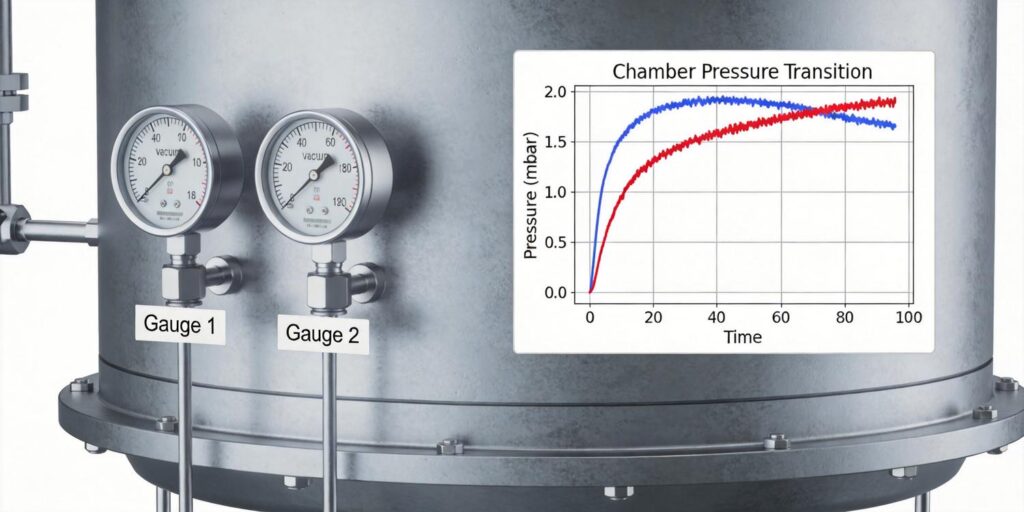
Understanding the Overlap Pressure Range
Vacuum systems rarely operate in a single pressure regime. Most pump-down cycles begin at atmosphere and must reach high vacuum, creating a natural transition zone where both Pirani and cold-cathode technologies can provide valid data. Poseidon Scientific’s VG-SP205 Pirani Vacuum Transmitter is optimized for atmospheric pressure down to 10⁻³ Torr, with its highest linearity and repeatability in the 10 Torr to 10⁻² Torr band. The VG-SM225 Cold Cathode Vacuum Gauge takes over from 10⁻³ Torr down to 10⁻⁷ Torr, delivering stable Penning-discharge readings in the high-vacuum region where Pirani sensitivity falls off.
This overlap—centered around 10⁻³ Torr—allows seamless handoff if configured correctly. Without proper transition logic, however, the system can experience brief periods of unreliable data or unnecessary gauge stress. Understanding the physics of each sensor ensures engineers select the right device for each phase while maintaining continuous, trustworthy pressure feedback throughout the entire cycle.
Automatic Switching Threshold
The key to a smooth transition is an automatic switching threshold set slightly below the upper limit of the cold-cathode gauge. Poseidon recommends 5 × 10⁻⁴ Torr as the default crossover point. At this pressure the VG-SP205 Pirani still provides accurate data, while the VG-SM225 Cold Cathode has already established a stable discharge and is ready to assume control.
Automatic switching is accomplished in the PLC or controller by monitoring both analog outputs simultaneously. When the Pirani reading falls below the threshold for a short confirmation period (typically 5–10 seconds), the system switches the active pressure value to the cold-cathode channel. This prevents premature reliance on the cold cathode before its discharge has stabilized and avoids leaving the Pirani active in a region where its resolution degrades.
Avoiding Measurement Dead Zone
A “dead zone” occurs when neither gauge is trusted during the handoff, creating a gap in process control that can lead to aborted cycles or inconsistent results. The most common cause is a hard switch without hysteresis or confirmation delay. To eliminate this risk, implement a small hysteresis band—typically 1 × 10⁻⁴ Torr—around the threshold.
For example, switch from Pirani to cold cathode when pressure drops below 5 × 10⁻⁴ Torr, but do not switch back to Pirani until pressure rises above 6 × 10⁻⁴ Torr. This prevents rapid toggling during minor fluctuations. The VG-SM225’s built-in software protection automatically disables its high voltage above 10⁻³ Torr, providing an additional safety layer that keeps the cold cathode offline during the high-gas-load roughing phase and eliminates any possibility of sensor damage during transition.
PLC Logic Configuration
Modern controllers make dual-gauge switching straightforward. A typical ladder-logic or structured-text routine includes the following steps:
- Continuously read both 0–10 V analog channels (or RS232 digital values for higher resolution).
- Apply factory-calibrated scaling tables to convert raw signals to Torr.
- Compare the Pirani reading against the switching threshold (5 × 10⁻⁴ Torr) with a 5-second debounce timer.
- When the condition is met, set a software flag to use the cold-cathode value as the process variable.
- Route the selected pressure value to PID loops, interlocks, and HMI displays.
Poseidon Scientific’s engineering team supplies ready-to-use sample code and protocol templates for all major PLC brands. Because the RS232 output on both gauges is fully customizable at orders as low as 5–10 units, the digital values can be formatted to match existing register maps, eliminating the need for additional scaling blocks in the PLC.
Verifying Cross Calibration
Before releasing a dual-gauge system to production, perform a side-by-side cross-check at the transition pressure. Evacuate the chamber to approximately 5 × 10⁻⁴ Torr and compare the two readings for at least 10 minutes. The values should agree within ±15 %; larger discrepancies usually indicate scaling errors or minor contamination.
Poseidon ships each gauge with an individual factory calibration certificate traceable to NIST standards. Use these certificates to confirm that both analog outputs are mapped correctly in the PLC. Repeating the cross-check after the first 10 operating cycles establishes a baseline for long-term drift monitoring. The modular, field-cleanable design of the VG-SM225 makes any necessary electrode maintenance quick and non-disruptive.
Practical Pump-Down Example
Consider a typical 300-liter vacuum coating chamber equipped with a rotary vane roughing pump and 300 L/s turbomolecular pump. The table below shows a representative pump-down sequence using both Poseidon gauges:
| Time (min) | Pressure (Torr) | Active Gauge | Notes |
|---|---|---|---|
| 0 | 760 | VG-SP205 Pirani | Atmosphere, chamber vented |
| 1.5 | 10 | VG-SP205 Pirani | Bulk air removed |
| 4 | 0.001 | VG-SP205 Pirani | Approaching transition |
| 5 | 5.2 × 10⁻⁴ | Switch to VG-SM225 | Automatic handoff complete |
| 12 | 8.7 × 10⁻⁶ | VG-SM225 Cold Cathode | Base pressure achieved |
| 30 | 7.9 × 10⁻⁶ | VG-SM225 Cold Cathode | Stable high vacuum confirmed |
The transition at 5 × 10⁻⁴ Torr is invisible to the operator and the control system; pressure data remains continuous, and interlocks or PID loops experience no discontinuity.
Recommended Transition Pressure
Poseidon recommends a default transition pressure of 5 × 10⁻⁴ Torr for most industrial and laboratory applications. This value sits comfortably within the overlap region, gives the cold cathode time to establish a stable discharge, and keeps the Pirani well within its accurate operating band. For applications with unusually high gas loads (such as resin degassing or vacuum drying), the threshold can be raised slightly to 8 × 10⁻⁴ Torr; for ultra-clean systems requiring the lowest possible base pressure, it can be lowered to 2 × 10⁻⁴ Torr. The exact setting is easily adjusted in the PLC and documented on the system’s calibration record.
Conclusion: Seamless Dual-Gauge Operation for Reliable Vacuum Control
Transitioning from Pirani to cold-cathode measurement does not have to introduce complexity or risk. With a clearly defined overlap range, an automatic switching threshold, hysteresis logic, and proper cross-calibration, engineers can achieve continuous, high-accuracy pressure data from atmosphere all the way to high vacuum. Poseidon Scientific’s VG-SP205 Pirani Vacuum Transmitter and VG-SM225 Cold Cathode Vacuum Gauge are designed from the ground up to work together, offering fast response, field serviceability, and fully customizable communication protocols that simplify integration into any existing or new vacuum system.
By implementing the practices described above, process engineers eliminate measurement gaps, protect sensors, and maintain the tight process windows required for repeatable results in coating, degassing, heat treatment, and analytical applications.
Ready to implement a smooth, dual-gauge vacuum monitoring strategy? Contact Poseidon Scientific today for a no-obligation dual-gauge consultation. Our team—led by the engineers who developed both the VG-SP205 and VG-SM225—will review your chamber layout, pump configuration, and control architecture and deliver a complete transition logic package, including PLC sample code, scaling tables, and commissioning support.
Explore the full specifications of the VG-SP205 Pirani Vacuum Transmitter for roughing-stage monitoring or the VG-SM225 Cold Cathode Vacuum Gauge for high-vacuum verification and discover how easy it is to achieve continuous, accurate vacuum measurement across the entire operating range.


