Environmental Sources of Steroid Hormones
Steroid hormones enter wastewater systems through multiple pathways, primarily from human and veterinary pharmaceutical use, agricultural runoff, and industrial discharges. Natural and synthetic estrogens (estrone, estradiol, ethinylestradiol), androgens (testosterone), progestins, and corticosteroids are routinely detected in municipal wastewater treatment plant effluents at concentrations ranging from low ng/L to μg/L levels. According to environmental monitoring studies, these compounds originate from:
- Human excretion of endogenous hormones and unmetabolized pharmaceutical compounds
- Veterinary applications in livestock farming
- Agricultural runoff containing hormone-based growth promoters
- Industrial effluents from pharmaceutical manufacturing facilities
- Leaching from landfills containing hormone-containing waste
The persistence of steroid hormones in aquatic environments is particularly concerning due to their endocrine-disrupting properties, which can affect aquatic organisms at concentrations as low as 1 ng/L.
Trace Concentration Detection Challenges
Detecting steroid hormones in wastewater presents significant analytical challenges due to their extremely low concentrations (typically 0.1-100 ng/L) and complex matrix interferences. Wastewater matrices contain high levels of dissolved organic matter, salts, particulates, and competing organic compounds that can:
- Mask target analytes during chromatographic separation
- Cause ion suppression in mass spectrometric detection
- Lead to false positives or negatives through matrix effects
- Reduce method sensitivity and reproducibility
As noted in environmental analytical literature, “the determination of organic contaminants in aqueous samples at low and sub parts per trillion levels requires sophisticated sample preparation techniques” (Cai et al., 1993). The hydrophilic nature of some hormone metabolites further complicates extraction efficiency, necessitating specialized enrichment strategies.
SPE Enrichment Methods for ng/L Hormone Detection
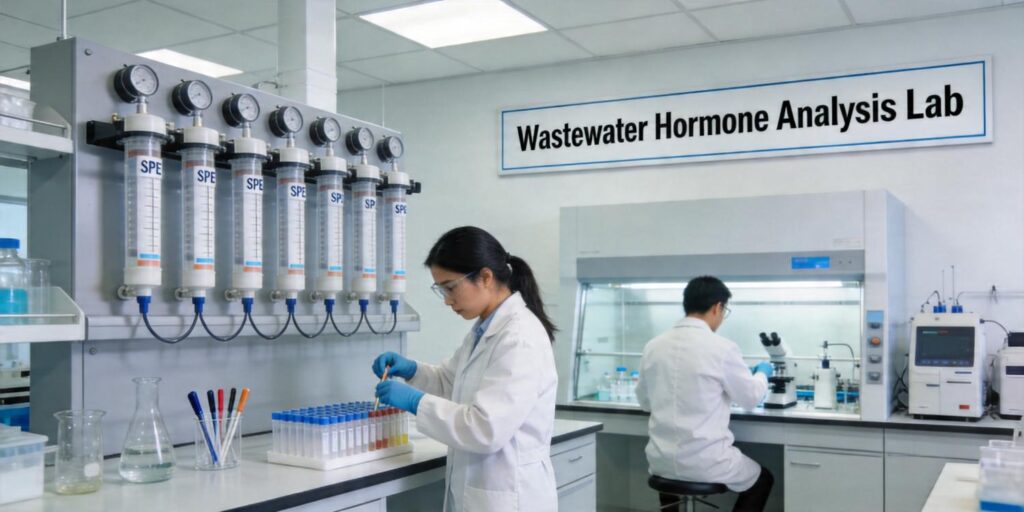
Solid-phase extraction (SPE) has emerged as the gold standard for preconcentrating steroid hormones from large-volume wastewater samples. The technique offers several advantages over traditional liquid-liquid extraction:
- Higher and more reproducible recoveries (typically >90%)
- Reduced organic solvent consumption and waste generation
- Improved selectivity through sorbent chemistry optimization
- Ease of automation for high-throughput analysis
- Better removal of matrix interferences
SPE Sorbent Selection for Hormone Extraction
For steroid hormone analysis, mixed-mode sorbents combining hydrophobic and ion-exchange interactions provide optimal recovery. Poseidon Scientific offers several specialized SPE cartridges suitable for hormone extraction:
- HLB (Hydrophilic-Lipophilic Balanced): Ideal for broad-spectrum extraction of both polar and non-polar hormones
- MAX (Mixed-mode Anion Exchange): Excellent for acidic hormone metabolites
- MCX (Mixed-mode Cation Exchange): Suitable for basic hormone compounds
- WAX (Weak Anion Exchange): Effective for strongly acidic hormones
- WCX (Weak Cation Exchange): Optimal for weakly basic hormones
Research demonstrates that “particle-loaded membranes to extract steroids for high-performance liquid chromatographic analysis provide improved analyte stability and detection” (Lensmeyer et al., 1995). The choice of sorbent depends on the specific hormone classes targeted and the wastewater matrix characteristics.
Example Wastewater Extraction Workflow
A comprehensive SPE workflow for steroid hormone analysis typically follows these optimized steps:
- Sample Preparation: Filter 500-1000 mL wastewater samples through 0.45 μm glass fiber filters to remove particulates. Adjust pH to optimize retention based on hormone pKa values (typically pH 3-4 for acidic hormones, pH 7-8 for neutral/basic hormones).
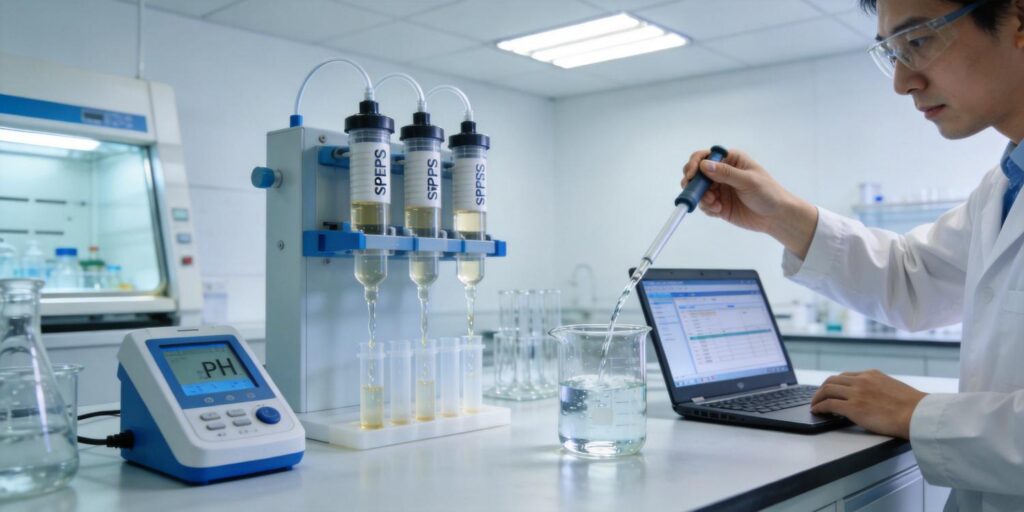
- SPE Cartridge Conditioning: Condition HLB or mixed-mode cartridges with 5-10 mL methanol followed by 5-10 mL deionized water or pH-adjusted buffer at a flow rate of 1-3 mL/min.
- Sample Loading: Pass the filtered wastewater sample through the cartridge at a controlled flow rate of 5-10 mL/min to ensure optimal analyte retention.
- Cartridge Washing: Wash with 5-10 mL of 5% methanol in water to remove weakly retained matrix components while retaining target hormones.
- Cartridge Drying: Apply vacuum or positive pressure for 5-10 minutes to remove residual water.
- Analyte Elution: Elute hormones with 5-10 mL of appropriate organic solvent (typically methanol, acetonitrile, or mixtures with acid/base modifiers). For mixed-mode cartridges, sequential elution with different solvent compositions may be necessary.
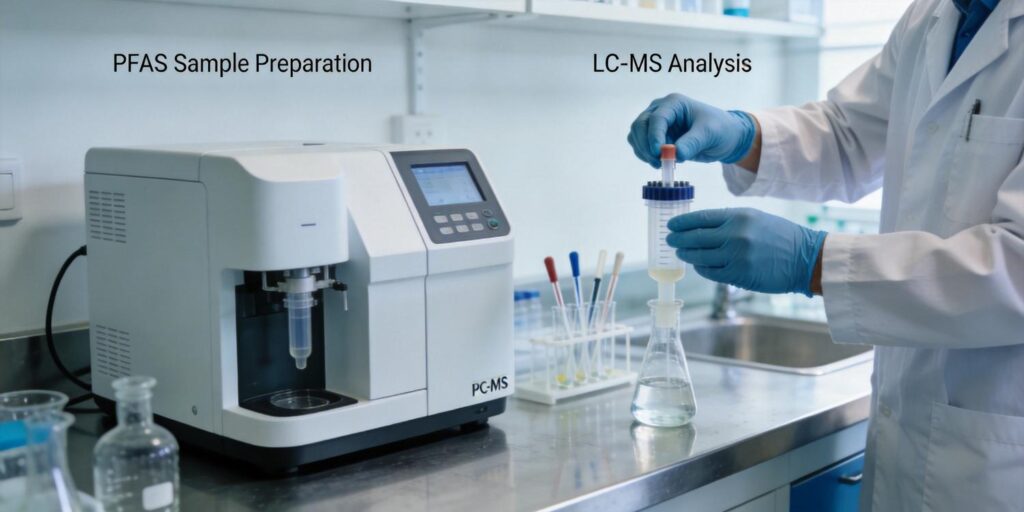
- Concentration and Reconstitution</strong: Evaporate eluate to dryness under gentle nitrogen stream and reconstitute in 100-500 μL of initial mobile phase for LC-MS/MS analysis.
This workflow typically achieves enrichment factors of 1000-5000×, enabling detection at ng/L levels with excellent recovery (80-120%) and precision (RSD <15%).
LC-MS/MS Analytical Methods
Liquid chromatography coupled with tandem mass spectrometry (LC-MS/MS) provides the sensitivity and selectivity required for steroid hormone quantification at environmental concentrations. Key methodological considerations include:
Chromatographic Separation
Reverse-phase C18 or C8 columns (50-150 mm × 2.1 mm, 1.7-3.5 μm particle size) with gradient elution using water-methanol or water-acetonitrile mobile phases provide optimal separation. Addition of 0.1% formic acid or ammonium acetate improves ionization efficiency and peak shape.
Mass Spectrometric Detection
Electrospray ionization (ESI) in negative or positive mode, depending on hormone polarity, coupled with multiple reaction monitoring (MRM) provides the necessary sensitivity and specificity. Typical instrument parameters include:
- Source temperature: 150-300°C
- Desolvation gas flow: 600-1000 L/hr
- Cone gas flow: 50-150 L/hr
- Collision energies: 10-40 eV (compound-dependent)
Method validation should include determination of method detection limits (MDLs, typically 0.1-1 ng/L), linearity (r² >0.99), accuracy (80-120% recovery), and precision (RSD <20% at LOQ).
Environmental Impact Monitoring
Regular monitoring of steroid hormones in wastewater is crucial for assessing environmental impact and treatment efficiency. SPE-LC-MS/MS methods enable:
- Source Tracking: Identifying major contributors of hormone contamination
- Treatment Evaluation: Assessing removal efficiencies of different wastewater treatment processes
- Ecological Risk Assessment: Determining potential impacts on aquatic organisms
- Regulatory Compliance: Monitoring against emerging environmental quality standards
Studies have shown that conventional wastewater treatment removes only 50-90% of steroid hormones, with advanced treatments (ozonation, activated carbon, membrane filtration) achieving >90% removal. Continuous monitoring using robust SPE methods provides essential data for optimizing treatment strategies and protecting aquatic ecosystems.
For laboratories requiring high-throughput analysis, Poseidon Scientific’s 96-well SPE plates offer automated processing capabilities while maintaining the excellent recovery and reproducibility of our cartridge products. These platforms are particularly valuable for large-scale monitoring programs and research studies requiring analysis of multiple hormone classes across numerous samples.