Pharmaceutical Contamination in Drinking Water Sources
The presence of pharmaceutical compounds in drinking water sources has emerged as a significant environmental concern over the past two decades. As Simpson (2000) notes in his comprehensive review of solid-phase extraction (SPE), environmental applications of SPE have “exploded during the 1990s,” with particular focus on drinking water, surface waters, groundwater, wastewater, and seawater analysis. Pharmaceuticals enter water systems through multiple pathways, including excretion of unmetabolized drugs, improper disposal of medications, and effluent from pharmaceutical manufacturing facilities.
These compounds, often present at trace levels (ng/L to μg/L), pose unique analytical challenges due to their diverse chemical properties and low concentrations in complex aqueous matrices. The hydrophilic nature of many pharmaceutical compounds, coupled with their persistence through conventional water treatment processes, makes them particularly problematic for drinking water treatment facilities. As environmental regulations become more stringent and analytical detection limits continue to improve, the need for reliable extraction and concentration methods has become increasingly critical.
Role of Treatment Processes in Pharmaceutical Removal
Conventional drinking water treatment processes vary significantly in their effectiveness at removing pharmaceutical contaminants. Coagulation, flocculation, and sedimentation primarily target particulate matter and may have limited impact on dissolved pharmaceutical compounds. Filtration processes, while effective for particulate removal, generally show poor retention of small molecular weight pharmaceuticals.
Advanced treatment technologies have demonstrated greater efficacy in pharmaceutical removal. Activated carbon adsorption, both granular (GAC) and powdered (PAC), has shown promise for removing hydrophobic pharmaceuticals through adsorption mechanisms. However, as Owen et al. (1993) demonstrated in their characterization of natural organic matter, competitive adsorption with background organic matter can significantly reduce pharmaceutical removal efficiency.
Oxidation processes, including ozonation and advanced oxidation processes (AOPs), can effectively degrade many pharmaceutical compounds but may produce transformation products with unknown toxicity. Membrane processes, particularly reverse osmosis and nanofiltration, offer high removal efficiencies but at increased operational costs and energy requirements. Understanding the fate of pharmaceuticals through these treatment processes requires sophisticated analytical methods capable of detecting trace concentrations in complex matrices.
SPE Enrichment Methods for Trace Pharmaceutical Analysis
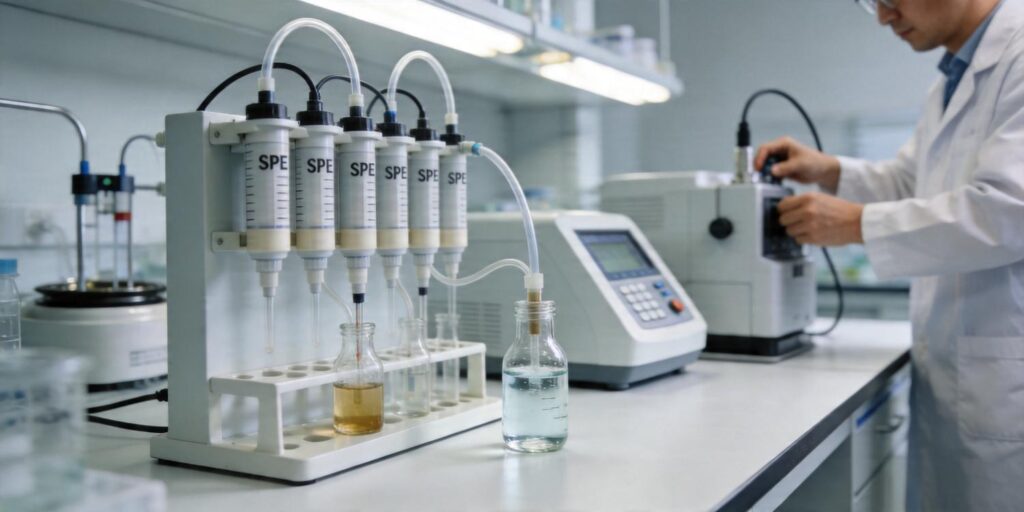
Solid-phase extraction has become the method of choice for concentrating trace pharmaceutical compounds from water matrices due to its efficiency, selectivity, and compatibility with various detection techniques. As described in forensic applications literature, SPE involves “the separation technique in which liquids contact modified solid surfaces and a component of the liquid adheres to the solid” (Telepchak et al., 2007).
SPE Mechanism Selection for Pharmaceutical Extraction
The selection of appropriate SPE sorbents depends on the chemical properties of target pharmaceuticals. Reversed-phase sorbents (C18, C8, HLB) are commonly used for hydrophobic compounds, while mixed-mode sorbents (MCX, MAX, WAX, WCX) provide enhanced selectivity through combined reversed-phase and ion-exchange mechanisms. As Law (2000) discusses in his examination of secondary interactions and mixed-mode extraction, these sorbents offer improved selectivity for pharmaceuticals with ionizable functional groups.
For drinking water applications, hydrophilic-lipophilic balanced (HLB) sorbents have gained popularity due to their ability to retain both hydrophilic and hydrophobic compounds without requiring pH adjustment. This characteristic makes them particularly suitable for multi-residue methods targeting pharmaceuticals with diverse physicochemical properties.
Optimization of SPE Parameters
Successful SPE method development requires careful optimization of several parameters:
- Sample pH adjustment: Critical for ionizable compounds to ensure optimal retention
- Sample volume: Typically 100-1000 mL for drinking water to achieve adequate enrichment factors
- Flow rate: Controlled at 1-3 drops/second to maximize recovery
- Wash solvents: Selected to remove interferences while retaining analytes
- Elution solvents: Optimized for complete analyte recovery in minimal volume
As Bouvier (1995) emphasizes in his SPE method development guide, understanding analyte characteristics including structure, pKa, polarity, and functional groups is essential for successful method development.
Example Extraction Workflow for Treated Water Samples
Sample Collection and Preservation
Proper sample handling begins at the point of collection. Drinking water samples should be collected in clean glass containers, preserved with appropriate additives (typically sodium thiosulfate to quench residual chlorine), and stored at 4°C until extraction. Samples should be extracted within 48 hours of collection to minimize degradation.
SPE Procedure for Multi-Residue Pharmaceutical Analysis
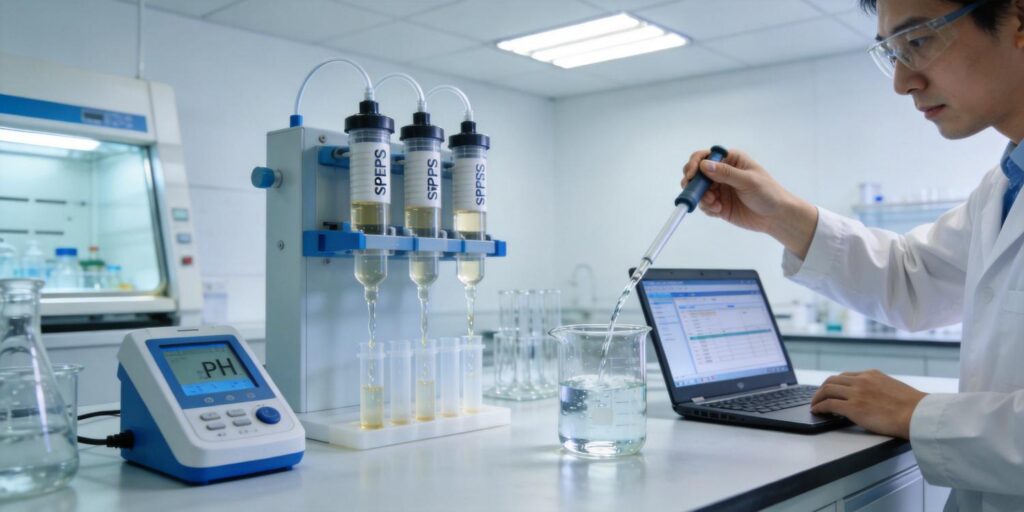
A typical SPE workflow for pharmaceutical analysis in treated drinking water includes:
- Cartridge conditioning: Sequential conditioning with methanol and reagent water (or appropriate buffer)
- Sample loading: Passage of 500 mL sample at controlled flow rate (5-10 mL/min)
- Cartridge washing: Washing with 5-10 mL of water or mild organic solvent to remove interferences
- Cartridge drying: Application of vacuum or nitrogen stream to remove residual water
- Analyte elution: Sequential elution with appropriate solvents (typically methanol, acetonitrile, or mixtures with acid/base modifiers)
- Extract concentration: Gentle evaporation under nitrogen stream to final volume (typically 0.5-1.0 mL)
- Reconstitution: Adjustment to final analysis conditions
As Wells et al. (1994) demonstrated in their optimization of SPE schemes for agricultural runoff water, method validation should include assessment of recovery, precision, method detection limits, and matrix effects.
LC-MS/MS Detection of Pharmaceuticals in Water Extracts
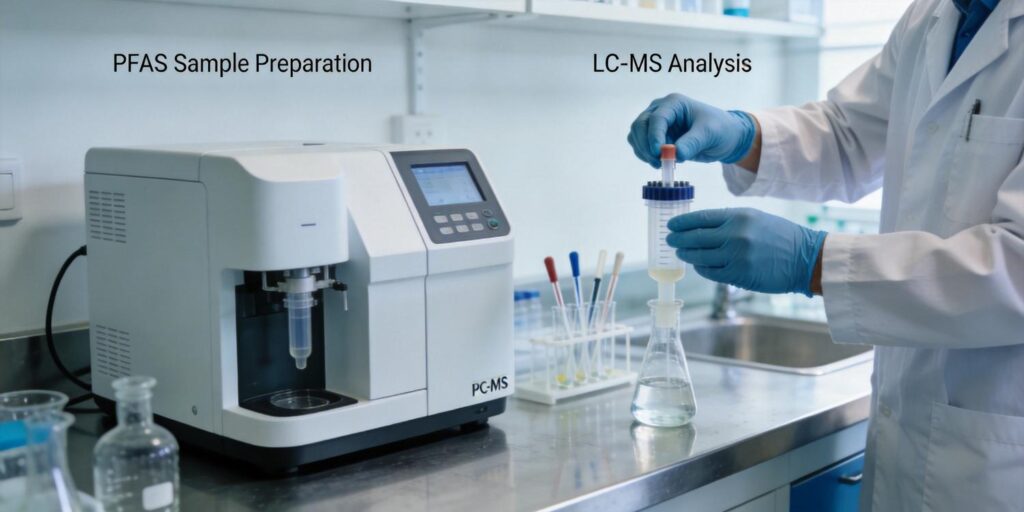
Liquid chromatography coupled with tandem mass spectrometry (LC-MS/MS) has become the gold standard for pharmaceutical analysis in water matrices due to its sensitivity, selectivity, and ability to confirm compound identity. The combination of SPE enrichment with LC-MS/MS detection enables reliable quantification at ng/L levels, essential for drinking water monitoring.
Chromatographic Separation Considerations
Reversed-phase chromatography using C18 or similar stationary phases provides adequate separation for most pharmaceutical compounds. Mobile phase optimization typically involves gradient elution with water and organic modifiers (methanol or acetonitrile), often with acid or buffer additives to improve peak shape and ionization efficiency.
Mass Spectrometric Detection Strategies
Multiple reaction monitoring (MRM) provides the necessary sensitivity and selectivity for trace pharmaceutical analysis. Key considerations include:
- Ionization mode selection: Electrospray ionization (ESI) in positive or negative mode depending on compound properties
- Optimization of collision energies: To maximize sensitivity of product ions
- Use of isotope-labeled internal standards: To correct for matrix effects and recovery variations
- Quality control measures: Including calibration verification, continuing calibration checks, and matrix spike samples
As Bowers et al. (1997) demonstrated in their work quantifying drugs at picogram levels, the integration of SPE with tandem MS without HPLC columns can provide exceptional sensitivity for certain applications.
Applications in Water Treatment Research
Treatment Process Evaluation
SPE-LC-MS/MS methods enable comprehensive evaluation of pharmaceutical removal across different treatment processes. Research applications include:
- Pilot-scale studies: Evaluating emerging treatment technologies
- Full-scale monitoring: Assessing performance of operational treatment plants
- Process optimization: Determining optimal conditions for pharmaceutical removal
- By-product identification: Characterizing transformation products from oxidation processes
Regulatory Compliance and Risk Assessment
The development of sensitive and reliable analytical methods supports regulatory decision-making and risk assessment activities. SPE-based methods provide the data necessary for:
- Occurrence studies: Establishing baseline concentrations in source waters and finished drinking water
- Exposure assessment: Estimating population exposure through drinking water consumption
- Treatment efficiency requirements: Informing regulatory standards for pharmaceutical removal
- Source tracking: Identifying major contributors to pharmaceutical contamination
Future Directions in SPE Technology
As Simpson (2000) predicted in his concluding thoughts on SPE, the future of solid-phase extraction lies in continued innovation. Emerging trends relevant to drinking water pharmaceutical analysis include:
- Miniaturization: Development of smaller bed mass cartridges and 96-well plate formats for high-throughput analysis
- New sorbent materials: Including molecularly imprinted polymers and restricted access materials
- Automation: Integration with robotic systems for improved reproducibility and throughput
- On-line SPE-LC-MS/MS: Direct coupling for automated analysis with reduced sample handling
The continued evolution of SPE technology, combined with advances in detection methods, will further enhance our ability to monitor and understand the fate of pharmaceutical compounds in drinking water treatment systems. As environmental awareness grows and analytical capabilities improve, SPE-based methods will remain essential tools for ensuring drinking water safety and advancing water treatment research.
For researchers and water quality professionals, understanding the principles and applications of SPE for pharmaceutical analysis provides valuable insights into method development, optimization, and implementation. By selecting appropriate sorbents, optimizing extraction parameters, and validating method performance, laboratories can generate reliable data to support water treatment decisions and protect public health.