Overview of Cyanotoxin Contamination in Freshwater Systems
Cyanotoxin contamination represents one of the most pressing environmental challenges in freshwater ecosystems worldwide. These potent toxins are produced by cyanobacteria (blue-green algae) during harmful algal blooms (HABs), which have become increasingly frequent due to nutrient enrichment, climate change, and other anthropogenic factors. The presence of cyanotoxins in drinking water sources, recreational waters, and aquatic ecosystems poses significant risks to human health, wildlife, and ecosystem integrity.
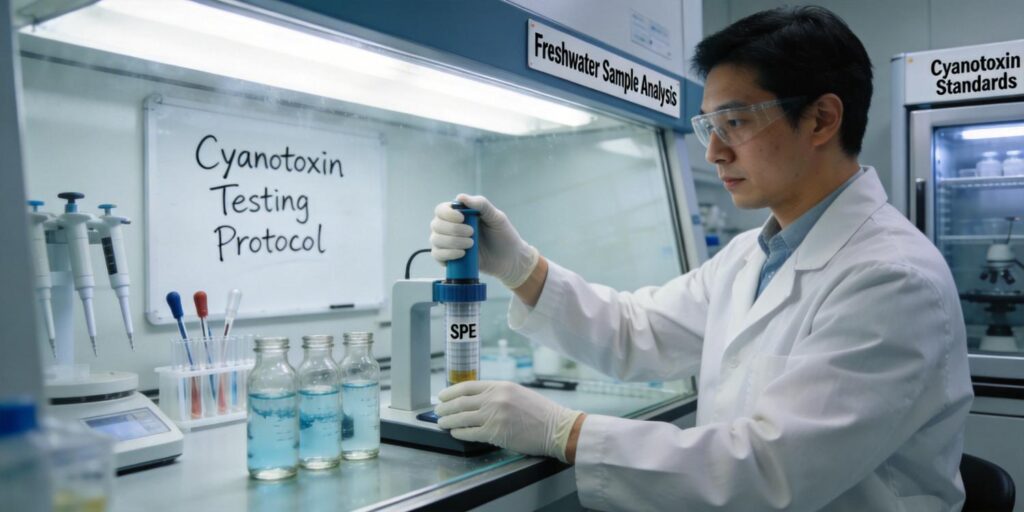
From an analytical perspective, cyanotoxins present unique challenges due to their diverse chemical structures, wide concentration ranges (from ng/L to μg/L), and complex environmental matrices. Effective monitoring requires robust sample preparation strategies that can handle large-volume freshwater samples while achieving the necessary sensitivity and selectivity for regulatory compliance and risk assessment.
Target Compounds: Microcystins and Anatoxin-a
Microcystins: The Hepatotoxic Threat
Microcystins are cyclic heptapeptides containing unusual amino acids that make them resistant to conventional degradation processes. With over 100 known variants, microcystin-LR is the most studied and toxic form. These compounds exhibit strong hepatotoxicity through inhibition of protein phosphatases, leading to liver damage and potential carcinogenic effects. Their molecular weights range from 800-1100 Da, and they contain both hydrophobic and hydrophilic regions, making their extraction particularly challenging.
Anatoxin-a: The Neurotoxic Challenge
Anatoxin-a, also known as “Very Fast Death Factor,” is a potent neurotoxin that acts as a postsynaptic depolarizing neuromuscular blocking agent. This secondary amine (molecular weight 165 Da) is highly polar and water-soluble, requiring specialized extraction approaches. Unlike microcystins, anatoxin-a lacks chromophores, complicating its detection and quantification.
SPE Sorbent Selection for Cyanotoxin Extraction
Understanding Sorbent Chemistry
Solid-phase extraction sorbent selection is critical for successful cyanotoxin analysis. The choice depends on the target compounds’ chemical properties, sample matrix characteristics, and detection requirements. As noted in SPE literature, “The choice of the solid support depends on the analyte polarity and the potential coextracted components of the matrix” (Capriotti et al., 2010).
Recommended Sorbents for Cyanotoxin Analysis
1. HLB (Hydrophilic-Lipophilic Balanced) Sorbents
HLB sorbents, such as those available from Poseidon Scientific, offer exceptional versatility for cyanotoxin extraction. These polymeric materials contain both hydrophilic N-vinylpyrrolidone and lipophilic divinylbenzene monomers, providing balanced retention for compounds with diverse polarities. For microcystins, which contain both hydrophobic and hydrophilic regions, HLB sorbents typically achieve recoveries exceeding 85% across multiple variants.
2. Mixed-Mode Sorbents for Comprehensive Extraction
Mixed-mode sorbents combining hydrophobic and cation exchange interactions are particularly effective for simultaneous extraction of microcystins and anatoxin-a. As research demonstrates, “The strategy of a mixed-mode cartridge providing hydrophobic and cation exchange interactions, combined with a pH-dependent sample application and extraction, can give high recoveries of analytes” (Simpson, 2000). For anatoxin-a, which exists as a cation at environmental pH, cation exchange functionality is essential for effective retention.
3. C18 Sorbents for Microcystin Enrichment
While C18 sorbents are commonly used for mycotoxin analysis in cereals because “its lipophilic characteristic allows good disruption, dispersion, and retention of lipophilic species” (Barker, 2007), they may require pH adjustment and organic solvent optimization for optimal microcystin recovery from aqueous samples.
Sorbent Selection Guidelines
- For microcystins only: HLB or C18 sorbents with methanol conditioning
- For anatoxin-a only: Mixed-mode cation exchange (MCX) sorbents at pH < pKa (9.4)
- For simultaneous extraction: Mixed-mode sorbents or sequential extraction using different sorbent chemistries
- For high-throughput analysis: 96-well SPE plates for automated processing
Large-Volume Freshwater Sample Enrichment
Sample Collection and Preservation
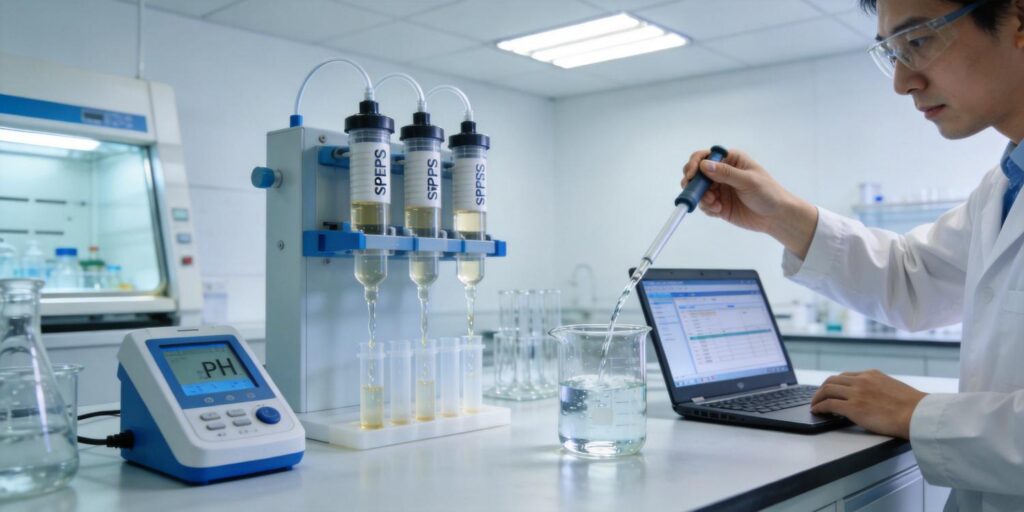
Freshwater samples for cyanotoxin analysis typically require collection of 1-4 liters to achieve adequate detection limits. Immediate preservation with ascorbic acid (to prevent oxidation) and refrigeration at 4°C is essential. Filtration through glass fiber filters (0.45-1.2 μm) removes particulate matter and cyanobacterial cells, though intracellular toxins may require cell lysis procedures.
SPE Method Optimization
Large-volume enrichment demands careful optimization of SPE parameters:
- Conditioning: 5-10 mL methanol followed by 10-20 mL ultrapure water
- Sample Loading: Flow rates of 5-15 mL/min to prevent breakthrough
- Washing: 5-10 mL 5-20% methanol in water to remove interferences
- Drying: 10-30 minutes under vacuum or nitrogen stream
- Elution: 5-10 mL methanol or methanol with 0.1% formic acid
As environmental monitoring research indicates, “On-line monitoring of aquatic samples using automated procedures increases the speed of analysis and improves analyte detectability” (Brinkman, 1995). For large-scale monitoring programs, automated SPE systems significantly enhance throughput and reproducibility.
Matrix Effects and Interference Removal
Freshwater matrices contain dissolved organic matter, humic substances, and inorganic ions that can interfere with cyanotoxin analysis. SPE washing steps must be optimized to remove these interferences while retaining target compounds. Research shows that “Simple removal of humic and fulvic acid interferences using polymeric sorbents” is achievable through careful method development (Pichon et al., 1996).
LC-MS Detection Strategies for Cyanotoxins
Liquid Chromatography Separation
Reverse-phase chromatography using C18 columns (150 × 2.1 mm, 3-5 μm) provides excellent separation of cyanotoxin variants. Mobile phases typically consist of water and acetonitrile, both containing 0.1% formic acid to enhance ionization. Gradient elution from 5% to 95% organic over 10-20 minutes effectively separates microcystin variants and anatoxin-a.
Mass Spectrometry Detection
1. Triple Quadrupole MS/MS for Quantification
Multiple reaction monitoring (MRM) provides the sensitivity and selectivity required for regulatory monitoring. Key transitions for common cyanotoxins include:
- Microcystin-LR: 995.5 → 135.1 (quantifier), 995.5 → 213.1 (qualifier)
- Anatoxin-a: 166.1 → 149.1 (quantifier), 166.1 → 131.1 (qualifier)
Collision energies and other parameters must be optimized for each instrument and matrix.
2. High-Resolution Mass Spectrometry for Screening
Time-of-flight (TOF) or Orbitrap instruments enable untargeted screening and identification of unknown cyanotoxin variants. Accurate mass measurements (±5 ppm) combined with isotopic patterns facilitate structural elucidation of novel toxins.
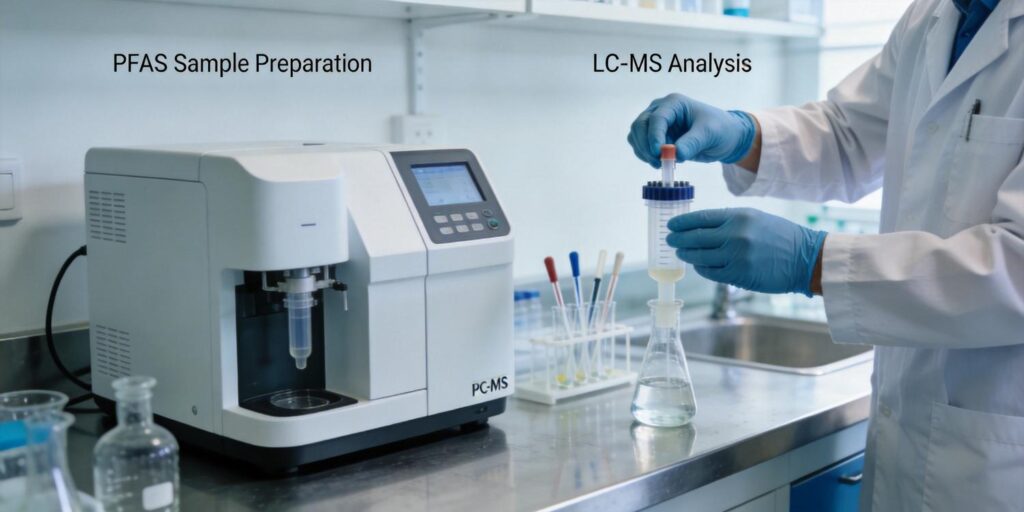
3. On-line SPE-LC-MS for High-Throughput Analysis
As demonstrated in environmental applications, “On-line SPE and tandem MS without HPLC columns for quantifying drugs at the picogram level” (Bowers et al., 1997) can be adapted for cyanotoxin monitoring. This approach eliminates manual sample handling and increases analytical throughput.
Method Validation Parameters
Validated methods should demonstrate:
- Linearity: R² > 0.99 over relevant concentration ranges
- Accuracy: 80-120% recovery for most applications
- Precision: <20% RSD for intra- and inter-day variability
- Limit of detection: <0.1 μg/L for drinking water applications
- Matrix effects: <±20% signal suppression/enhancement
Environmental Monitoring Programs and Regulatory Frameworks
Global Monitoring Initiatives
Environmental monitoring programs for cyanotoxins have evolved significantly in response to increasing bloom frequency and severity. Key initiatives include:
- WHO Guidelines: Provisional value of 1 μg/L for microcystin-LR in drinking water
- US EPA: Health advisory levels and upcoming regulatory determinations
- European Union: Monitoring requirements under the Drinking Water Directive
- National Programs: Country-specific monitoring and response protocols
Integrated Monitoring Approaches
Effective cyanotoxin monitoring requires integration of multiple approaches:
1. Early Warning Systems
Combining remote sensing, in-situ sensors, and predictive modeling with targeted chemical analysis enables proactive management of bloom events.
2. Tiered Analytical Approaches
Screening methods (ELISA, biosensors) followed by confirmatory analysis (LC-MS) provide cost-effective monitoring while ensuring data quality.
3. Quality Assurance/Quality Control
Implementation of laboratory proficiency testing, reference materials, and standardized protocols ensures data comparability across monitoring programs.
Future Directions in Cyanotoxin Monitoring
Emerging trends in cyanotoxin analysis include:
- Automation: Increased use of automated SPE systems and 96-well formats
- Miniaturization: Development of micro-SPE devices for field applications
- High-throughput: Parallel processing of multiple samples and analytes
- Data integration: Combining chemical, biological, and ecological data
Conclusion
SPE workflows for cyanotoxin detection in freshwater represent a critical component of environmental monitoring and public health protection. The selection of appropriate sorbents—particularly HLB and mixed-mode materials—combined with optimized large-volume enrichment protocols and sensitive LC-MS detection enables reliable quantification of these potent toxins at environmentally relevant concentrations.
As monitoring programs expand and regulatory requirements evolve, continued innovation in SPE technology and method development will be essential. The integration of automated systems, improved sorbent chemistries, and advanced detection strategies will enhance our ability to understand and mitigate the risks posed by cyanotoxin contamination in freshwater ecosystems worldwide.
For laboratories implementing cyanotoxin monitoring programs, careful consideration of SPE sorbent selection, method validation, and quality control measures will ensure reliable data generation for risk assessment and regulatory compliance. The availability of specialized SPE products, such as those offered by Poseidon Scientific, provides analytical chemists with the tools needed to address this complex analytical challenge effectively.