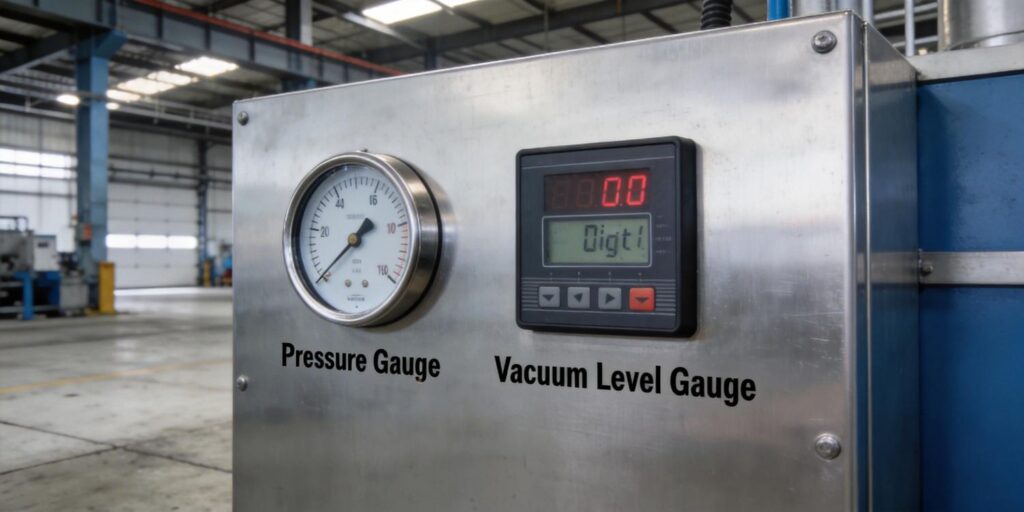
Vacuum Packaging Process Overview
In modern food packaging, vacuum systems remove air from pouches, trays, or containers before sealing to minimize oxygen exposure, inhibit microbial growth, and extend shelf life. The process typically begins with product placement in a barrier film package, followed by chamber evacuation using rotary vane or dry screw pumps. Once the target vacuum level is reached, the package is heat-sealed under vacuum or backfilled with modified atmosphere gases for MAP applications. High-speed lines cycle every 2–10 seconds, demanding precise, real-time pressure monitoring to ensure consistent seal integrity and product quality.
Effective vacuum control directly impacts food safety and economics. Insufficient vacuum leads to residual oxygen that accelerates oxidation and spoilage, while over-pumping wastes energy and risks package collapse. Poseidon Scientific’s vacuum gauges, engineered for industrial reliability, provide the accurate, responsive data packaging OEMs need to optimize these high-throughput operations.
Required Pressure Levels in Food Vacuum Packaging
Food vacuum packaging operates primarily in the rough-to-medium vacuum regime. Typical target absolute pressures range from 10 mbar (approximately 7.5 Torr) down to 1 mbar (0.75 Torr) for standard flexible pouches, with some high-barrier applications reaching 0.1–0.5 mbar. These levels correspond to 98–99.9% vacuum relative to atmosphere, sufficient to collapse flexible films tightly around the product while preventing oxidative rancidity in meats, cheeses, and ready-to-eat foods.
In the linear high-precision band of 10 Torr to 10⁻² Torr, thermal conductivity gauges deliver repeatable readings critical for process validation. Below 10⁻³ Torr, ionization-based instruments become necessary, but most packaging lines never require ultra-high vacuum. Poseidon Scientific’s VG-SP205 Pirani Vacuum Transmitter is optimized exactly for this mid-vacuum window, offering factory-calibrated accuracy where it matters most for food applications.
The Need for Rapid Cycle Monitoring
Packaging machines demand vacuum gauges with fast response times to support rapid pump-down cycles without introducing lag that could reduce throughput or cause inconsistent seals. Pirani sensors excel here because their heat-transfer measurement principle responds almost instantaneously to pressure changes in the 10–10⁻³ Torr range, unlike slower ionization gauges that require discharge stabilization.
During a typical 3–6 second evacuation, the gauge must track pressure drop from atmosphere through the viscous-flow regime into molecular flow without overshoot or hysteresis. Poseidon Scientific’s VG-SP205 incorporates temperature-compensated circuitry and proprietary algorithms to maintain <50 ms response across its operating band, enabling closed-loop pump control and real-time quality alerts. This speed directly translates to higher line speeds and fewer rejected packages.
Hygiene Considerations in Food Industry Applications
Food-contact and wash-down environments impose stringent requirements on sensor design. Gauges must feature smooth, crevice-free surfaces, IP67/IP69K-rated housings, and materials compatible with aggressive cleaning agents, high-temperature steam, and sanitizers. Stainless-steel process connections and non-porous exteriors prevent microbial harborage while allowing rapid disassembly for inspection.
Pirani gauges avoid the electrode contamination issues common in cold-cathode designs, eliminating the need for frequent internal cleaning that could introduce downtime or contamination risk. The VG-SP205’s platinum filament and robust construction ensure long-term stability even in humid, fatty, or particulate-laden packaging atmospheres, meeting FDA and EU hygiene expectations without compromising measurement performance.
Pirani Suitability for Mid-Vacuum Range
The Pirani principle—measuring power required to maintain a constant filament temperature via gas thermal conductivity—aligns perfectly with food packaging’s pressure requirements. At higher pressures, molecular collisions efficiently transfer heat from the platinum filament; as vacuum improves, conductivity drops, requiring less power. This yields a monotonic, highly repeatable output across the atmospheric-to-10⁻³ Torr span.
Key advantages of the VG-SP205 include:
- Linear high-accuracy region from 10 Torr to 10⁻² Torr, matching 90% of packaging cycles
- Platinum filament selected for superior temperature coefficient, chemical inertness, and resistance to oxidation or contamination
- Maintenance-free operation with 3–5 year typical lifespan in clean packaging environments
- Built-in temperature compensation for stable readings between 15 °C and 50 °C
Unlike cold-cathode gauges that require high-voltage startup and risk discharge instability below 10⁻³ Torr, the Pirani delivers continuous, drift-resistant output without auxiliary protection circuits. Poseidon Scientific’s self-developed design further reduces cost while preserving performance equivalent to higher-priced imported units.
Maintenance Best Practices for Reliable Operation
Routine maintenance for Pirani transmitters is minimal, enhancing uptime in 24/7 packaging facilities. Factory calibration establishes the voltage-to-pressure curve; field verification uses a reference gauge at known test points. The VG-SP205 requires no periodic filament replacement or electrode polishing—simply confirm electrical connections and housing integrity during scheduled line sanitation.
Best practices include:
- Install with KF16 or KF25 flanges oriented for easy access and condensate drainage
- Protect from direct product splash using short isolation tubing where needed
- Monitor for filament integrity via built-in status codes (open filament triggers immediate alert)
- Replace every 3–5 years or after 10,000+ cycles, depending on gas composition and duty
These low-maintenance characteristics contrast sharply with cold-cathode alternatives, where electrode carbon buildup necessitates disassembly and abrasive cleaning. For food lines prioritizing hygiene and minimal intervention, Pirani technology delivers unmatched reliability.
Seamless Integration into Packaging Production Lines
Modern packaging OEMs require flexible communication and compact footprints. The VG-SP205 offers 0–10 V analog output (2–8 V effective range) for direct PLC integration, plus RS232 digital interface with fully customizable protocols—ideal for 5–10 unit orders. RJ45 connectivity aligns with industry standards; optional DB9/DB15 adapters are available.
Compact dimensions and lightweight construction allow mounting directly on chambers or manifolds without compromising machine ergonomics or cycle speed. Dual analog/digital outputs support both real-time control loops and data logging for traceability. Poseidon Scientific’s 3-person engineering team ensures rapid customization of protocol layers while maintaining hardware integrity.
Engineers appreciate the gauge’s immunity to gas composition variations when calibrated for air or nitrogen—common in food packaging—while still delivering <±15% accuracy across the full range. For lines handling mixed gases, multi-point factory calibration options further tighten performance.
Conclusion: Elevating Packaging Performance with Purpose-Built Vacuum Measurement
Vacuum gauges are no longer optional accessories but essential components for consistent, compliant, and cost-effective food packaging. By delivering precise mid-vacuum monitoring, rapid response, hygienic design, and effortless integration, the Poseidon Scientific VG-SP205 Pirani Vacuum Transmitter helps OEMs reduce energy consumption, minimize rejects, and extend product shelf life—all while lowering total ownership cost compared with premium imported alternatives.
Whether specifying new lines or retrofitting existing equipment, engineers and procurement teams benefit from a partner that understands both vacuum physics and food-industry realities. Explore the full specifications of the VG-SP205 Pirani Vacuum Transmitter or the complementary VG-SM225 Cold Cathode Vacuum Gauge for deeper vacuum needs.
Ready to optimize your packaging vacuum systems? Packaging OEMs and integrators are invited to contact Poseidon Scientific for application engineering support, custom protocol development, or sample units. Our team delivers the responsive, cost-effective solutions that keep your lines running cleanly and profitably.