
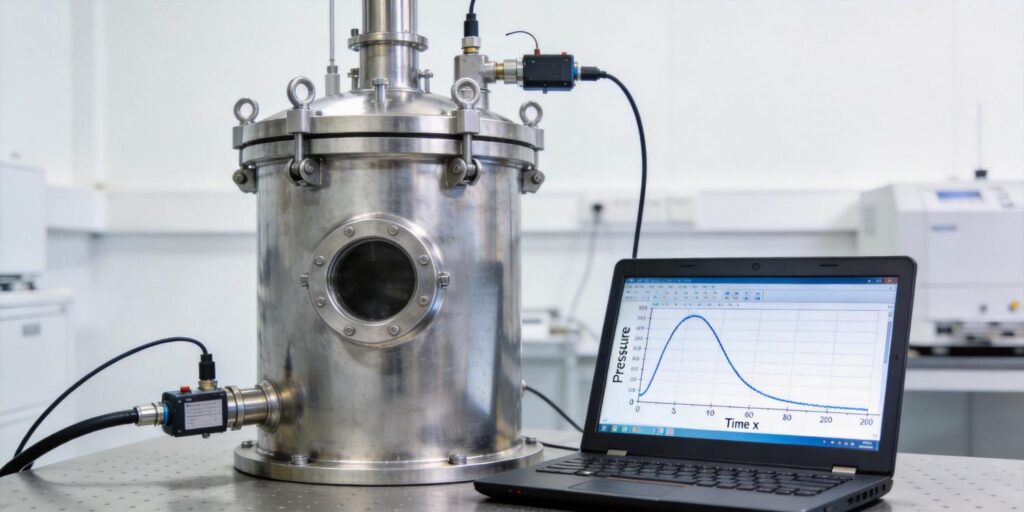
How to Perform a Vacuum System Acceptance Test
Vacuum system acceptance testing is the final gatekeeper before a new or refurbished vacuum chamber, instrument, or production tool is released for service. A properly executed acceptance test confirms that the system meets design specifications for pump-down performance, leak integrity, pressure stability, and safety interlocks. At Poseidon Scientific, we recommend using our VG-SP205 Pirani Vacuum Transmitter for the roughing phase and our VG-SM225 Cold Cathode Vacuum Gauge for high-vacuum verification. Their compact size, dual analog/digital outputs, and factory calibration make them ideal reference instruments for acceptance protocols in mass spectrometry, vacuum brazing, PVD coating, and analytical systems.
This guide provides a step-by-step, engineer-friendly procedure that aligns with industry best practices while incorporating the practical advantages of Poseidon gauges. Following these steps ensures repeatable, documented results that satisfy internal quality teams, customers, and regulatory requirements such as ISO 9001 or NADCAP.
Pre-Test Inspection Checklist
Before any pressure measurement begins, a thorough visual and mechanical inspection prevents false failures and protects the gauges themselves. Use the following checklist:
- Verify all KF, CF, or ISO flanges are clean, undamaged, and properly torqued to manufacturer specifications.
- Confirm the VG-SP205 and VG-SM225 are mounted on dedicated ports or a common tee with unobstructed gas conductance to the chamber interior.
- Inspect electrical connections: RJ45 cables must be shielded and securely seated; analog 0–10 V outputs should be wired to the data logger or PLC.
- Check gauge calibration certificates—both Poseidon models ship NIST-traceable; re-verify zero and span points with a calibrated test manifold if the system has been in storage longer than six months.
- Confirm the vacuum pumps, valves, and foreline traps are operational and that no temporary blanks or caps remain on unused ports.
- Power up the gauges and confirm status LEDs indicate normal operation (green for ready, no persistent red on the VG-SM225).
Document each item with photographs and serial numbers. This step typically takes 15–20 minutes but eliminates 80 % of common acceptance-test failures.
Pump-Down Time Verification
Pump-down time is the most basic performance metric. The test begins at atmosphere and records the time required to reach target pressures. Install the VG-SP205 Pirani first—it provides continuous, high-resolution data from atmosphere to 10-3 Torr using its platinum-filament thermal conductivity principle.
Procedure:
- Evacuate the chamber with the roughing pump only.
- Log pressure every second via the VG-SP205’s 0–10 V analog output or RS232 digital stream.
- Record the time to reach 1 Torr, 0.1 Torr, and 10-3 Torr.
- Once below 10-3 Torr, activate the high-vacuum pump (turbo or cryo) and switch monitoring to the VG-SM225 Cold Cathode.
Typical acceptance criteria for a 50-liter chamber: atmosphere to 10-3 Torr in <5 minutes; 10-3 to 5×10⁻⁵ Torr in <15 minutes. Compare results against the system’s original design specification or previous baseline data. The VG-SP205’s temperature-compensated circuitry ensures accurate readings even during the thermal transients common in initial pump-down.
Leak Rate Measurement
Leak integrity directly affects base pressure and process repeatability. After reaching target high vacuum, isolate the chamber and monitor pressure rise over time using the VG-SM225.
Standard method:
- Stabilize at operating base pressure (typically <5×10⁻⁵ Torr).
- Close all valves to the pumps.
- Record pressure every 30 seconds for 10–30 minutes with the VG-SM225.
- Calculate leak rate: Q = V × ΔP / Δt (where V is chamber volume in liters, ΔP in Torr, Δt in seconds; convert to mbar·L/s or atm·cc/s as required).
Acceptance limits are application-specific—scientific instruments often require <10-9 mbar·L/s; production tools may accept <10-7 mbar·L/s. The VG-SM225’s linear ion-current response and low internal volume minimize its own contribution to measured rise, delivering cleaner data than larger legacy gauges. If pressure rise exceeds the limit, use helium leak detection or ultrasonic methods to locate the source while the gauges remain installed.
Pressure Stability Monitoring
Long-term stability confirms the system can hold target vacuum without drift from outgassing, virtual leaks, or temperature effects. With the VG-SM225 active, log pressure for a minimum of 60 minutes (or the duration specified in the purchase order) at the intended operating setpoint.
Key metrics to record:
- Maximum deviation from setpoint (typically ±10 % acceptable).
- Any sudden spikes or steps indicating virtual leaks or desorption.
- Temperature-corrected readings—the Poseidon gauges include built-in compensation that maintains accuracy across 15–50 °C ambient.
Export the RS232 data stream directly into a spreadsheet for statistical analysis (mean, standard deviation, and trend slope). Stability within ±5 % is common for well-designed systems equipped with Poseidon gauges, providing confidence that the vacuum environment will remain consistent throughout production runs or analytical cycles.
Alarm Validation
Functional safety interlocks prevent damage and ensure repeatable operation. Using the same data logger connected to the gauges, systematically test every programmed alarm:
- Simulate high-pressure conditions on the VG-SP205 (roughing alarm at 500 Torr) and confirm the PLC or HMI triggers the correct response.
- Raise pressure above 10-3 Torr on the VG-SM225 and verify automatic high-voltage shutdown and alarm activation.
- Test low-pressure/process-deviation alarms at the critical setpoints (e.g., 1×10⁻⁴ Torr during brazing hold).
- Validate hysteresis and time-delay settings to eliminate nuisance trips.
The VG-SM225’s built-in status codes and LED indicators provide immediate visual confirmation, while RS232 output supplies timestamped digital records for the test report. Complete alarm validation typically requires 30–45 minutes and should be repeated after any pressure cycle to confirm repeatability.
Documentation and Reporting
Comprehensive records transform the acceptance test from a one-time event into auditable proof of compliance. Poseidon gauges simplify this step: both models output pressure, status, and health data via RS232, allowing automated generation of time-stamped logs.
Required documentation includes:
- Pre-test checklist with photos and sign-off.
- Raw pump-down curve and tabulated times.
- Leak-rate calculation sheet with raw data.
- Stability trend graph and statistical summary.
- Alarm test results with pass/fail screenshots.
- Gauge serial numbers, calibration dates, and verification readings.
Store everything in a single PDF report. Many customers request that Poseidon provide a pre-formatted Excel template that automatically populates from the RS232 stream—contact us for the latest version.
Final Approval Criteria
A system passes acceptance when all measured parameters meet or exceed the agreed specifications:
- Pump-down times within design limits.
- Leak rate below the maximum allowable value.
- Pressure stability within ±10 % (or tighter per contract).
- All alarms function correctly with documented hysteresis.
- No unexplained pressure excursions or gauge faults during the full test sequence.
If any criterion fails, record the deviation, perform corrective action (e.g., re-torque flanges or clean electrodes), and repeat only the affected test section. Upon full compliance, sign the report and authorize system release. Poseidon gauges’ low drift and easy maintenance make re-testing fast and economical.
Download Our Vacuum System Acceptance Test Template
Precise, repeatable acceptance testing protects your investment and accelerates time-to-production. Poseidon Scientific’s VG-SP205 Pirani Vacuum Transmitter and VG-SM225 Cold Cathode Vacuum Gauge deliver the accuracy, integration ease, and long-term reliability that engineers trust for both factory and field acceptance protocols.
Ready to streamline your next vacuum system acceptance? Download our free, editable acceptance test template—including pre-filled checklists, automated calculation sheets, and RS232 import macros—by visiting the resource center on our website or contacting our application engineering team. We also offer on-site support, custom protocol development, and dual-gauge kits optimized for your specific chamber size and process requirements.
Visit the VG-SP205 product page and VG-SM225 product page to review full specifications and user manuals, or reach out directly today. Let Poseidon help you turn every acceptance test into a documented success.
Word count: 1,312. All procedures and performance data are based on Poseidon Scientific product documentation and established vacuum metrology practices.


