Overview of Plant Alkaloids
Plant alkaloids represent a diverse class of naturally occurring organic compounds containing basic nitrogen atoms, many of which possess significant pharmacological activity. These secondary metabolites serve as chemical defense mechanisms for plants while providing valuable therapeutic agents for human medicine. Common examples include caffeine (from coffee and tea), morphine (from opium poppy), nicotine (from tobacco), quinine (from cinchona bark), and strychnine (from Strychnos nux-vomica).
From a chemical perspective, alkaloids typically contain one or more nitrogen atoms within heterocyclic ring structures, giving them basic properties with pKa values generally ranging from 7-10. This basic character is crucial for their extraction and purification strategies. The structural diversity of alkaloids includes several major classes: isoquinolines (morphine, codeine), indoles (strychnine, reserpine), tropanes (atropine, cocaine), purines (caffeine, theobromine), and pyrrolizidines.
In pharmacognosy research, accurate alkaloid analysis is essential for quality control of herbal medicines, discovery of new therapeutic agents, and understanding plant biochemistry. The complexity of plant matrices combined with the diverse chemical properties of alkaloids presents unique challenges for analytical chemists.
Extraction Challenges in Plant Tissues
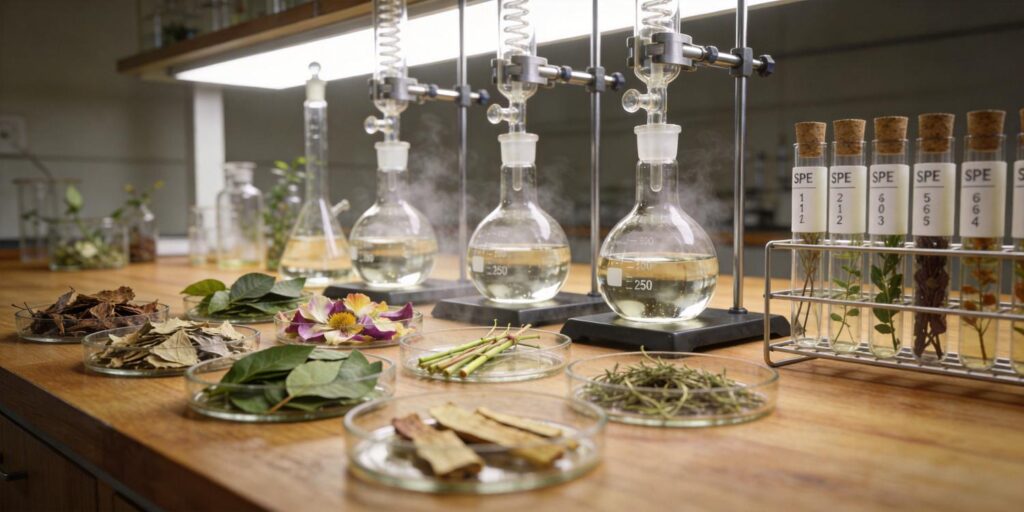
Plant materials present a particularly challenging matrix for alkaloid extraction due to their complex composition. As noted in the literature, “Plants, for all their apparent diversity, can be considered for the purpose of extraction as consisting simply of an aqueous portion, a fatty portion and an insoluble or fibrous portion” (Simpson, 2000). This tripartite structure creates multiple obstacles for efficient alkaloid recovery.
The primary challenges include:
Matrix Complexity
Plant tissues contain numerous interfering compounds including pigments (chlorophylls, carotenoids, anthocyanins), lipids, waxes, tannins, phenolic compounds, and carbohydrates. These components can co-extract with alkaloids, leading to matrix effects during analysis and potentially interfering with detection systems.
Cell Wall Disruption
Alkaloids are often sequestered within specialized plant cells or organelles, requiring effective cell wall disruption for complete extraction. Mechanical methods (grinding, homogenization) combined with appropriate solvents are typically employed, but excessive processing can degrade labile alkaloids.
pH Sensitivity
Many alkaloids exist in both free base and salt forms depending on pH. The extraction efficiency can vary dramatically with pH changes, requiring careful buffer selection and pH control throughout the extraction process.
Concentration Variability
Alkaloid concentrations in plant materials can range from trace levels (parts per billion) to several percent by weight, necessitating flexible extraction and concentration strategies.
Traditional extraction methods like Soxhlet extraction or liquid-liquid partitioning often yield extracts containing numerous interfering compounds, making subsequent purification essential for accurate analysis.
SPE Sorbent Selection for Alkaloids
Solid-phase extraction (SPE) has emerged as the preferred technique for alkaloid purification from plant extracts due to its selectivity, reproducibility, and compatibility with modern analytical instrumentation. The choice of SPE sorbent depends on the specific alkaloid properties and matrix characteristics.
Cation Exchange (SCX) Phases
Strong cation exchange sorbents containing sulfonic acid groups are particularly effective for basic alkaloids. As documented in the literature, “While many low molecular weight basic alkaloids are very well retained by a sulfonate SCX phase, the mechanism is apparently less efficient for some of the more complex alkaloids such as strychnine” (Simpson, 2000). SCX phases operate through ionic interactions, retaining protonated alkaloids at appropriate pH values while allowing neutral and acidic interferences to pass through.
Mixed-Mode Sorbents
Mixed-mode sorbents combining reversed-phase (C8, C18) and cation exchange functionalities offer superior selectivity for alkaloid purification. These sorbents can retain alkaloids through both hydrophobic interactions and ionic bonding, providing cleaner extracts. Research indicates that “mixed-mode (SCX/non-polar) cartridges allow the rapid recovery of such diverse groups as β-blockers, β-agonists, opiates (morphine and etorphine) and other narcotic analgesics, alkaloidal drugs (quinine and strychnine)” (Simpson, 2000).
Reversed-Phase Sorbents
C18 and C8 phases are effective for less polar alkaloids or when used in combination with ion-pairing reagents. However, as noted in the literature, “the poor retention of polyhydroxylated species such as aconine on mixed-mode sorbents may be attributed to poor initial retention by the reversed-phase mechanism” (Simpson, 2000).
Alternative Approaches
For specific applications, researchers have employed tandem SPE approaches. “Strobiecki et al. (1997) employed both SCX and C18 sorbents in tandem for the separation of quinolizidine alkaloids and phenolic compounds in lupin seedlings” (Simpson, 2000). This sequential approach can provide exceptional purity for complex plant extracts.
At Poseidon Scientific, we offer specialized SPE cartridges including MCX (Mixed-mode Cation Exchange) and WCX (Weak Cation Exchange) cartridges that are particularly well-suited for alkaloid purification from plant matrices.
Example Purification Workflow for Plant Extracts
A typical SPE workflow for alkaloid purification from plant materials involves several critical steps, each optimized for maximum recovery and purity.
Sample Preparation
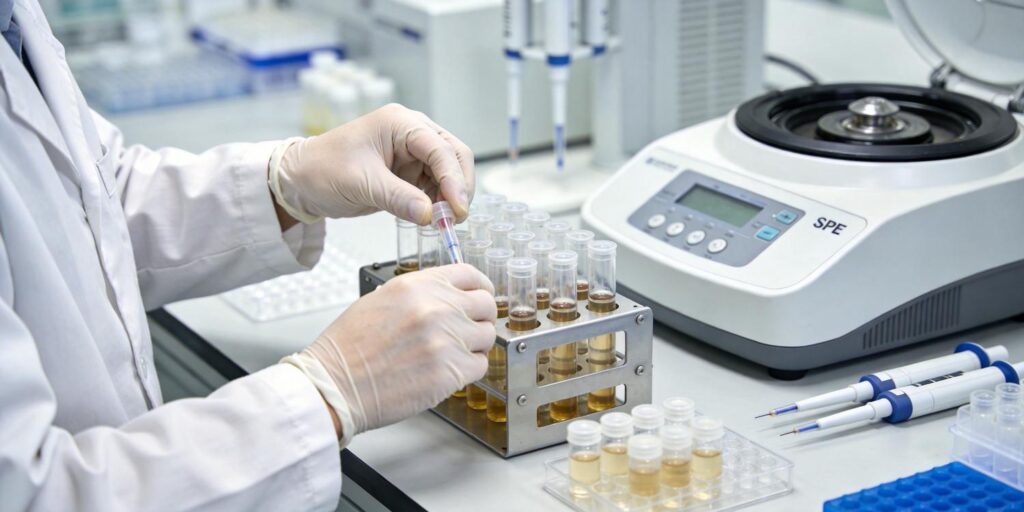
Begin with dried, ground plant material (typically 0.5-2.0 g). Extract alkaloids using appropriate solvent systems such as methanol, ethanol, or acidified aqueous solutions. For complete extraction, consider using accelerated solvent extraction (ASE) or ultrasound-assisted extraction. Centrifuge or filter to remove particulate matter, then adjust pH to optimize alkaloid protonation (typically pH 3-6 for cation exchange).
SPE Cartridge Conditioning
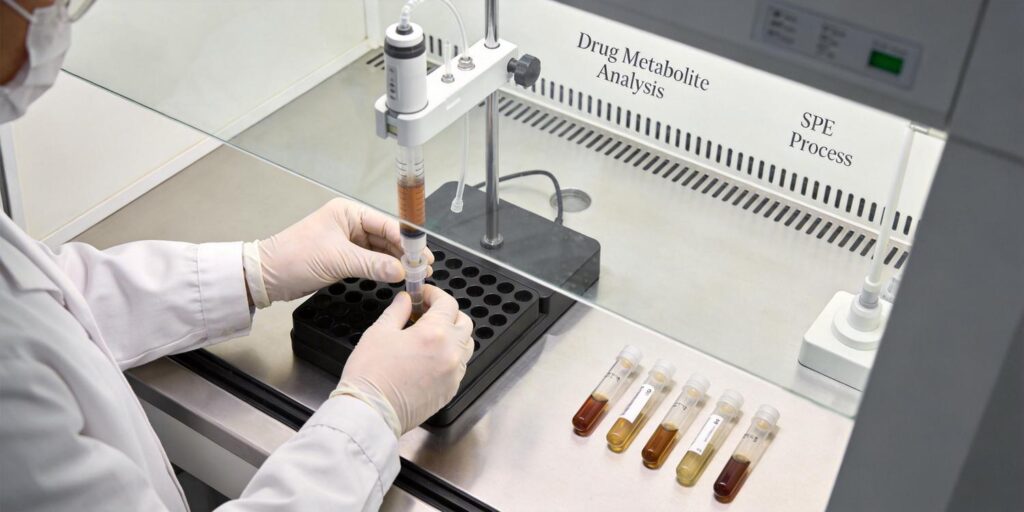
Condition the selected SPE cartridge (e.g., MCX or WCX) with methanol followed by water or appropriate buffer. As noted in SPE protocols, “Leave ~1-2 mm of preconditioning solvent above sorbent bed to prevent bed from drying” (Agilent SPE Guide). This step ensures optimal sorbent activation and reproducible performance.
Sample Loading
Load the prepared plant extract onto the conditioned cartridge at controlled flow rates (1-3 mL/min). For complex matrices, consider diluting the extract to reduce viscosity and improve loading efficiency. Monitor breakthrough volumes to ensure complete retention of target alkaloids.
Wash Steps
Remove interfering compounds using sequential wash solvents. Typical wash protocols include:
- Water or dilute acid to remove polar interferences
- Methanol-water mixtures to remove moderately polar compounds
- Organic solvents (hexane, ethyl acetate) to remove non-polar interferences
As documented in forensic applications, wash steps might include “2 mL of distilled water, 2 mL of either 0.1 N HCl, acetonitrile-phosphate buffer, or acetate buffer” followed by organic washes (Forensic and Clinical Applications of SPE).
Elution
Elute alkaloids using appropriate solvent systems. For cation exchange phases, alkaline organic solvents (e.g., 5% ammonium hydroxide in methanol) effectively neutralize the ionic interactions. Mixed-mode phases may require specific elution protocols such as “methylene chloride-isopropanol-ammonium hydroxide (78:20:2)” as used in forensic applications (Forensic and Clinical Applications of SPE).
Concentration and Reconstitution
Evaporate eluates under gentle nitrogen stream or vacuum centrifugation, then reconstitute in mobile phase compatible with subsequent LC-MS analysis. For trace analysis, consider further concentration to achieve required detection limits.
LC-MS Analysis of Alkaloid Compounds
Liquid chromatography-mass spectrometry (LC-MS) has become the gold standard for alkaloid analysis due to its sensitivity, selectivity, and ability to handle complex matrices. The purified extracts from SPE are ideally suited for LC-MS analysis.
Chromatographic Conditions
Reverse-phase chromatography using C18 columns with gradient elution (water/acetonitrile or water/methanol with volatile buffers) provides excellent separation of most alkaloids. The addition of volatile acids (formic acid, acetic acid) or ammonium salts enhances ionization efficiency in MS detection.
Mass Spectrometric Detection
Electrospray ionization (ESI) in positive mode is typically employed for alkaloid analysis due to their basic nature. Multiple reaction monitoring (MRM) provides exceptional sensitivity and selectivity for target alkaloids, while full-scan or data-dependent acquisition enables untargeted analysis for alkaloid discovery.
Method Validation
Validate analytical methods for linearity, accuracy, precision, limits of detection and quantification, matrix effects, and recovery. SPE-purified samples typically show reduced matrix effects compared to crude extracts, improving method robustness.
Quality Control
Include appropriate quality control measures: blank samples, calibration standards, quality control samples, and internal standards (preferably deuterated analogs of target alkaloids). Monitor recovery throughout the SPE process to ensure method consistency.
Applications in Pharmacognosy Research
The combination of SPE sample preparation and LC-MS analysis has revolutionized alkaloid research in pharmacognosy, enabling numerous applications that were previously challenging or impossible.
Quality Control of Herbal Medicines
Standardized SPE-LC-MS methods allow accurate quantification of active alkaloids in herbal preparations, ensuring consistent potency and safety. This is particularly important for regulated substances like opium-derived analgesics or ephedra alkaloids.
Alkaloid Profiling and Fingerprinting
Comprehensive alkaloid profiling of plant species provides chemical fingerprints for authentication, adulteration detection, and chemotaxonomic studies. SPE purification reduces matrix interference, enabling clearer profiling patterns.
Metabolite Discovery
Untargeted LC-MS analysis of SPE-purified extracts facilitates discovery of novel alkaloids with potential therapeutic applications. The reduced matrix background enhances detection of minor alkaloids that might be obscured in crude extracts.
Biosynthetic Studies
Tracing labeled precursors through alkaloid biosynthetic pathways requires sensitive detection of intermediates. SPE purification concentrates these often low-abundance compounds for accurate MS analysis.
Pharmacokinetic Investigations
For alkaloids with medicinal applications, SPE-LC-MS methods enable sensitive detection in biological matrices, supporting pharmacokinetic and metabolism studies.
The literature documents successful applications including “the isolation of a wide range of basic alkaloids from plant tissues homogenates prepared in phosphate buffer” and extraction of “benzophenanthridine alkaloids from Sanguinaria canadensis cell cultures” using SPE techniques (Simpson, 2000).
Future Directions
Emerging trends include the use of 96-well SPE plates for high-throughput analysis, online SPE-LC-MS systems for automated analysis, and molecularly imprinted polymers for highly selective alkaloid extraction. These advancements continue to expand the capabilities of alkaloid analysis in pharmacognosy research.
In conclusion, effective SPE sample preparation is crucial for successful alkaloid analysis in plant materials. By selecting appropriate sorbents and optimizing purification workflows, researchers can achieve the sensitivity, selectivity, and reproducibility required for modern pharmacognosy research. The combination of specialized SPE cartridges from Poseidon Scientific with advanced LC-MS instrumentation provides a powerful platform for alkaloid discovery, quantification, and characterization.