Migration Testing Requirements for Food Packaging
Food packaging migration testing represents a critical component of food safety assessment, designed to evaluate the potential transfer of substances from packaging materials into food products. Regulatory bodies worldwide, including the FDA, EFSA, and various national authorities, mandate comprehensive migration testing to ensure consumer protection from potentially harmful chemicals that could leach from packaging materials.
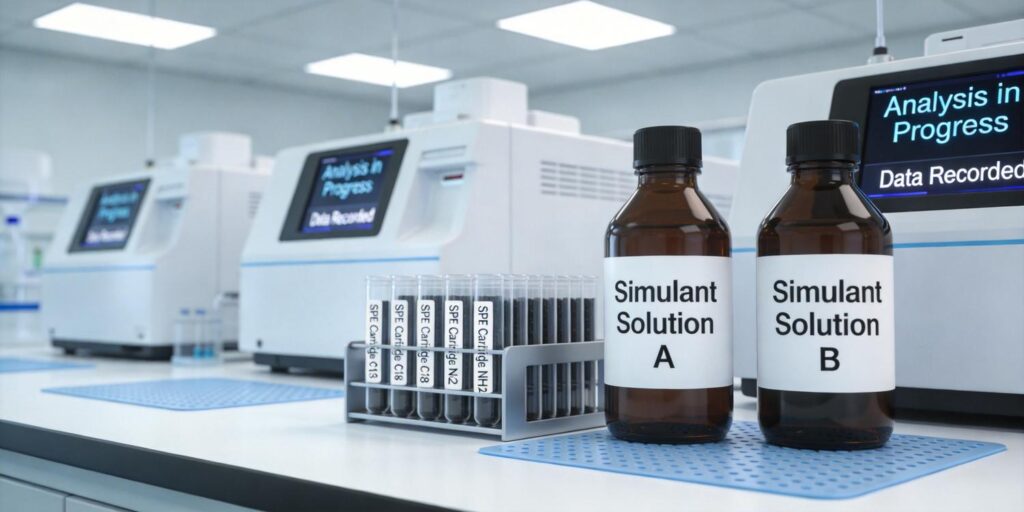
The fundamental principle behind migration testing involves simulating real-world conditions where food packaging comes into contact with food products. This typically involves using food simulants – standardized liquids that mimic different types of foods based on their chemical properties. Common food simulants include:
- Distilled water (for aqueous foods)
- 3% acetic acid (for acidic foods)
- 10% ethanol (for alcoholic foods)
- Vegetable oil (for fatty foods)
Testing protocols specify contact times and temperatures that reflect actual storage conditions, ranging from refrigerated storage to high-temperature processing. The European Union’s Framework Regulation (EC) No 1935/2004 and Commission Regulation (EU) No 10/2011 establish specific migration limits (SMLs) for various substances, while the FDA’s Food Contact Notification program provides similar oversight in the United States.
Target Analytes: Phthalates and Plasticizers
Plasticizers represent one of the most critical classes of compounds monitored in food packaging migration testing. These additives enhance the flexibility, durability, and workability of plastic materials but can potentially migrate into food products. The primary target analytes include:
Phthalate Esters
Phthalates are among the most widely used plasticizers in food packaging materials. Key compounds of concern include:
- Diethyl phthalate (DEP)
- Dibutyl phthalate (DBP)
- Bis(2-ethylhexyl) phthalate (DEHP)
- Bis(2-ethylhexyl) adipate
Research has identified these compounds as potential endocrine disruptors, leading to strict regulatory limits. For instance, DEHP has specific migration limits established at 1.5 mg/kg in food simulants under EU regulations.
Other Plasticizers
Beyond phthalates, other plasticizers of concern include:
- Triethyl citrate
- Tributyl citrate
- Acetyl triethyl citrate
- Dibutyl sebacate
- Triacetin
These compounds are commonly used in various polymer formulations and require careful monitoring due to their potential migration characteristics.
SPE Sorbent Selection for Plasticizer Extraction
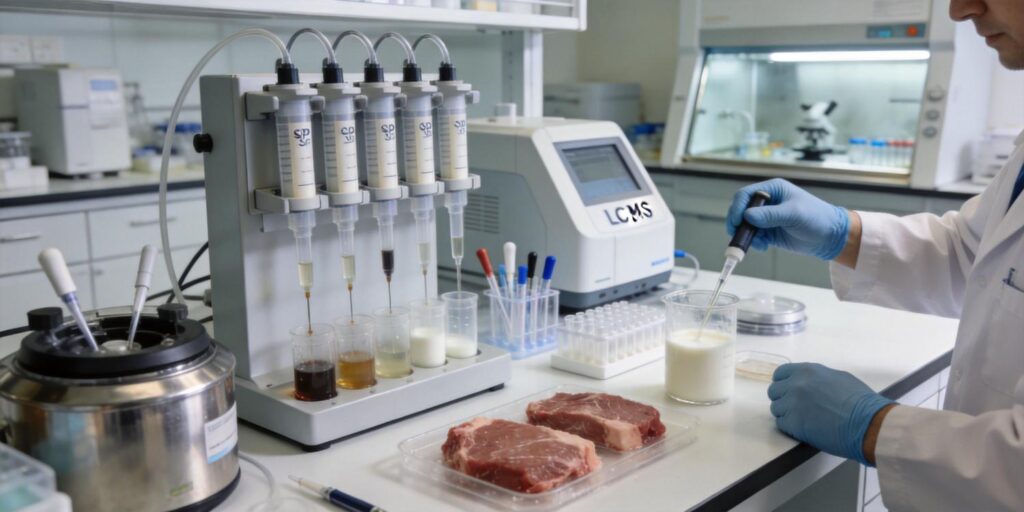
Solid Phase Extraction (SPE) has emerged as the preferred technique for plasticizer extraction from food simulants due to its efficiency, reproducibility, and reduced solvent consumption compared to traditional liquid-liquid extraction methods. The selection of appropriate SPE sorbents is crucial for successful plasticizer analysis.
Primary Sorbent Choices
HLB (Hydrophilic-Lipophilic Balanced) Sorbents: These polymeric sorbents containing N-vinylpyrrolidone and divinylbenzene copolymers offer excellent retention for medium-polar and non-polar compounds like plasticizers. Their dual retention mechanism makes them particularly effective for extracting phthalates from aqueous food simulants.
C18 Bonded Silica: Traditional reversed-phase sorbents provide reliable retention for hydrophobic plasticizers. However, careful conditioning is essential to avoid secondary interactions with residual silanol groups that can affect recovery.
Specialized Considerations
When selecting SPE sorbents for plasticizer extraction, several critical factors must be considered:
- Contaminant Awareness: SPE cartridge components themselves can be sources of plasticizer contamination. Polypropylene housings, polyethylene frits, and even bonded silica phases can contain plasticizers like dibutyl phthalate and bis(2-ethylhexyl) phthalate. Proper conditioning with strong solvents before sample application helps minimize these interferences.
- pH Optimization: Plasticizers typically require neutral pH conditions (pH 3) for optimal SPE retention. However, secondary interactions with silanol groups may require pH adjustment to 9 just before elution to achieve quantitative recoveries.
- Matrix Compatibility: Different food simulants present varying challenges. Aqueous simulants work well with standard SPE protocols, while fatty food simulants may require additional clean-up steps or specialized sorbents.
Example Workflow for Food Simulant Samples
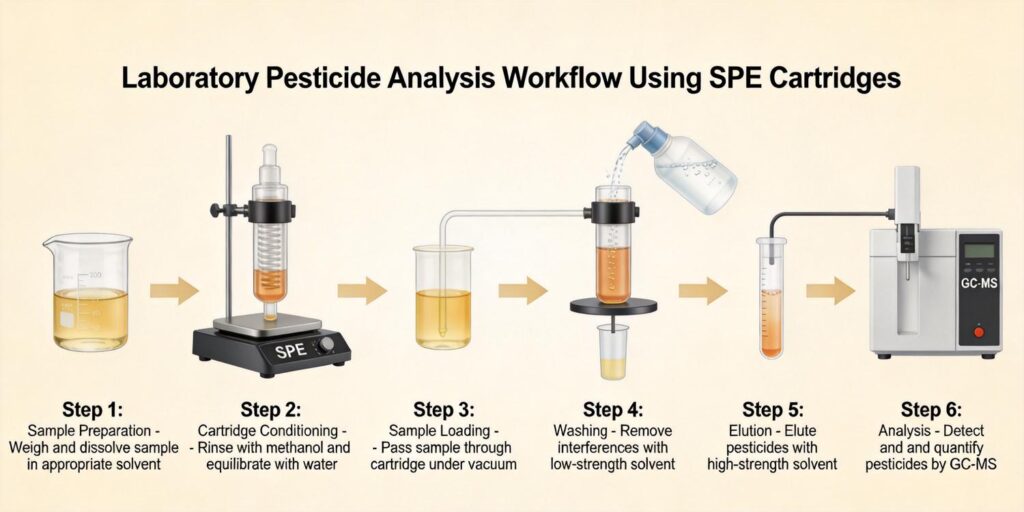
A comprehensive SPE workflow for plasticizer extraction from food simulants typically follows these steps:
1. Sample Preparation
Food simulant samples are collected after appropriate contact time with packaging materials. For fatty food simulants, initial extraction with acetone or hexane may be necessary before SPE clean-up.
2. SPE Cartridge Conditioning
Critical step to remove potential contaminants from SPE components:
- Condition with 5-10 mL of methanol (or elution solvent)
- Equilibrate with 5-10 mL of water or appropriate buffer
- Maintain sorbent wetness throughout the process
3. Sample Loading
Apply the food simulant sample to the conditioned SPE cartridge at controlled flow rates (typically 1-5 mL/min). For large volume samples, vacuum or positive pressure manifolds ensure consistent processing.
4. Washing Steps
Remove interfering matrix components while retaining target plasticizers:
- 5-10 mL of water or water/methanol mixtures (5-20% methanol)
- Optional: Additional wash with hexane for fatty samples
5. Elution
Selective elution of plasticizers using appropriate solvents:
- Primary elution: 5-10 mL of methylene chloride or ethyl acetate
- Alternative: Acetone/CO₂ mixtures for specialized applications
- For difficult elutions: Consider supercritical fluid extraction techniques
6. Concentration and Reconstitution
Evaporate eluate to dryness under gentle nitrogen stream and reconstitute in appropriate solvent for analysis (typically 100-500 μL of methanol or acetonitrile).
LC-MS or GC-MS Detection
Modern analytical laboratories employ sophisticated detection techniques for plasticizer analysis, each with specific advantages:
Gas Chromatography-Mass Spectrometry (GC-MS)
GC-MS remains the gold standard for plasticizer analysis due to its excellent separation efficiency and sensitivity:
- Column Selection: Non-polar or mid-polar capillary columns (5% phenyl methylpolysiloxane) provide optimal separation
- Ionization: Electron impact (EI) ionization at 70 eV generates characteristic fragmentation patterns
- Detection Modes: Selected ion monitoring (SIM) for targeted analysis; full scan for unknown identification
- Typical Limits: Detection limits in the low ng/mL range
Liquid Chromatography-Mass Spectrometry (LC-MS)
LC-MS offers advantages for less volatile plasticizers and complex matrices:
- Column Selection: C18 or C8 reversed-phase columns with methanol/water or acetonitrile/water gradients
- Ionization: Electrospray ionization (ESI) in positive or negative mode, depending on the analyte
- Detection: Multiple reaction monitoring (MRM) provides exceptional selectivity and sensitivity
- Advantages: No derivatization required, suitable for thermally labile compounds
Method Validation Considerations
Both techniques require comprehensive validation including:
- Linearity studies (typically 1-1000 ng/mL)
- Recovery assessments (acceptable range: 70-120%)
- Precision evaluation (RSD < 15%)
- Limit of detection/quantification determination
- Matrix effect evaluation
Regulatory Compliance Testing
Regulatory compliance testing for plasticizers in food packaging follows established international standards and guidelines:
European Union Framework
The EU’s comprehensive regulatory system includes:
- Framework Regulation (EC) No 1935/2004: General requirements for all food contact materials
- Commission Regulation (EU) No 10/2011: Specific rules for plastic materials and articles
- Specific Migration Limits (SMLs): Established for individual substances based on toxicological assessments
- Overall Migration Limit (OML): 10 mg/dm² of food contact surface
United States Regulations
The FDA regulates food contact materials through:
- Food Contact Notification (FCN) Program: Pre-market approval for new substances
- Threshold of Regulation (TOR): Exemptions for substances with minimal migration
- Food Additive Regulations: Specific limitations for approved substances
Testing Protocol Requirements
Compliance testing must adhere to standardized protocols:
- Test Conditions: Time-temperature conditions reflecting intended use
- Food Simulants: Appropriate selection based on food type
- Analytical Methods: Validated methods with documented performance characteristics
- Reporting: Comprehensive documentation including method validation data
Quality Assurance Measures
Effective compliance testing requires robust quality systems:
- Use of certified reference materials
- Regular participation in proficiency testing programs
- Implementation of internal quality control samples
- Documented method validation and verification
- Adherence to ISO/IEC 17025 accreditation requirements
The integration of SPE techniques with advanced detection methods has revolutionized plasticizer analysis in food packaging migration testing. By providing efficient, reproducible extraction with minimal solvent consumption, SPE enables laboratories to meet increasingly stringent regulatory requirements while maintaining high throughput and analytical confidence. As regulatory standards continue to evolve and detection limits become more demanding, SPE methodologies will remain essential tools for ensuring food packaging safety and regulatory compliance.
For laboratories seeking optimized SPE solutions for plasticizer analysis, HLB SPE cartridges offer excellent performance for medium-polar compounds, while MCX mixed-mode cartridges provide additional selectivity for complex matrices. High-throughput applications benefit from 96-well SPE plates that streamline sample processing while maintaining analytical integrity.