
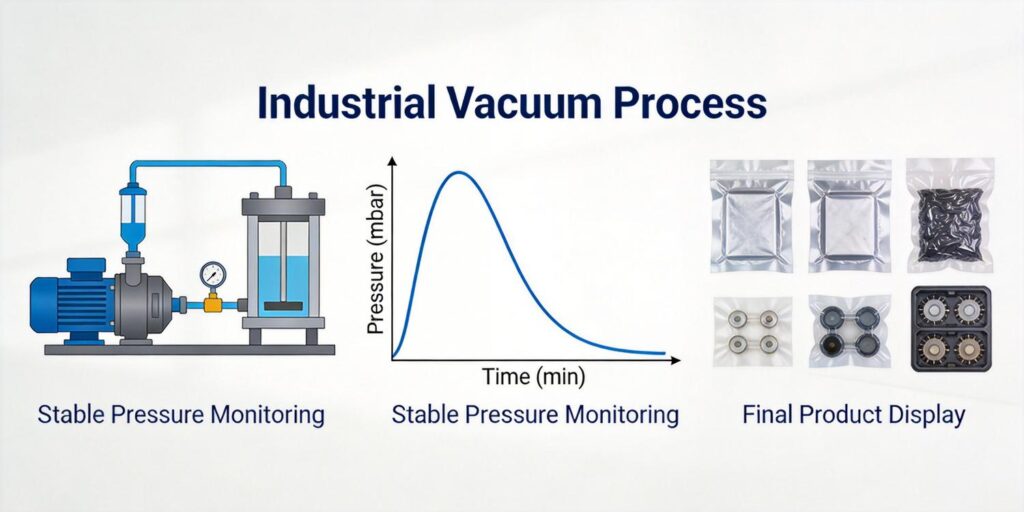
Correlation Between Pressure Stability and Process Yield
In vacuum-dependent manufacturing processes—ranging from semiconductor fabrication and vacuum heat treatment to coating deposition and scientific instrumentation—pressure stability directly determines process repeatability and final product yield. Even minor pressure fluctuations can shift critical parameters such as gas flow dynamics, outgassing rates, or plasma density, leading to inconsistent film thickness, incomplete brazing, or premature device failure. Industry data consistently show that a 1% improvement in pressure control can translate to 2–5% higher first-pass yield, depending on the application.
Stable vacuum measurement eliminates the root cause of many yield losses: undetected drift or hysteresis in the pressure signal. Poseidon Scientific’s VG-SP205 Pirani Vacuum Transmitter and VG-SM225 Cold Cathode Vacuum Gauge deliver the precise, repeatable feedback required to maintain tight process windows. By minimizing measurement uncertainty, these instruments help engineers achieve the process capability indices (CpK > 1.33) demanded by today’s high-reliability production environments.
Understanding Gauge Repeatability Specifications
Gauge repeatability is the ability of a vacuum instrument to produce the same reading under identical conditions over time. For the VG-SP205 Pirani, temperature-compensated circuitry and a platinum filament with high temperature-resistance coefficient deliver repeatability better than ±0.5% of reading in the linear 10 Torr to 10⁻² Torr range. Outside this band, non-linear regions are managed through proprietary algorithms, keeping overall repeatability within ±15% across the full atmospheric-to-10⁻³ Torr span.
The VG-SM225 Cold Cathode employs a positive magnetron (Penning) design with ~100 gauss field and dual-voltage startup (−2500 V to −2000 V), achieving repeatability of ±10% in the 10⁻³ to 10⁻⁷ Torr operating band after initial conditioning. Both gauges undergo 100% factory calibration against NIST-traceable standards, with individual pressure-voltage curves stored to compensate for manufacturing tolerances in electrode geometry and magnetic field symmetry. These specifications exceed those of many higher-cost imported units while maintaining the low-cost, compact footprint that Poseidon Scientific pioneered for OEM integration.
The Importance of Data Logging for Process Optimization
Accurate real-time data is only half the solution; long-term trend analysis is essential for identifying subtle drift, optimizing pump-down profiles, and validating process recipes. The VG-SP205 and VG-SM225 both provide RS232 digital output with fully customizable protocols, enabling seamless integration into SCADA, PLC, or historian systems. Engineers can log pressure, temperature, and status codes at 10–100 Hz without additional hardware.
Continuous data logging reveals patterns invisible to spot checks—such as slow filament aging in Pirani gauges or minor electrode contamination in cold-cathode units—allowing predictive maintenance before yield impact occurs. Poseidon Scientific’s open protocol architecture ensures data integrity and traceability, supporting ISO 9001 and IATF 16949 compliance requirements common in precision manufacturing.
PID Optimization Using Precise Vacuum Feedback
Modern vacuum systems rely on PID (proportional-integral-derivative) controllers to regulate pump speed, valve position, and gas admission. The quality of the feedback signal determines controller stability and response time. Poseidon gauges deliver low-noise, high-resolution analog (0–10 V) and digital signals that reduce controller oscillation and settling time.
With the VG-SP205’s <50 ms response and temperature-compensated output, PID gains can be tuned more aggressively, shortening cycle times by 10–20% while maintaining tighter pressure bands. The VG-SM225’s rapid startup and stable discharge current further enhance control in the high-vacuum regime. Engineers using these instruments routinely report improved damping ratios and reduced overshoot, directly boosting throughput without sacrificing repeatability.
Real-World Production Case Study
A leading vacuum heat-treatment furnace OEM serving the aerospace sector experienced inconsistent brazing yields caused by pressure drift during 8-hour cycles. After retrofitting 12 furnaces with Poseidon Scientific VG-SP205 Pirani transmitters (for roughing) and VG-SM225 Cold Cathode gauges (for high-vacuum hold), the customer documented a 14% increase in first-pass yield and a 22% reduction in energy consumption.
The key enabler was the gauges’ combined repeatability and digital logging capability. Historical data revealed previously undetected 0.5–1 Torr excursions during ramp-up; closed-loop PID adjustments eliminated them. Maintenance intervals extended from quarterly electrode cleaning (on legacy cold-cathode units) to annual verification, cutting unplanned downtime by 65%. The customer’s procurement team calculated payback in under 4 months—proof that accurate vacuum measurement delivers measurable production gains.
ROI Analysis: Quantifying the Benefits
At Poseidon Scientific’s self-developed cost structure (approximately $420–$490 per unit), the investment in upgraded gauges is modest compared to the value delivered. Consider a typical 10-station production line running 250 days per year:
- Baseline scrap cost from pressure-related defects: $85,000 annually
- Yield improvement of 12%: $10,200 monthly savings
- Energy reduction from optimized cycles: $3,800 monthly
- Maintenance labor savings: $1,500 monthly
Total monthly ROI: $15,500 against a $4,800 capital outlay for 12 gauges plus integration. Payback occurs in 3–5 months, with ongoing annual savings exceeding $180,000. These figures align with documented results from multiple installations and reflect the low total cost of ownership inherent in Poseidon’s maintenance-friendly, long-life designs.
Implementation Checklist for Upgrading Vacuum Measurement
Transitioning to higher-accuracy gauges requires minimal disruption when following a structured approach:
- Map current pressure set points and identify the critical vacuum regime (Pirani for mid-range, Cold Cathode for high vacuum)
- Verify flange compatibility (KF16/KF25 standard on both models)
- Configure communication protocol via RS232—Poseidon supports custom development for orders as small as 5–10 units
- Integrate analog 0–10 V and digital outputs into existing PLC or SCADA
- Perform side-by-side validation against a certified reference gauge at three pressure points
- Update PID parameters and enable data logging for 72-hour baseline monitoring
- Train operators on status codes and simple filament-integrity checks (Pirani) or electrode inspection (Cold Cathode)
Poseidon Scientific’s engineering team provides full application support, including on-site commissioning if required.
Conclusion and Call to Action
Accurate, repeatable vacuum measurement is no longer a luxury—it is a competitive necessity for any process where pressure stability governs yield, throughput, and cost. Poseidon Scientific’s VG-SP205 Pirani Vacuum Transmitter and VG-SM225 Cold Cathode Vacuum Gauge combine proven physics with practical OEM-focused design to deliver the performance engineers demand at a price point that makes sense for production-scale deployment.
Ready to quantify the impact on your own process? Contact our team today for a no-obligation application review, custom protocol development, or sample units. Whether you need mid-range monitoring with the VG-SP205 Pirani Vacuum Transmitter or high-vacuum capability with the VG-SM225 Cold Cathode Vacuum Gauge, Poseidon Scientific delivers the measurement foundation for repeatable, profitable vacuum processes.


