Complex Chemical Composition of Herbal Teas
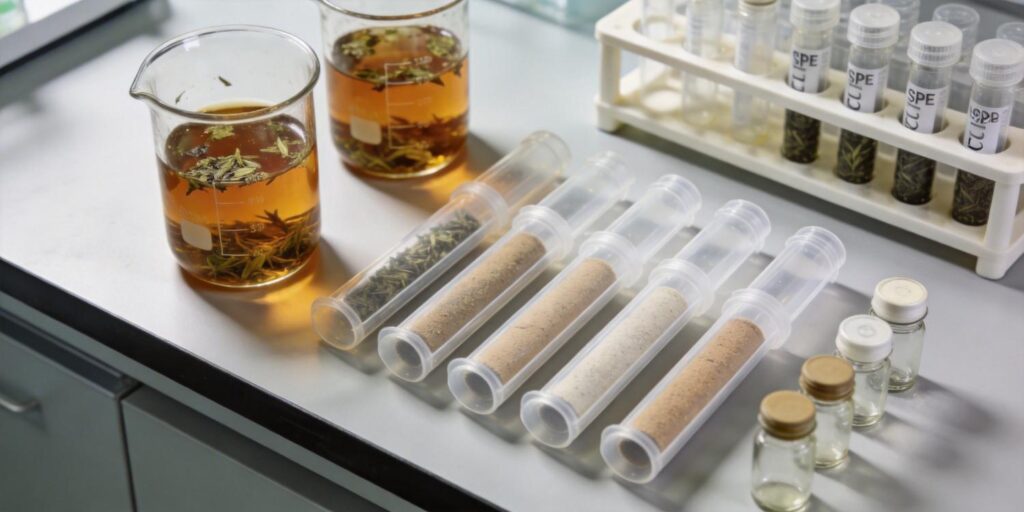
Herbal teas represent one of the most chemically complex matrices encountered in analytical chemistry, containing hundreds to thousands of bioactive compounds that vary significantly based on plant species, growing conditions, and processing methods. These beverages typically contain phenolic acids, flavonoids, tannins, alkaloids, terpenoids, pigments, and various volatile compounds that contribute to their therapeutic properties and sensory characteristics.
According to research by Simpson and Wynne (2000), plant materials like those used in herbal teas contain “highly oxygenated, often water-soluble compounds as potential therapeutic agents and important dietary factors.” The extraction of bioflavonoids such as rutin from plants has been extensively investigated, with various sorbents showing different retention characteristics for these polar compounds. The complexity is further increased by the presence of endogenous plant acids, sugars, and pigments that can interfere with analytical determinations.
Traditional analytical approaches often struggle with this complexity, particularly when using liquid chromatography-mass spectrometry (LC-MS) where matrix effects can significantly impact ionization efficiency and detection limits. The presence of co-eluting compounds can cause ion suppression or enhancement, leading to inaccurate quantification and reduced method sensitivity.
Removing Pigments and Tannins Using SPE
Solid-phase extraction (SPE) offers a powerful solution for removing interfering pigments and tannins from herbal tea extracts prior to LC-MS analysis. These compounds, while beneficial from a nutritional perspective, present significant analytical challenges due to their strong UV absorption, potential for column fouling, and interference with mass spectrometric detection.
Research demonstrates that SPE can effectively remove pigments through selective retention mechanisms. As noted in the literature, “pigments, too, were reportedly eliminated by coagulation steps” in fruit and vegetable analysis, with similar principles applying to herbal tea matrices. The key advantage of SPE lies in its ability to perform class fractionation, separating target analytes from interfering matrix components under mild pH conditions that minimize decomposition or rearrangement of labile compounds.
For herbal teas, the removal of tannins is particularly important as these polyphenolic compounds can bind to proteins and other analytes, potentially causing precipitation or altered chromatographic behavior. SPE methods using appropriate sorbents can selectively retain tannins while allowing target compounds to pass through or be eluted separately, significantly improving analytical performance.
Sorbent Selection for Phenolic Compounds
The selection of appropriate SPE sorbents for phenolic compound analysis in herbal teas requires careful consideration of the target analytes’ chemical properties and the matrix composition. Different sorbents offer varying selectivity and retention mechanisms that can be optimized for specific applications.
C18 and C8 Sorbents
Octadecyl (C18) and octyl (C8) bonded silica sorbents represent the most commonly used materials for phenolic compound extraction. These reversed-phase sorbents provide excellent retention of moderately hydrophobic phenolic compounds through hydrophobic interactions. Research by Buszewski et al. (1992, 1993) demonstrated successful isolation of rutin and other flavonoids using C18 sorbents, while Katalinic (1997) isolated flavans in phenolic fractions using similar approaches.
Mixed-Mode Sorbents
For more complex matrices containing both acidic and basic phenolic compounds, mixed-mode sorbents combining reversed-phase and ion-exchange functionalities offer superior selectivity. These sorbents can retain compounds through multiple interaction mechanisms, allowing for more effective separation of target analytes from matrix interferences.
Specialized Sorbents
For specific applications, specialized sorbents may offer advantages. Polyvinylpolypyrrolidone (PVPP) sorbents have been used for cytokinin extraction from plant tissues, while polystyrene-divinylbenzene polymers provide alternative retention mechanisms for certain phenolic compounds. The choice of sorbent should be guided by the specific phenolic compounds of interest and their chemical properties.
Example Extraction and Cleanup Workflow
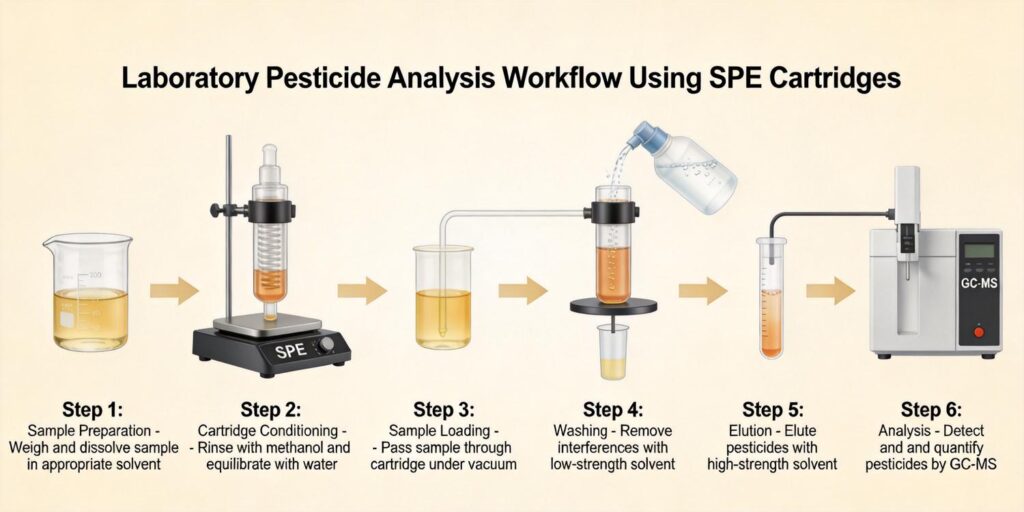
A comprehensive SPE workflow for herbal tea analysis typically involves several key steps designed to maximize recovery while minimizing matrix interference:
- Sample Preparation: Herbal tea samples are typically prepared by brewing under standardized conditions, followed by filtration to remove particulate matter. The extract may be diluted or pH-adjusted depending on the target analytes and selected SPE sorbent.
- SPE Cartridge Conditioning: The selected SPE cartridge (commonly 3 cc/500 mg or 6 cc/1 g formats) is conditioned with appropriate solvents, typically methanol followed by water or buffer solution, to activate the sorbent and ensure reproducible retention.
- Sample Loading: The prepared tea extract is loaded onto the conditioned cartridge at controlled flow rates (typically 1-5 mL/min) to ensure optimal analyte retention.
- Washing: Interfering compounds, including sugars, acids, and some pigments, are removed using appropriate wash solvents. For phenolic compound analysis, this often involves water or dilute aqueous methanol solutions.
- Elution: Target phenolic compounds are eluted using optimized solvent systems, typically methanol, acetonitrile, or mixtures containing small percentages of acid or base to disrupt specific interactions.
- Concentration and Reconstitution: The eluate is concentrated under gentle conditions (often nitrogen evaporation) and reconstituted in mobile phase compatible solvents for LC-MS analysis.
This workflow can be adapted based on specific requirements, with some methods incorporating multiple SPE steps or specialized sorbents for particularly challenging matrices.
LC-MS Analysis Improvements
The implementation of SPE cleanup prior to LC-MS analysis of herbal teas provides several significant improvements in analytical performance:
Reduced Matrix Effects
SPE effectively removes compounds that cause ion suppression or enhancement in the mass spectrometer source, leading to more accurate quantification and improved method robustness. Research has shown that SPE cleanup can eliminate up to 90% of matrix-induced ionization effects in complex plant extracts.
Enhanced Sensitivity
By removing interfering compounds, SPE allows for lower detection limits and improved signal-to-noise ratios. The concentration effect achieved during SPE (typically 10-50 fold) further enhances sensitivity for trace-level phenolic compounds.
Improved Chromatographic Performance
Cleaner extracts result in better chromatographic peak shapes, reduced column fouling, and extended column lifetime. This is particularly important for herbal tea analysis where complex matrices can rapidly degrade analytical columns.
Method Reproducibility
SPE provides more consistent sample preparation compared to traditional liquid-liquid extraction methods, leading to improved method precision and reproducibility across different sample batches and analysts.
Applications in Quality Control
SPE-based methods for herbal tea analysis find extensive applications in quality control and assurance programs within the food, beverage, and nutraceutical industries:
Authenticity Verification
SPE-LC-MS methods enable the establishment of characteristic phenolic profiles that can be used to verify herbal tea authenticity and detect adulteration with cheaper plant materials.
Batch-to-Batch Consistency
Regular monitoring of key phenolic markers using SPE-LC-MS ensures consistent product quality and helps identify variations in raw materials or processing conditions.
Stability Studies
SPE methods facilitate the monitoring of phenolic compound degradation during storage, helping establish shelf-life and optimal storage conditions for herbal tea products.
Regulatory Compliance
For herbal teas marketed with specific health claims, SPE-LC-MS methods provide the analytical rigor needed to support label claims and ensure regulatory compliance regarding bioactive compound content.
Process Optimization
By providing detailed phenolic profiles, SPE-LC-MS analysis supports optimization of extraction and processing conditions to maximize retention of beneficial compounds while minimizing undesirable components.
The integration of SPE cleanup with LC-MS analysis represents a powerful approach for comprehensive characterization of herbal teas, combining the selectivity of solid-phase extraction with the sensitivity and specificity of mass spectrometric detection. This combination addresses the unique challenges posed by complex plant matrices while providing the analytical performance required for both research and quality control applications.