Monitoring Veterinary Drug Residues in Fish Tissue Using SPE
Aquaculture has grown rapidly to meet global protein demand, but with it comes the critical need to monitor veterinary drug residues in fish tissue. Unregulated use of antibiotics, antiparasitics, and growth promoters can lead to residues that pose health risks, including antibiotic resistance and allergic reactions. Regulatory bodies such as the FDA, EU, and Codex Alimentarius have established maximum residue limits (MRLs) for compounds like oxytetracycline, sulfonamides, and quinolones. Solid-phase extraction (SPE) has become the gold standard for sample cleanup and concentration prior to LC-MS/MS analysis, enabling reliable, sensitive, and compliant testing.
Extraction of Fish Tissue Samples
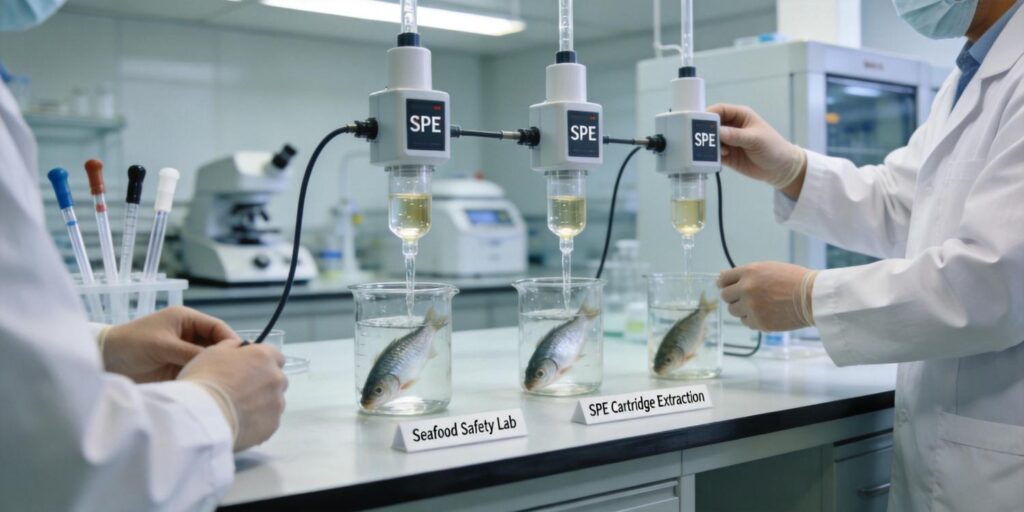
Fish tissue samples, typically muscle or skin with subcutaneous fat, are homogenized and extracted using a solvent mixture such as acetonitrile/water or acidified methanol. For example, a common protocol involves weighing 2 g of homogenized tissue into a centrifuge tube, adding 10 mL of acetonitrile, vortexing, and centrifuging to separate the supernatant. Some methods include a sodium chloride or magnesium sulfate step to induce phase separation and remove water-soluble interferences. The organic extract is then diluted with water to reduce solvent strength, making it suitable for SPE loading.
HLB SPE Sorbent Selection
For veterinary drug residues spanning a wide polarity range, the HLB SPE cartridges from Poseidon Scientific are the preferred choice. The HLB (Hydrophilic-Lipophilic Balance) sorbent, composed of a divinylbenzene-N-vinylpyrrolidone copolymer, provides a balanced retention mechanism for both polar and nonpolar analytes. This is ideal for multi-residue methods targeting diverse drug classes like tetracyclines (polar), fluoroquinolones (amphoteric), and macrolides (moderately nonpolar). The water-wettable nature of HLB ensures reproducible retention even when the sorbent dries out inadvertently.
Conditioning and Loading Protocols
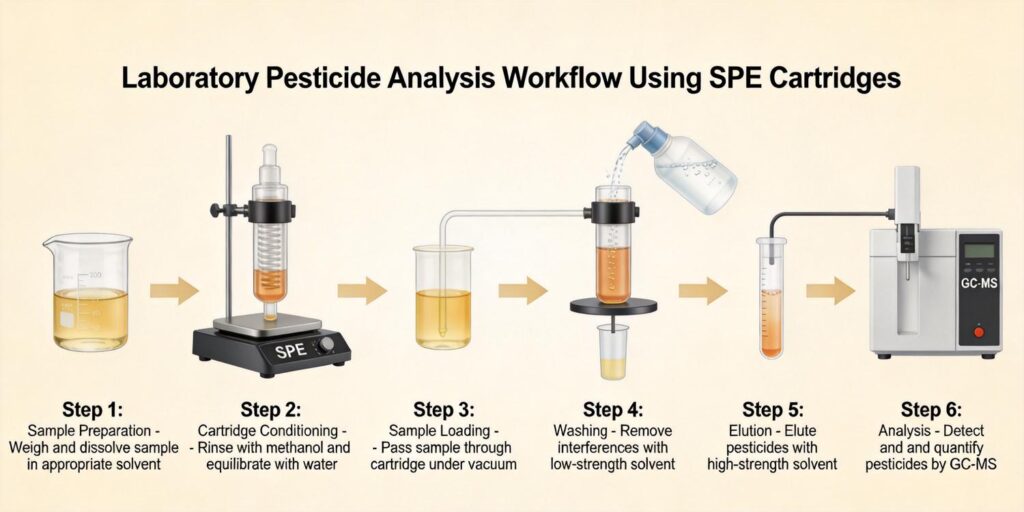
Proper conditioning is critical for reproducible results. For Poseidon Scientific’s HLB cartridges, condition with 3 mL of methanol followed by 3 mL of water. Avoid letting the sorbent dry between steps. Load the diluted fish extract (e.g., 10 mL of 5% acetonitrile in water) at a flow rate of 1–2 mL/min. The sorbent retains the target drug residues while many matrix components—such as salts, polar metabolites, and some proteins—pass through unretained. For maximum recovery, ensure the pH of the loading solution is adjusted to 2–3 for acidic drugs or 7–8 for basic drugs, using formic acid or ammonium hydroxide, respectively.
Washing Steps Removing Lipids
Lipids and fatty acids are major interferences in fish tissue analysis. After loading, a washing step is employed to remove these matrix components without eluting the target analytes. A typical wash uses 5 mL of 5% methanol in water, followed by 5 mL of hexane or a hexane/ethyl acetate mixture to elute neutral lipids. The key is to optimize the solvent strength: too strong a wash may prematurely elute drugs; too weak fails to clean the sample. For fish with high fat content (e.g., salmon), a dedicated defatting step using C18 SPE or freezing lipid precipitation may precede the HLB cleanup.
Elution Conditions for Drug Residues
Elution of retained veterinary drugs is achieved with a solvent that disrupts the sorbent-analyte interaction. For HLB, elute with 3–5 mL of methanol, acetonitrile, or a mixture of both. For drugs that are strongly retained, add 0.1–1% formic acid or ammonia to improve recovery. For example, tetracyclines benefit from 0.1% formic acid in methanol, while sulfonamides elute well with neutral methanol. The eluate is then evaporated under nitrogen and reconstituted in mobile phase for LC-MS/MS analysis.
LC-MS/MS Detection Workflow
LC-MS/MS provides the sensitivity and specificity required for regulatory compliance. A C18 reversed-phase column (e.g., 2.1 × 100 mm, 1.7 µm) with a gradient mobile phase of water/acetonitrile containing 0.1% formic acid is commonly used. The MS is operated in positive electrospray ionization (ESI+) mode with multiple reaction monitoring (MRM) transitions for each analyte. Quantitation is performed using matrix-matched calibration standards to compensate for matrix effects, and isotopically labeled internal standards (e.g., sulfamethazine-13C6) are recommended for accurate results.
Regulatory Compliance Testing
To meet regulatory requirements such as the EU Commission Decision 2002/657/EC or FDA Compliance Policy Guide, the method must be validated for specificity, accuracy, precision, and reproducibility at the MRL level. Typical LOQs are in the range of 0.5–10 µg/kg. Use of Poseidon Scientific HLB cartridges ensures low batch-to-batch variability and high lot consistency, supporting reliable passing of proficiency tests and third-party audits. Labs can also explore mixed-mode SPE options for further cleanup needs.
In summary, a robust SPE method using HLB sorbents is indispensable for monitoring veterinary drug residues in fish tissue. By following systematic extraction, cleanup, and detection protocols, laboratories can achieve the sensitivity and compliance demanded by global food safety standards. Poseidon Scientific’s SPE product line provides the quality assurance needed for confident results.