Why Polyphenols Matter in Wine Quality
Polyphenols are the backbone of wine’s sensory and health-promoting properties. They contribute to color, astringency, bitterness, and aging potential. In red wines, anthocyanins and tannins define the structure and hue, while flavonoids and phenolic acids influence antioxidant capacity. Quantifying these compounds is essential for quality control, authenticity testing, and research into oenological practices. Solid-phase extraction (SPE) using HLB (Hydrophilic-Lipophilic Balanced) cartridges offers a robust, scalable approach to isolate polyphenols from complex wine matrices before chromatography.
The Chemical Complexity of Wine Phenolics
Wine contains over 200 phenolic compounds, including:
- Flavonoids: Anthocyanins, flavan-3-ols (catechins, proanthocyanidins), flavonols (quercetin, kaempferol).
- Non-flavonoids: Phenolic acids (caffeic, p-coumaric, ferulic), stilbenes (resveratrol), and hydrolyzable tannins.
Their diverse polarities and molecular weights require a balanced SPE sorbent. The HLB sorbent (a divinylbenzene-N-vinylpyrrolidone copolymer) provides both hydrophilic and lipophilic retention, making it ideal for capturing a broad spectrum of phenolics while excluding sugars and organic acids.
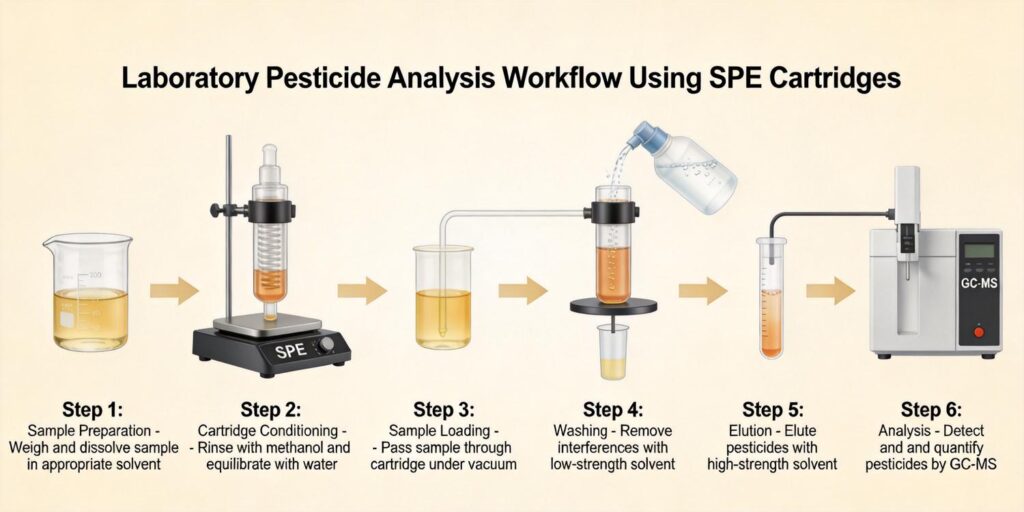
Sample Preparation: Dilution and pH Adjustment
Direct loading of undiluted wine can lead to column overload and poor recovery. A typical protocol dilutes wine 1:1 to 1:5 (v/v) with acidified water (pH 2–3, using HCl or formic acid) to promote protonation of phenolic hydroxyl groups, enhancing retention on the HLB sorbent. For white wines, dilution is less critical, but for red wines, especially those high in tannins, a 1:10 dilution is recommended to prevent clogging and improve mass transfer.
Conditioning the HLB SPE Cartridge
Proper conditioning is crucial for reproducibility. Using Poseidon Scientific HLB SPE cartridges, the stepwise protocol is:
- Wet the sorbent: 3 mL methanol (or acetonitrile).
- Equilibrate: 3 mL acidified water (pH 2–3).
- Avoid drying: The sorbent must remain wet until sample loading.
This activation ensures the polymer surface is fully solvated, maximizing hydrophobic and hydrophilic interactions.
Loading Wine Samples and Washing Sugars
Apply the diluted, acidified wine sample at a flow rate of 1–2 mL/min. The volume depends on analyte concentration; typically 1–5 mL of diluted sample per 200 mg cartridge. After loading, wash with 2–3 mL of acidified water (pH 2–3) to remove sugars, organic acids, and other polar interferences. The sugars (glucose, fructose) have low affinity for the HLB sorbent and are efficiently washed away without eluting target phenolics.
Elution Optimization for Maximum Recovery
Elution is the most critical step for method sensitivity. A two-step elution strategy is often employed:
- Step 1: 2 mL of 20% methanol in water (v/v) to remove weakly retained compounds (e.g., phenolic acids).
- Step 2: 2 mL of 100% methanol (or methanol with 0.1% formic acid) to elute strongly retained flavonoids and anthocyanins.
For LC-MS analysis, methanol is preferred over acetonitrile due to lower ionization suppression. The elution solvent can be evaporated under nitrogen and reconstituted in mobile phase for enhanced concentration.
Detection by HPLC or LC-MS
After SPE cleanup, the eluate is analyzed via reversed-phase HPLC with UV-Vis (280 nm for phenolic acids, 520 nm for anthocyanins) or mass spectrometry. Common columns include C18 (2.1×100 mm, 1.7 µm) with a gradient of water/acetonitrile (both with 0.1% formic acid). LC-MS/MS in multiple reaction monitoring (MRM) mode provides high sensitivity and selectivity for quantification of individual polyphenols, even at trace levels.
Reproducibility Considerations
To ensure robust analytical results:
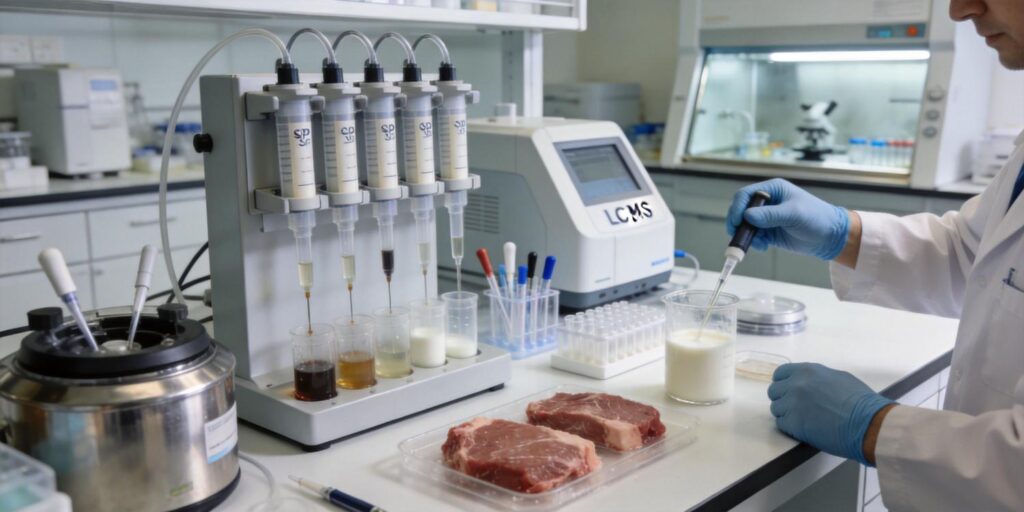
- Control flow rate: Use a vacuum manifold or positive pressure to maintain consistent flow (1-2 mL/min).
- Internal standards: Add deuterated analogs (e.g., caffeic acid-d3) before SPE to correct for matrix effects and volume variations.
- Cartridge batch consistency: High-quality sorbents like those from Poseidon Scientific minimize lot-to-lot variability.
- Blanks and QC samples: Include a solvent blank and a spiked wine sample in each batch to monitor carryover and recovery.
With careful optimization of the SPE workflow, wine polyphenol analysis becomes highly reproducible and suitable for routine quality control in wineries and research laboratories.
Conclusion
The HLB-based SPE method described here efficiently isolates a wide range of polyphenols from wine, removing sugars and acids that interfere with downstream detection. By following the conditioning, loading, washing, and elution steps outlined, analysts can achieve high recoveries (>85%) and excellent reproducibility. For laboratories seeking reliable SPE consumables, Poseidon Scientific HLB cartridges offer a cost-effective alternative with performance comparable to leading brands.