Why HLB SPE is the Gold Standard for Steroid Hormone Extraction from Wastewater
Steroid hormones such as estradiol and testosterone are endocrine-disrupting compounds (EDCs) that enter water bodies through sewage, agricultural runoff, and industrial discharge. Even at nanogram-per-liter concentrations, these hormones can impair reproductive health in aquatic wildlife and potentially affect human drinking water sources. Reliable extraction and quantification of these trace analytes from complex wastewater matrices demand a robust sample preparation technique. Hydrophilic-Lipophilic Balance (HLB) solid-phase extraction (SPE) has emerged as the method of choice due to its balanced retention of both polar and non-polar analytes, high capacity, and compatibility with subsequent LC-MS/MS analysis.
Target Analytes: Estradiol and Testosterone
The primary target compounds in environmental monitoring include 17β-estradiol (E2), estrone (E1), estriol (E3), and 17α-ethinylestradiol (EE2) for estrogens, and testosterone and androstenedione for androgens. These steroids are amphiphilic, with log P values ranging from 1.6 (estriol) to 3.7 (testosterone). Their diverse polarities require a sorbent that can retain both hydrophilic (e.g., estriol) and hydrophobic (e.g., testosterone) steroids without breakthrough. Poseidon HLB SPE cartridges, with their N-vinylpyrrolidone-divinylbenzene copolymer, provide the necessary hydrophilic-lipophilic balance to achieve recoveries above 90% for all target steroids.
Wastewater Sampling and Filtration
Grab samples (1 L) are collected in amber glass bottles pre-rinsed with methanol and stored at 4°C for no more than 48 hours. Prior to SPE, samples are vacuum-filtered through 0.7 µm glass fiber filters (GF/F) to remove suspended solids. Filtration is critical because particulate matter can clog the SPE cartridge and also adsorb hydrophobic analytes. Acidification to pH 3 with HCl is commonly employed to suppress ionization of phenolic estrogens (pKa~10) and improve retention on the HLB sorbent. However, for neutral steroids like testosterone, pH adjustment is less critical.
HLB SPE Conditioning and Sample Loading
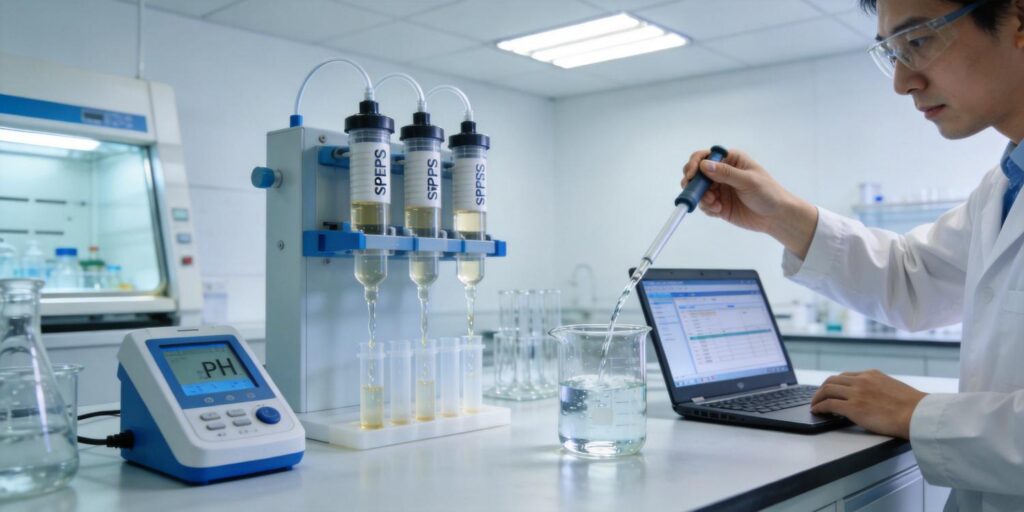
A typical protocol for 500 mg/6 mL Poseidon HLB cartridges includes:
- Conditioning: 5 mL of methanol followed by 5 mL of HPLC-grade water. This step wets the sorbent and removes residual impurities from manufacturing.
- Equilibration: 5 mL of water at sample pH to solvate the sorbent before loading.
- Loading: Filtrate is passed through the cartridge at 5–10 mL/min under gentle vacuum (5–10 in. Hg). The high surface area of the HLB polymer ensures quantitative retention of steroids even at flow rates up to 15 mL/min.
For high-throughput workflows, the 96-well HLB SPE plate format allows parallel processing of 96 samples, significantly increasing lab productivity.
Washing Steps to Remove Organic Matter
Matrix components such as humic acids, surfactants, and salts are removed using a two-step wash:
- Water Wash (5 mL): Removes salts and polar interferents.
- 5% Methanol in Water (5 mL): More aggressive wash to elute moderately polar matrix compounds without displacing target analytes. Higher methanol percentages (>10%) may cause premature elution of estriol; thus, optimizng the wash solvent is critical.
Elution with Organic Solvents
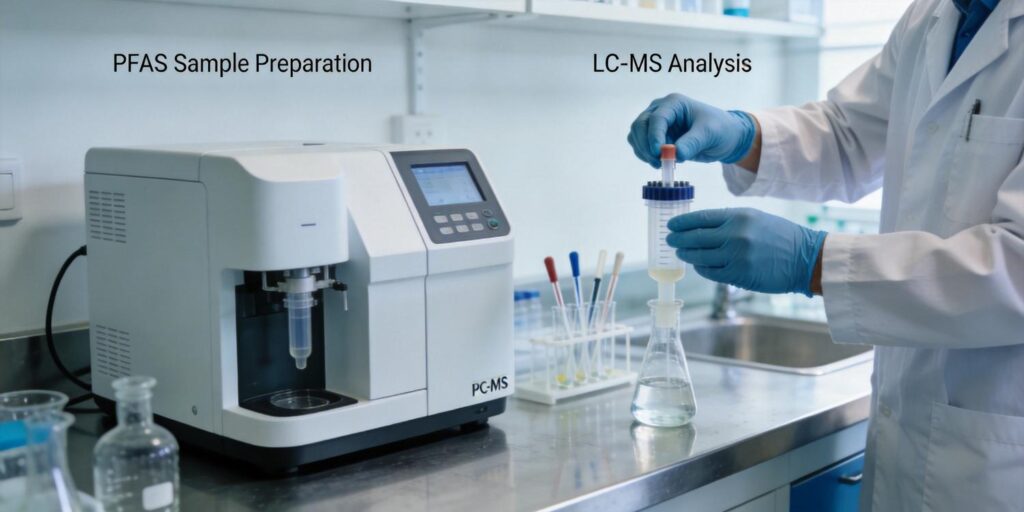
Target steroids are eluted using 5 mL of methanol or ethyl acetate. Methanol is preferred for LC-MS/MS because it is miscible with mobile phases and provides high recoveries for all analytes (>85%). For more hydrophobic steroids like testosterone, adding 0.1% formic acid to the elution solvent can improve solubility. The eluate is then evaporated to dryness under a gentle nitrogen stream at 40°C and reconstituted in 250 µL of 50:50 methanol:water (v/v) for injection.
LC-MS/MS Detection and Quantification
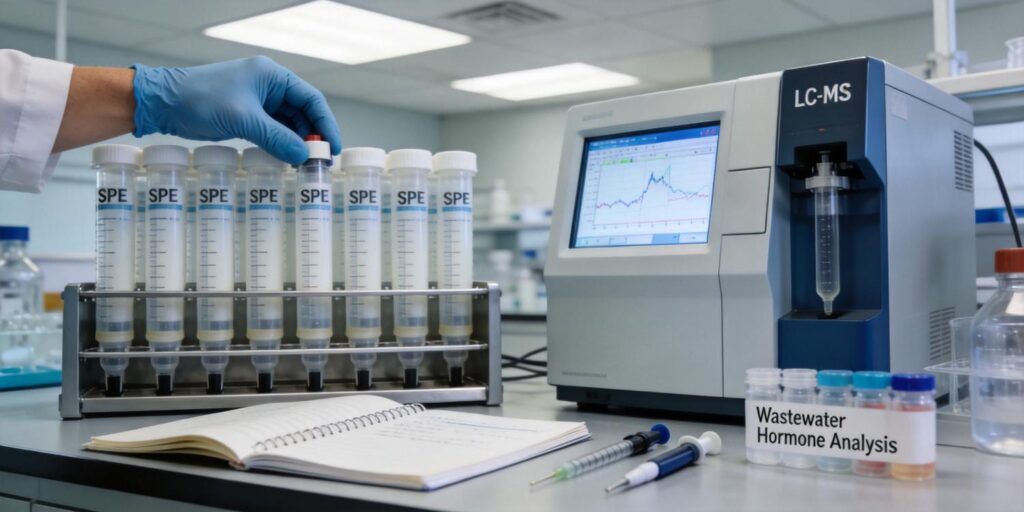
Separation is typically achieved on a C18 column (2.1 × 100 mm, 1.7 µm) with a gradient of 0.1% formic acid in water (A) and methanol (B). The mass spectrometer operates in positive electrospray ionization (ESI+) mode for androgens and negative ESI mode for estrogens. Multiple reaction monitoring (MRM) transitions ensure selectivity:
- Estradiol: m/z 271.2 → 145.1, 183.1
- Testosterone: m/z 289.2 → 97.1, 109.1
Quantification uses isotope-labeled internal standards (e.g., 17β-estradiol-d4) to correct for matrix effects. The method reporting limits (MRL) are typically 0.5 ng/L for estrogens and 1 ng/L for androgens.
Environmental Monitoring Interpretation
Detection of steroid hormones in wastewater indicates either incomplete removal during treatment or illegal discharge. Estradiol levels above 1 ng/L in receiving waters have been linked to feminization of male fish. Regular monitoring using the validated HLB SPE-LC-MS/MS method enables utilities to evaluate treatment efficacy and comply with emerging regulations such as the EU’s Water Framework Directive. For laboratories seeking a reliable, cost-effective alternative to traditional C18 or mixed-mode sorbents, Poseidon Scientific’s HLB product line offers consistent performance for challenging environmental matrices.
Related Products from Poseidon Scientific
- HLB SPE Cartridges
- MAX SPE Cartridges (for acidic analytes)
- MCX SPE Cartridges (mixed-mode strong cation exchange)
- WAX SPE Cartridges (weak anion exchange)
- WCX SPE Cartridges (weak cation exchange)
- 96-Well SPE Plate