Using WCX SPE for the Isolation of Peptide Biomarkers from Plasma
1. Importance of Peptide Biomarkers in Clinical Diagnostics
Peptide biomarkers have become indispensable in clinical diagnostics due to their specificity and sensitivity in detecting diseases such as cancer, cardiovascular disorders, and metabolic conditions. These small protein fragments provide real-time insights into physiological states, enabling early diagnosis, prognosis, and treatment monitoring. However, their low abundance in complex biological matrices like plasma poses significant analytical challenges. Effective isolation and purification are critical to achieving reliable quantification, and solid-phase extraction (SPE) with weak cation exchange (WCX) sorbents offers a tailored solution for peptide enrichment.
2. Chemical Characteristics of Peptides and Charge States
Peptides are amphoteric molecules containing both acidic (carboxyl) and basic (amino) functional groups. Their net charge depends on the pH of the medium relative to their isoelectric point (pI). At pH values below the pI, peptides carry a net positive charge, making them suitable for retention on cation exchange sorbents. WCX phases feature weak acidic groups (e.g., carboxyl) that are negatively charged at pH 5–7, offering a balanced interaction that is milder than strong cation exchangers (SCX). This selectivity helps discriminate target peptides from highly abundant plasma proteins and salts.
3. Plasma Pretreatment Procedures
Plasma contains high levels of proteins, lipids, and salts that can interfere with peptide binding and downstream LC-MS/MS analysis. Typical pretreatment includes dilution with a volatile buffer (e.g., 50 mM ammonium acetate, pH 6.0) to reduce viscosity and modulate ionic strength. Addition of organic solvents like acetonitrile (up to 20%) can help precipitate high-molecular-weight proteins while keeping target peptides soluble. Centrifugation at 10,000–15,000 × g for 10 minutes at 4°C removes particulates, and the supernatant is adjusted to a pH that ensures peptides carry a net positive charge (usually pH 5–6).
4. WCX SPE Mechanism for Peptide Retention
WCX sorbents, such as those in Poseidon Scientific’s WCX SPE cartridges, rely on electrostatic interactions between negatively charged carboxyl groups on the sorbent and positively charged amino groups on peptides. The weak acidic nature of the sorbent allows for pH-controlled retention and elution. At loading pH (e.g., 6.0), peptides with pI > 6 are positively charged and bind to the sorbent, while neutral or negatively charged species (many plasma proteins) pass through. This mechanism provides high selectivity for basic and neutral peptides.
5. Cartridge Conditioning and Sample Loading
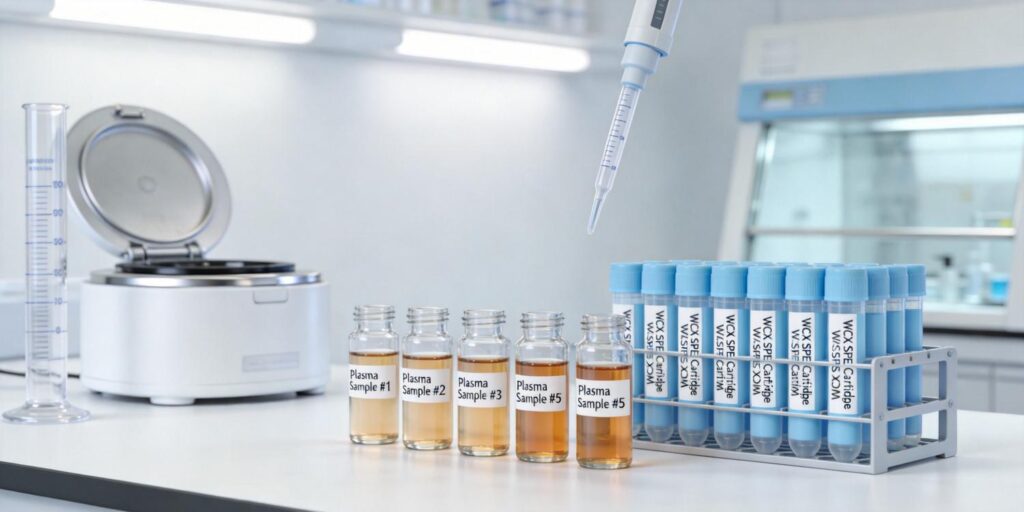
Proper cartridge conditioning ensures reproducible results. The WCX sorbent should be washed with 2–3 column volumes of methanol followed by equilibration with 2–3 column volumes of loading buffer (e.g., 50 mM ammonium acetate, pH 6.0). The pretreated plasma sample is then loaded at a slow flow rate (1–2 mL/min for a 3 mL cartridge) to maximize binding. The bed volume (typically 100–500 mg sorbent) must be matched to the expected peptide load to avoid breakthrough.
6. Washing Steps to Remove Proteins and Lipids
After sample loading, a series of washing steps removes non-specifically bound interferents. Typically, 2–3 column volumes of loading buffer are used to wash out residual proteins and salts. A second wash with loading buffer containing 5–10% methanol or acetonitrile can help elute hydrophobic lipids and weakly bound matrix components without affecting retained peptides. It is crucial to avoid high organic content that might prematurely elute target peptides.
7. Elution Strategy Using Acidic Organic Solvents
Elution from WCX sorbents is achieved by disrupting electrostatic interactions. A common eluent is 5% formic acid in 80% acetonitrile/water (v/v), which protonates the sorbent’s carboxyl groups (reducing negative charge) and peptides’ amino groups (reducing positive charge), while the organic solvent enhances desorption. For comprehensive peptide recovery, elution can be performed in two fractions: first with a lower organic content (e.g., 40% acetonitrile) for hydrophilic peptides, then with higher organic (e.g., 80% acetonitrile) for hydrophobic ones. The eluate is then evaporated or lyophilized for LC-MS/MS analysis.
8. LC-MS/MS Detection and Sensitivity Optimization
The concentrated peptide extract is reconstituted in a compatible mobile phase (e.g., 0.1% formic acid in water) and injected into a reversed-phase LC column coupled to a tandem mass spectrometer. MRM (multiple reaction monitoring) or high-resolution MS (e.g., Orbitrap) provides sensitive quantification. Optimal SPE cleanup minimizes ion suppression and matrix effects, enhancing signal-to-noise ratios. For method validation, recovery rates >80% for spiked peptide standards are achievable when using optimized WCX protocols. For high-throughput applications, the 96-well SPE plate format from Poseidon Scientific can streamline processing of multiple plasma samples in parallel.
For more details on WCX sorbent chemistry and application notes, refer to the product page for WCX SPE cartridges or explore other SPE phases such as HLB, MAX, MCX, and WAX offered by Poseidon Scientific.