SPE Cleanup for Analysis of Flavor Compounds in Beverages
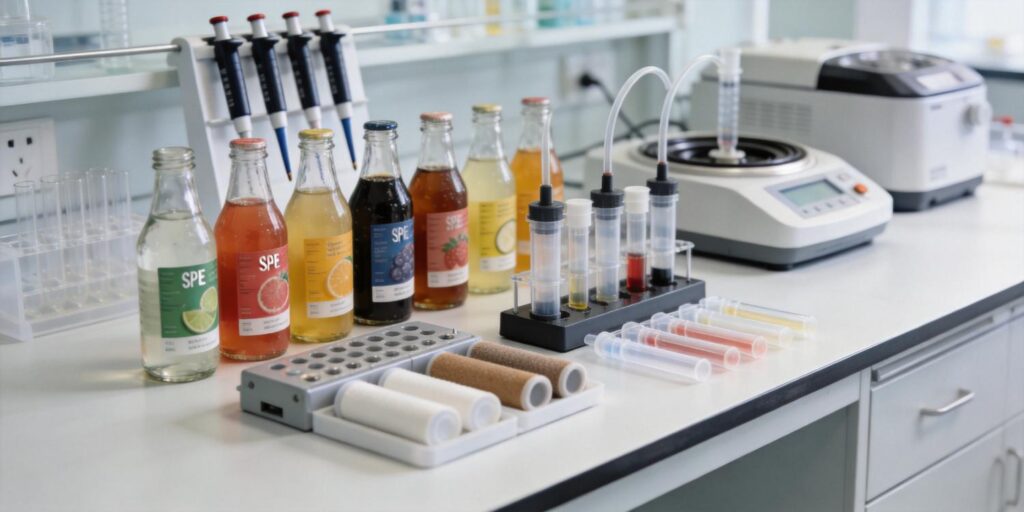
Beverages such as fruit juices, soft drinks, wines, and spirits contain complex flavor profiles that require precise analytical methods. Solid-phase extraction (SPE) is a critical technique for isolating and quantifying volatile and non-volatile flavor compounds before instrumental analysis. This blog outlines a robust SPE workflow for beverage flavor analysis, focusing on mixed-mode sorbents and quality control.
Complexity of Beverage Flavor Matrices
Beverages are complex mixtures containing sugars, organic acids, pigments, polyphenols, and volatile aroma compounds. The matrix can interfere with chromatographic separation and mass spectrometric detection. For example, high sugar content in fruit juices can cause column fouling, while organic acids may co-elute with target analytes. Effective sample cleanup is essential to reduce matrix effects and improve sensitivity.
Target Analytes: Esters, Aldehydes, and More
Key flavor compounds in beverages include esters (e.g., ethyl acetate, isoamyl acetate), aldehydes (e.g., hexanal, furfural), ketones, and alcohols. These compounds vary widely in polarity and volatility. For instance, esters are moderately polar, while short-chain aldehydes are relatively polar. A comprehensive SPE method must retain these analytes while removing sugars and acids.
Sample Preparation: Dilution and Extraction
Beverage samples are often diluted with deionized water or buffer to reduce viscosity and adjust pH. For carbonated beverages, degassing via sonication or nitrogen purging is recommended. A typical protocol involves acidifying the sample to pH 2-3 for acidic analytes, or adjusting to neutral pH for neutral compounds. Sample loading volume should be optimized to avoid breakthrough.
Selection of HLB Sorbent for Mixed Polarity Compounds
Hydrophilic-lipophilic balanced (HLB) sorbents, such as Poseidon HLB SPE cartridges, are ideal for capturing a broad range of polar and non-polar flavor compounds. HLB sorbents feature a water-wettable, reversed-phase polymer that retains analytes via hydrophobic interactions. They also exhibit some hydrogen bonding and π-π interactions, making them suitable for phenolic compounds and heterocyclic aromatics.
SPE Cleanup Steps: Removing Sugars and Acids
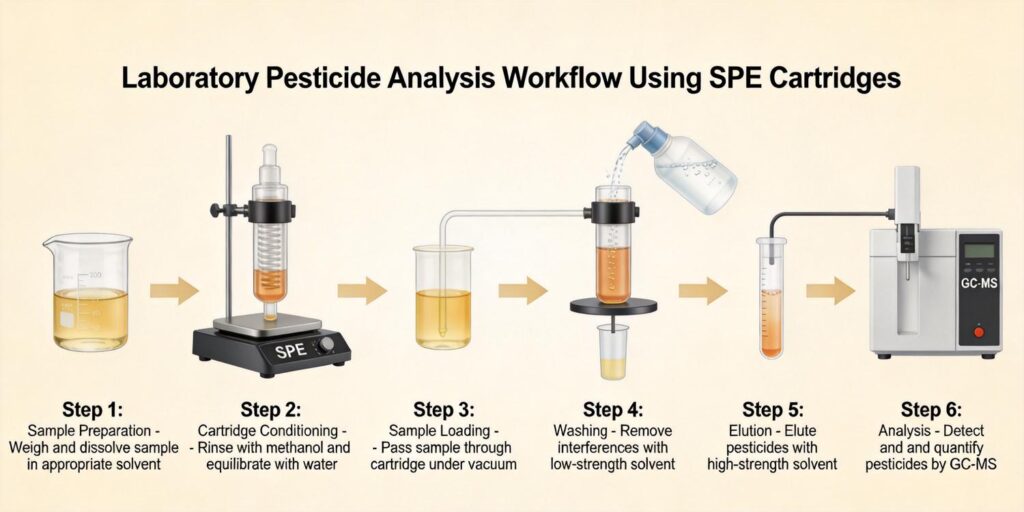
After conditioning and sample loading, a wash step with 5% methanol in water effectively elutes sugars, organic acids, and other highly polar interferences. For acidic beverages, a wash with 0.1% formic acid in water can remove residual acids while retaining target analytes. The wash volume should be carefully controlled (e.g., 2-3 mL) to avoid analyte loss.
Elution Solvent Optimization
Elution of flavor compounds typically uses methanol, acetonitrile, or ethyl acetate. For a broad selectivity, a stepwise elution with increasing solvent strength is recommended: first elute with 100% methanol for medium-polarity compounds, then with ethyl acetate for non-polar volatiles. Alternatively, a single elution with 1:1 methanol:ethyl acetate (v/v) provides balanced recoveries. Evaporation under nitrogen and reconstitution in GC- or LC-compatible solvent (e.g., hexane for GC, methanol for LC) completes preparation.
Detection by GC-MS or LC-MS
Volatile flavor compounds are typically analyzed by gas chromatography-mass spectrometry (GC-MS) using a non-polar or polar column (e.g., DB-5 or Stabilwax). Non-volatile compounds like vanillin or coumarin can be analyzed by liquid chromatography-mass spectrometry (LC-MS) with a C18 column. MS detection in selected ion monitoring (SIM) or full scan mode provides identification and quantification.
Quality Control Parameters
Reliable results require method validation. Include matrix-matched calibration curves (e.g., 0.1–50 µg/L), recovery studies at three spiking levels (e.g., 70–120%), and precision assessment (RSD < 15%). Use internal standards (e.g., deuterated esters) to correct for matrix effects. Process blanks and duplicate analyses confirm method cleanliness and reproducibility. Regular evaluation of SPE plate lot-to-lot consistency ensures long-term method stability.
By implementing these SPE workflows, beverage manufacturers and analytical laboratories can achieve accurate, robust quantification of flavor markers for quality control, authenticity testing, and product development.