Introduction
Artificial sweeteners such as sucralose and saccharin are widely used in food and beverages, but their persistence in the environment has raised concerns about potential contamination of water sources. Bottled water, often perceived as pure, can sometimes contain trace levels of these compounds due to contamination from manufacturing processes, leaching from packaging, or source water pollution. Detecting these low-concentration contaminants requires a robust sample preparation method. Solid-phase extraction (SPE) with hydrophilic-lipophilic balance (HLB) cartridges offers an effective solution for concentrating artificial sweeteners from bottled water prior to LC-MS/MS analysis.
1. Artificial Sweetener Contamination Sources
Artificial sweeteners enter bottled water through several pathways. Municipal water supplies used as source water may contain residues from wastewater treatment plant effluents, where sucralose and saccharin are not completely removed. Cross-contamination during bottling, such as shared processing lines with diet beverages, can introduce sweeteners. Additionally, leaching from plastic bottles, especially under heat or prolonged storage, may migrate trace amounts of these compounds. Monitoring these contaminants ensures product quality and compliance with regulatory standards.
2. Target Compounds: Sucralose and Saccharin
Sucralose (C12H19Cl3O8) is a chlorinated sucrose derivative, highly stable and non-caloric, with a detection limit often below 0.1 μg/L in water. Saccharin (C7H5NO3S) is one of the oldest artificial sweeteners, also persistent. Both are polar and anionic under neutral conditions, making them suitable for retention on HLB sorbents, which offer balanced retention for a wide range of polar and non-polar compounds.
3. Sample Preparation and Filtration
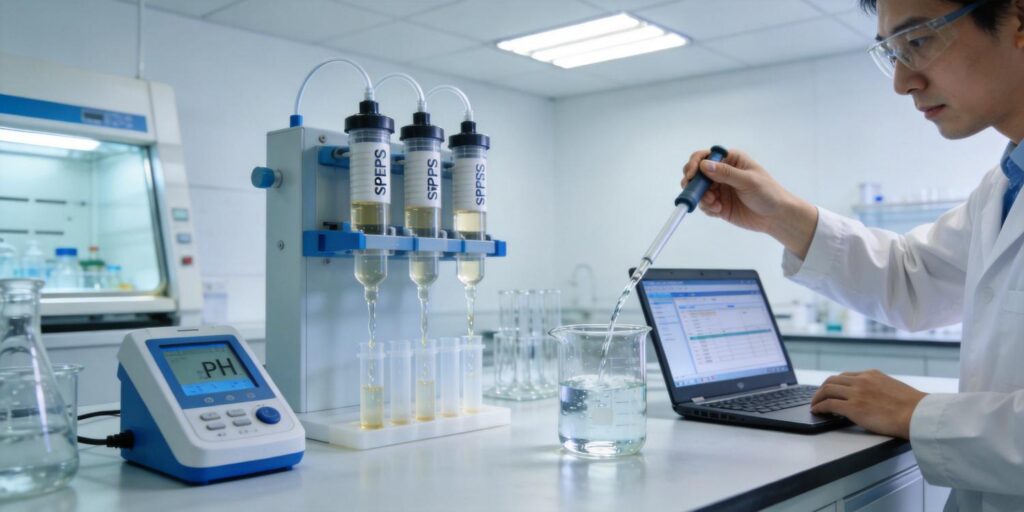
Before SPE, bottled water samples should be filtered to remove particulates that could clog the cartridge. Use 0.45 μm nylon or PTFE syringe filters. For carbonated or sparkling water, degas by sonication for 10 minutes or by stirring to remove dissolved CO2. Acidify the sample to pH 3 using hydrochloric acid to enhance retention of acidic sweeteners like saccharin (pKa ~1.3). Sucralose is neutral and less pH-dependent.
4. HLB SPE Cartridge Conditioning
For HLB SPE cartridges (e.g., 200 mg, 6 mL), proper conditioning is critical. First, wet the sorbent with 3 mL of methanol to activate the hydrophilic sites. Then, equilibrate with 3 mL of deionized water adjusted to pH 3. Avoid letting the cartridge dry out between conditioning and sample loading.
5. Loading Procedures for Bottled Water Samples
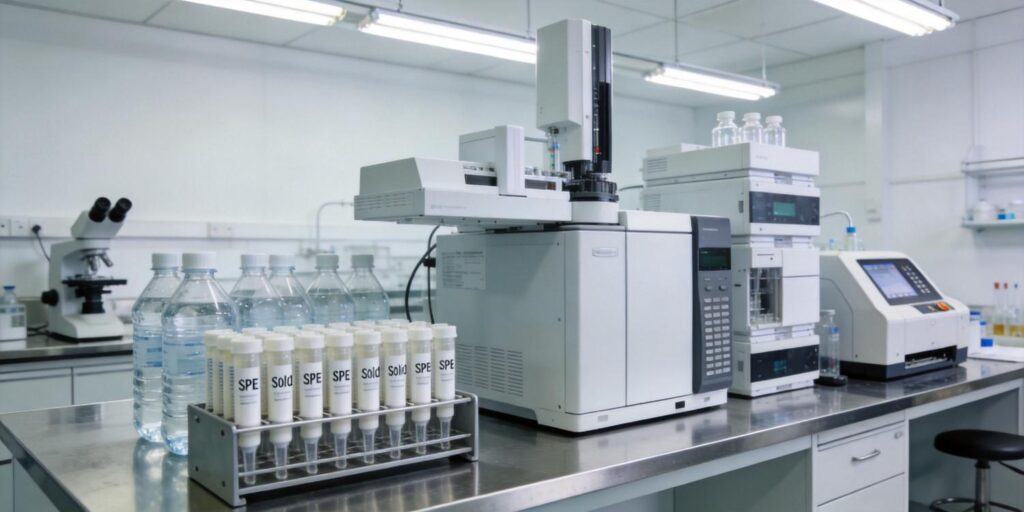
Load a known volume (typically 100–500 mL) of the acidified, filtered bottled water onto the conditioned HLB cartridge at a flow rate of 3–5 mL/min using a vacuum manifold. For larger volumes, use a reservoir adapter. The HLB sorbent retains both polar sweeteners through hydrophilic interactions and non-polar interferences through reversed-phase interactions.
6. Washing Steps to Remove Background Contaminants
After loading, wash the cartridge with 3 mL of 5% methanol in water (pH 3) to remove salts and highly polar interferences without eluting the target analytes. A second wash with 3 mL of 10% methanol in water can further reduce matrix effects. For bottled water with high organic content (e.g., flavored water), a wash with 3 mL of 30% methanol may be needed, but monitor breakthrough of saccharin.
7. Elution and Concentration Steps
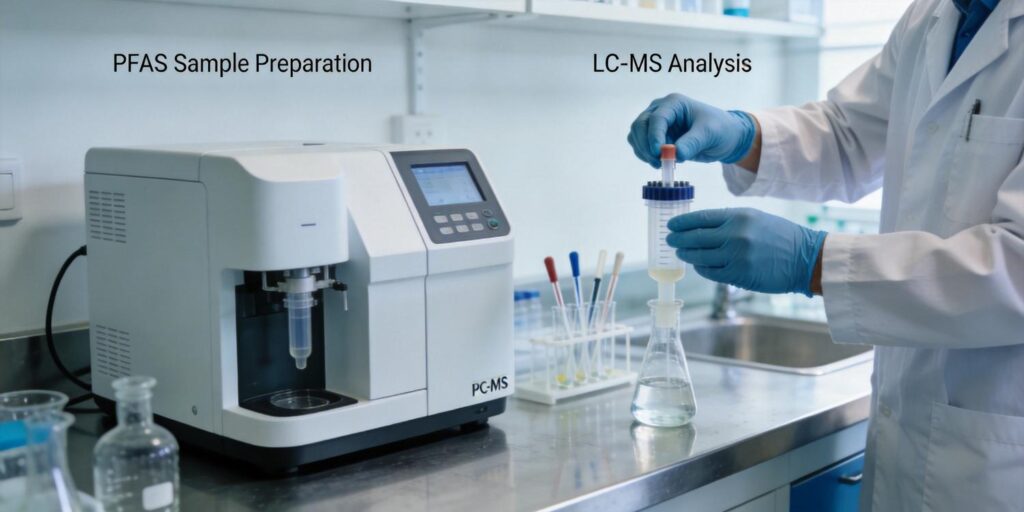
Elute the sweeteners with 3 mL of methanol for sucralose, followed by 3 mL of 2% ammonium hydroxide in methanol for saccharin. Alternatively, use a single elution with 4 mL of methanol containing 0.1% formic acid for both. Collect the eluate in a glass tube and evaporate to dryness under a gentle nitrogen stream at 40°C. Reconstitute in 200 μL of 80:20 water:methanol (v/v) and vortex for 30 seconds. Transfer to an LC vial for analysis.
8. LC-MS/MS Detection Workflow
Inject 10 μL of the reconstituted sample onto a C18 reversed-phase column (e.g., 2.1 × 100 mm, 1.8 μm) at 40°C. Use a mobile phase gradient of water (A) and methanol (B), both with 0.1% formic acid, starting at 5% B for 1 min, ramping to 95% B over 8 min, holding for 2 min, then re-equilibrating. Operate the mass spectrometer in negative electrospray ionization (ESI-) mode with multiple reaction monitoring (MRM). For sucralose, monitor m/z 395.0 → 359.0 (quantifier) and 395.0 → 35.0 (qualifier). For saccharin, monitor m/z 182.0 → 42.0 (quantifier) and 182.0 → 62.0 (qualifier). Quantify using external standards with internal standard (e.g., sucralose-d6) correction.
Conclusion
HLB SPE provides a reliable, high-recovery method for extracting sucralose and saccharin from bottled water, enabling detection at sub-ppb levels. This workflow is suitable for quality control labs and environmental monitoring. For high-throughput applications, consider 96-well SPE plates with HLB sorbent to process multiple samples simultaneously. Always validate method performance with spike-and-recovery experiments.