The Challenge of Herbal Matrices
Traditional Chinese Medicine (TCM) preparations are among the most analytically demanding samples due to their complex phytochemical composition. A single herbal decoction may contain thousands of compounds spanning a broad polarity range and diverse functional groups. For targeted analysis of alkaloids—the nitrogen-containing, often pharmacologically active bases—the analyst must contend with an overwhelming background of pigments, tannins, flavonoids, saponins, and sugars. These co-extractives not only suppress ionization in mass spectrometry but also degrade chromatographic performance over time.
Mixed-mode solid phase extraction (SPE) sorbents, particularly the MCX (mixed-mode cation exchange) chemistry, offer a robust solution for isolating alkaloids from this biological cacophony. By leveraging both reversed-phase retention and ion-exchange selectivity, MCX SPE provides the orthogonal selectivity necessary to capture alkaloids while flushing away neutral and acidic interferences.
Alkaloid Chemistry and the Role of Protonation
Alkaloids are basic compounds containing one or more nitrogen atoms, typically with pKa values in the range of 5–10. At low pH (typically <3), the nitrogen is fully protonated, giving the molecule a net positive charge. This charged state is key to the MCX retention mechanism: the quaternary amine groups (or sulfonic acid groups in strong cation exchangers) on the sorbent strongly bind the protonated alkaloid via ionic interactions, while the hydrophobic aromatic moiety simultaneously interacts with the polymeric reversed-phase backbone.
The dual retention allows the analyst to aggressively wash the cartridge with organic solvents (e.g., 100% methanol) at low pH, removing nonpolar neutral compounds and even moderately retained interferences—all while the alkaloids remain safely immobilized. Only after raising the pH to deprotonate the nitrogen does the ionic lock release, enabling a clean elution.
Acidified Solvent Extraction
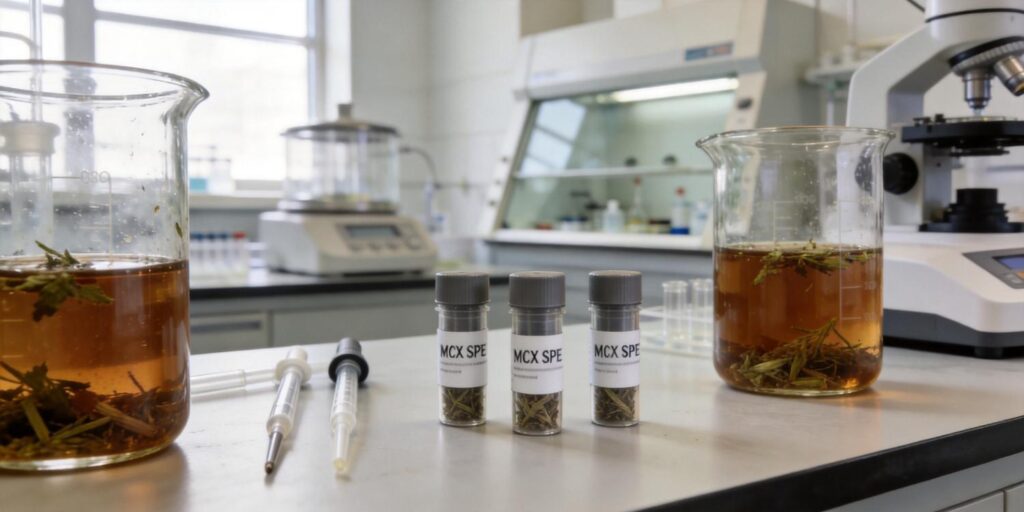
Before SPE, the herbal material itself must be extracted. A common approach is to use an acidified hydro-organic solvent, such as 0.1–1% formic acid or HCl in methanol/water (e.g., 70:30 v/v). The acidic medium ensures alkaloids are fully protonated and soluble. Ultrasonication at 40–60°C for 15–30 minutes improves cell wall disruption and recovery. After centrifugation or filtration, the supernatant is diluted with water or acidified water to reduce the organic content to below 10% before loading onto the SPE cartridge. This adjustment is critical: high organic content can disrupt the ion-exchange interaction and cause premature breakthrough.
MCX SPE Protocol
Conditioning & Equilibration
Start with a fresh Poseidon Scientific MCX SPE cartridge (typically 30 mg/1 mL or 60 mg/3 mL for herbal extracts). Condition with 3 column volumes (CV) of methanol, followed by 3 CV of 0.1% formic acid (or 0.1 M HCl) in water. This primes both the reversed-phase and ion-exchange sites.
Loading
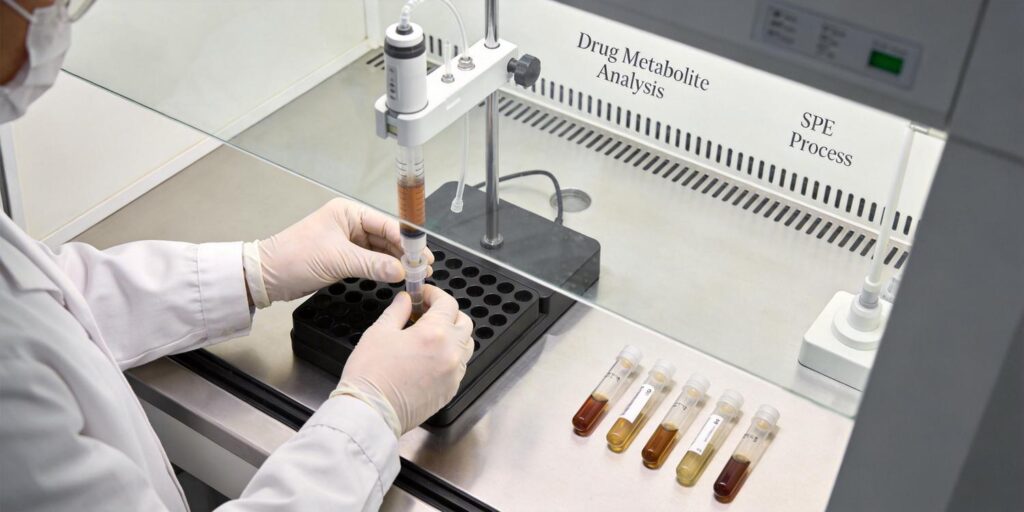
Pass the clarified, acidified extract (pH ≤3) through the cartridge at a flow rate of ~1 mL/min. The protonated alkaloids are retained. The loading capacity of a 60 mg cartridge is roughly 5–10 mg of total alkaloids; for routine analysis, 1–2 mL of concentrated TCM extract is typical.
Washing
Two sequential washes remove the bulk of interferents:
- Wash 1 (aqueous acid): 2 CV of 0.1% formic acid in water removes inorganic salts, sugars, and weakly retained polar compounds.
- Wash 2 (organic acid): 2 CV of methanol containing 0.1% formic acid. This powerful wash flushes out pigments (chlorophyll, anthocyanins), tannins, and other neutral hydrophobic species while keeping alkaloids protonated and bound.
For particularly dirty samples, a third wash with 2 CV of 1:1 methanol/ethyl acetate (with 0.1% formic acid) can further reduce pigment carryover, but ensure that the elution step still performs efficiently—some highly lipophilic alkaloids may begin to elute if the wash is too aggressive.
Elution
Switch to a basic organic solvent to deprotonate the alkaloids and break the ion-exchange bond. A mixture of methanol containing 5% ammonium hydroxide (NH₄OH, 28–30%) is the standard. Typically, 2 CV of this eluent is sufficient. Collect the eluate and evaporate under nitrogen at 40°C, then reconstitute in a compatible mobile phase (e.g., 0.1% formic acid in 50:50 methanol/water) for LC-MS analysis.
The entire workflow is also adaptable to Poseidon’s 96-well SPE plates, enabling parallel processing of multiple TCM samples.
LC-MS Analysis of Alkaloids
Reversed-phase C18 columns (2.1 × 100 mm, 1.8 µm) with a water/methanol gradient containing 0.1% formic acid typically resolve the major alkaloids. Positive ionization mode (ESI+) is preferred, as protonated alkaloids form [M+H]⁺ ions readily. Multiple reaction monitoring (MRM) provides specific and sensitive quantification. Common target analytes include berberine, palmatine, coptisine, aconitine, and strychnine, depending on the TCM species.
Validation and Reproducibility
To verify method performance, spike known alkaloid standards into a blank matrix (e.g., a neutral herbal extract or buffer) at three concentration levels. Recoveries should fall within the 80–120% range, with RSD <15%. The clean extracts typically show minimal matrix effects (ion suppression <10%) when compared to neat standard responses. A six-point calibration curve (1–1000 ng/mL) with r² > 0.99 is expected.
The MCX SPE approach is now the gold standard for alkaloid analysis in TCM. For researchers looking to standardize their workflows, Poseidon’s MCX cartridges deliver consistent batch-to-batch performance with low extractables, ensuring that the analytical focus stays on the active components, not on the background noise.
References
- Wang, Y., et al. J. Pharm. Biomed. Anal. 2019, 172, 58–66.
- Li, M., et al. J. Chromatogr. A 2021, 1640, 461943.
- Zhang, Q., et al. Anal. Chim. Acta 2020, 1124, 58–66.