Introduction to Metabolomics in Systems Biology
Metabolomics, the comprehensive study of small-molecule metabolites within biological systems, plays a pivotal role in systems biology research. It provides a functional readout of cellular activity, reflecting genetic, epigenetic, and environmental influences. By profiling endogenous metabolites such as amino acids, lipids, organic acids, and nucleotides, researchers can uncover biomarkers for disease, elucidate metabolic pathways, and assess drug toxicity. The complexity and dynamic range of the metabolome, however, demand robust, reproducible, and high-throughput sample preparation methods to ensure data quality and biological relevance.
The Need for High Sample Throughput
Modern metabolomics studies often involve large cohort sizes—ranging from hundreds to thousands of samples—to achieve statistical significance. Additionally, time-course experiments and multi-omics integrations require processing many samples in parallel. Traditional solid-phase extraction (SPE) using individual cartridges is labor-intensive and prone to variability when scaled. This drives the demand for formats that increase throughput without compromising cleanup efficiency or recovery.
Advantages of 96-Well SPE Plates Over Cartridges
96-well SPE plates are designed for parallel processing of 96 samples simultaneously, offering several key benefits:
- Speed: Simultaneous conditioning, loading, washing, and elution reduce overall processing time from hours to minutes.
- Consistency: Uniform sorbent bed mass and channel geometry minimize well-to-well variability, enhancing reproducibility.
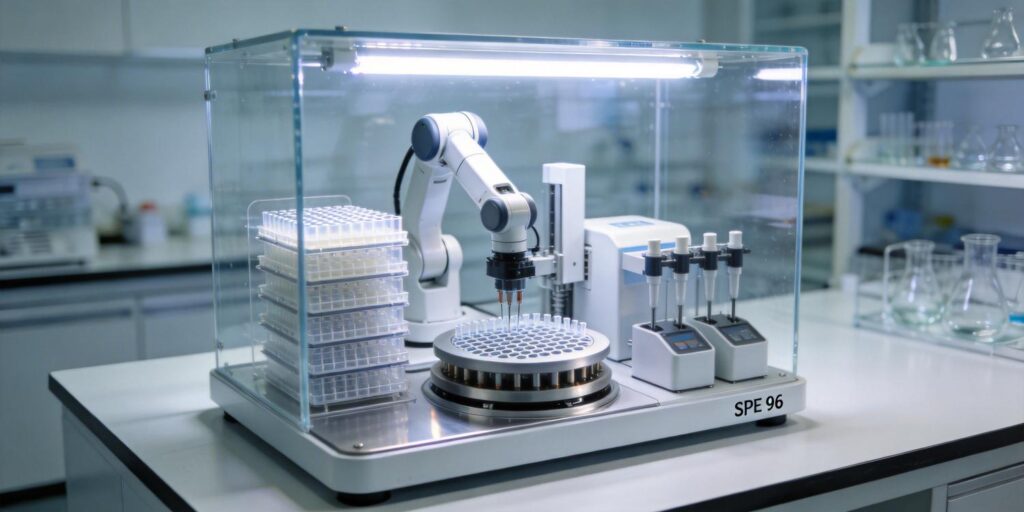
- Automation compatibility: Plates integrate seamlessly with liquid handling robots and positive pressure manifolds, enabling walk-away operation.
- Lower solvent consumption: Optimized bed volumes (e.g., 10–100 mg) reduce solvent usage compared to typical cartridge sizes.
- Direct elution into collection plates: Eluates can be directly placed into autosampler vials or microtiter plates, minimizing transfer steps.
For metabolomics applications, 96-well plates are especially advantageous when analyzing large sets of biofluids (plasma, urine, cerebrospinal fluid) or tissue extracts.
Plate Conditioning and Equilibration
Proper conditioning is critical to activate the sorbent and ensure reproducible retention. A generic protocol for reversed-phase or mixed-mode plates (e.g., HLB, MCX, WAX) involves:
- Conditioning: Apply 1 mL of methanol or acetonitrile to wet the sorbent and remove impurities.
- Equilibration: Follow with 1 mL of water or loading buffer (e.g., 0.1% formic acid in water) to prepare the column for sample introduction.
For ion-exchange plates (e.g., WCX, SAX), equilibration buffers should match the sample pH to maintain charge state. Use positive pressure (2–5 psi) or centrifugation at low g-force to ensure consistent flow rates across all wells.
Automated Sample Loading Using Pipetting Robots
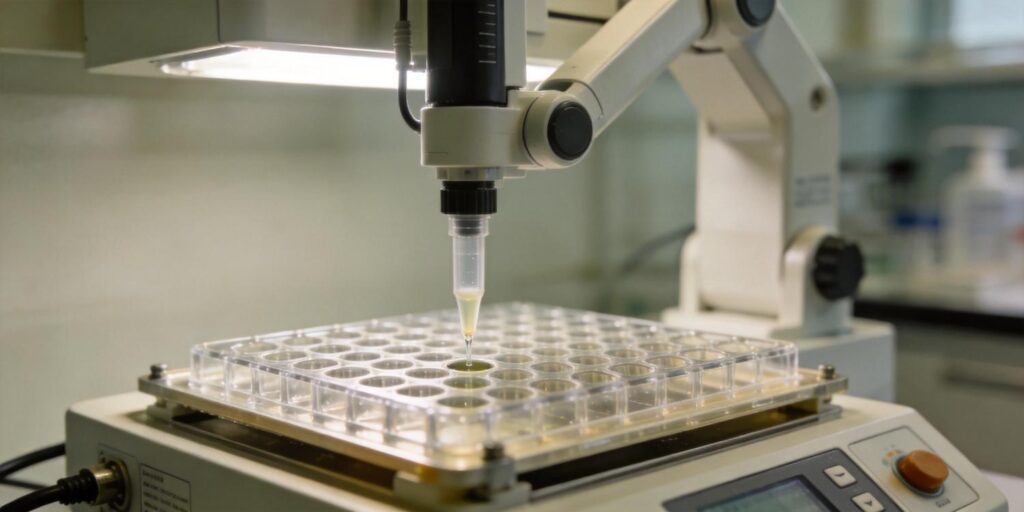
Liquid handling robots (e.g., Hamilton STAR, Tecan Fluent, Agilent Bravo) can precisely aspirate and dispense samples into 96-well plates. Key considerations for automation:
- Sample volume: Typically 50–500 µL per well; ensure the sorbent bed capacity is not exceeded.
- Flow control: Apply slow, consistent flow rates (0.5–2 mL/min) to maximize analyte-sorbent interaction.
- Pipetting tips: Use conductive tips to avoid cross-contamination; change tips between samples.
- Positive pressure manifolds: Use adjustable pressure to maintain uniform flow across all 96 channels.
Automation reduces manual handling errors and increases throughput to >200 samples per hour depending on protocol complexity.
Washing and Elution Protocols Optimized for Metabolite Classes
Metabolites span a wide polarity and charge range, so sorbent selection and washing steps must be tailored:
- Reversed-phase (HLB): Suitable for nonpolar to moderately polar metabolites. Wash with 5% methanol in water to remove salts; elute with 100% methanol or acetonitrile.
- Mixed-mode cation exchange (MCX): Retains basic metabolites (amines) via hydrophobic and ionic interactions. Wash with 2% formic acid in water; elute with 5% ammonium hydroxide in methanol.
- Mixed-mode anion exchange (MAX): Targets acidic metabolites (organic acids). Wash with 2% ammonium hydroxide in water; elute with 5% formic acid in methanol.
- Weak cation exchange (WCX): For quaternary amines; use pH 6–7 loading and elute with acidic buffer.
Example protocol for plasma metabolomics using Poseidon 96-well SPE plates:
| Step | Solvent | Volume | Repetitions |
|---|---|---|---|
| Condition | Methanol | 1 mL | 1× |
| Equilibrate | Water + 0.1% FA | 1 mL | 1× |
| Load | Sample (plasma + IS) | 200 µL | 1× |
| Wash 1 | Water + 0.1% FA | 1 mL | 1× |
| Wash 2 | 5% MeOH in water | 1 mL | 1× |
| Elute | 100% MeOH | 500 µL | 1× |
Collect eluate, evaporate to dryness, and reconstitute in mobile phase for LC-MS.
Integration with LC-MS Autosamplers
96-well plates are directly compatible with most LC-MS autosamplers, such as Waters Acquity, Thermo Vanquish, and Agilent 1290 Infinity. After elution, the collection plate can be sealed and placed directly in the autosampler tray. Benefits include:
- Reduced sample transfer errors.
- Minimized evaporation losses with pre-slit septa mats.
- Ability to run batch sequences with automated injections.
For best results, ensure the elution solvent is compatible with the LC mobile phase (e.g., 90:10 water/MeOH for reverse-phase). If not, evaporate and reconstitute.
Throughput and Reproducibility Considerations
When using 96-well plates, throughput can exceed 500 samples per day per technician with automation. Key factors affecting reproducibility:
- Channel-to-channel variability: Use plates from reputable manufacturers with <5% CV in bed mass (e.g., Poseidon 96-well plates).
- Flow rate consistency: Employ positive pressure manifolds instead of vacuum to avoid channel drying and channeling.
- Internal standards: Spike each sample with isotopically labeled standards to correct for recovery variation.
- Batch randomization: Use a randomized block design to minimize run-order effects.
Regular quality control samples (pooled QC) should be interspersed every 10–15 samples to monitor signal drift and precision. With proper protocols, 96-well SPE plates deliver the robustness needed for large-scale metabolomics.
Conclusion
Adopting 96-well SPE plates for metabolomics sample preparation significantly accelerates throughput while maintaining high reproducibility. By leveraging automated liquid handling and optimized protocols tailored to metabolite classes, laboratories can achieve consistent, high-quality data for complex systems biology studies. For researchers and procurement managers evaluating SPE formats, the 96-well plate offers a compelling balance of speed, efficiency, and scalability.