Introduction to Antibiotic Contamination in Apiculture
Antibiotics are widely used in apiculture to combat bacterial diseases such as American foulbrood and European foulbrood. However, their misuse or overuse can lead to residue accumulation in honey, posing risks to consumer health and international trade. Regulatory bodies like the European Union and the U.S. FDA have established strict maximum residue limits (MRLs) for antibiotics in honey, including tetracyclines, sulfonamides, fluoroquinolones, and macrolides. Effective detection requires robust sample preparation to overcome the challenges of honey’s complex matrix.
Matrix Complexity of Honey Samples
Honey is a viscous, sugar-rich matrix containing fructose, glucose, sucrose, and trace amounts of proteins, enzymes, pollen, and wax. These components can interfere with antibiotic analysis by co-extracting with target analytes, causing ion suppression or enhancement in LC-MS/MS, and reducing column lifespan. Pigments like flavonoids and carotenoids also contribute to matrix effects. Therefore, a selective cleanup method is essential to isolate antibiotics while removing interfering substances.
Dilution and Extraction of Honey with Aqueous Solvents
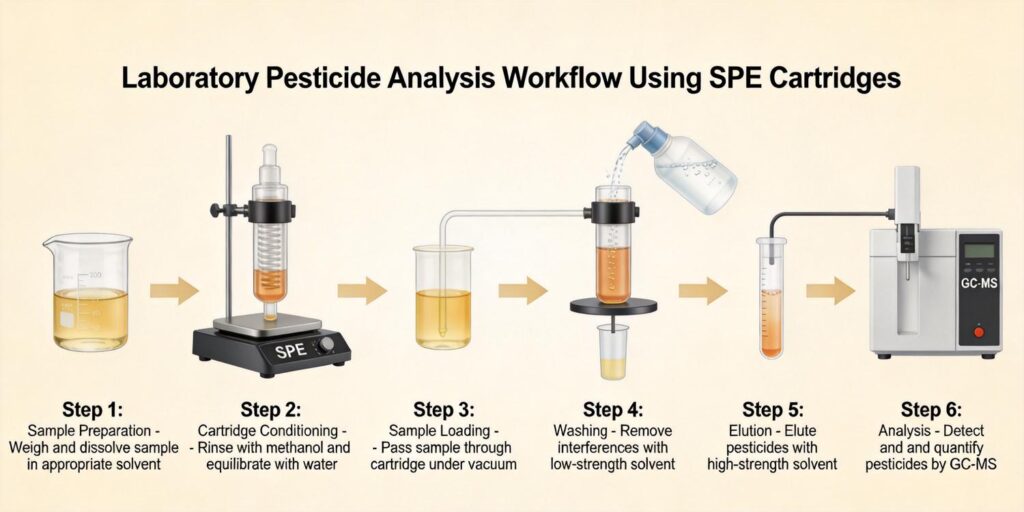
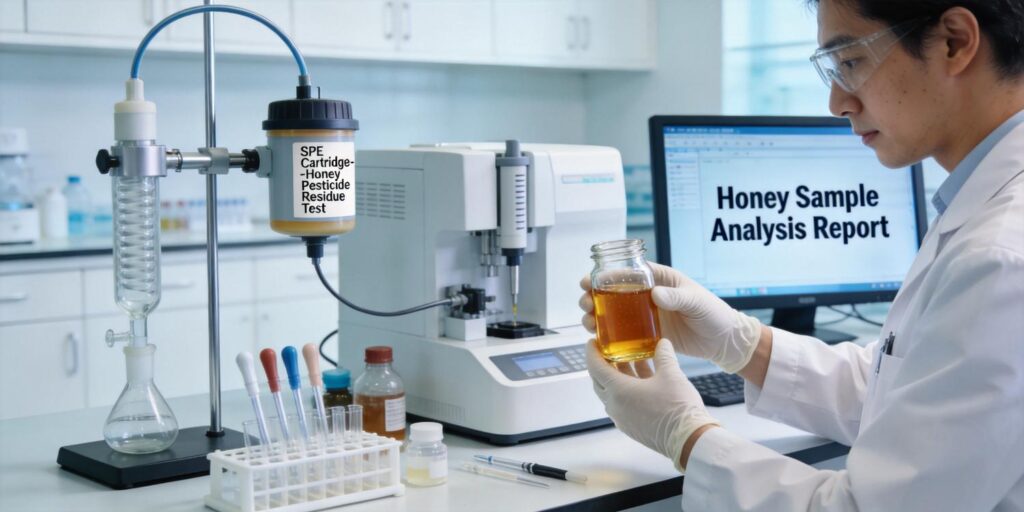
Due to honey’s high viscosity, dilution is the first step. Typically, honey is weighed (e.g., 1-5 g) and dissolved in a warm aqueous solution such as 0.1 M citric acid buffer or water (pH adjusted to 4-6) to improve solubility and maintain analyte stability. Some protocols use a mixture of water and acetonitrile or methanol to enhance extraction efficiency. After vortexing and sonication, the diluted honey is centrifuged or filtered to remove particulates before SPE loading. For example, a common method dilutes 2 g of honey in 10 mL of 0.1 M citrate buffer (pH 4).
SPE Sorbent Selection: Why HLB?
For multiclass antibiotic analysis, hydrophilic-lipophilic balance (HLB) sorbents are the preferred choice. Oasis HLB (Waters) and Poseidon HLB SPE Cartridges are polymeric reversed-phase sorbents that retain both polar and non-polar analytes over a wide pH range. HLB provides higher recoveries for a broad spectrum of antibiotics (log P range 0.5-4.5) compared to silica-based C18. For instance, tetracyclines (log P ~0.8), sulfonamides (log P ~0.5-2.0), and fluoroquinolones (log P ~1.0-3.0) all exhibit good retention on HLB.
Conditioning and Loading of Diluted Honey Extract
Prior to loading, the HLB cartridge is conditioned with methanol followed by water or buffer (e.g., 3 mL each). The diluted honey extract is then loaded at a flow rate of 1-2 mL/min. To avoid breakthrough, the loading volume should not exceed the sorbent’s capacity (typically 50-100 mg sorbent per 1 g honey equivalent). After loading, a wash step with water or 5% methanol helps remove sugars and polar interferences.
Washing Steps Removing Sugars and Pigments
Selective washing is critical. A common wash uses 0.1 M HCl or 0.1 M ammonium acetate at pH 4 to remove sugars without eluting analytes. For pigment removal, 5% methanol in water is effective. Some protocols include a hexane wash (2 mL) to remove non-polar waxes and lipids. The wash step should be optimized to balance cleanup and recovery; excessive methanol can prematurely elute target compounds.
Elution Optimization
Antibiotics are eluted with 2-5 mL of methanol or acetonitrile, optionally acidified with 0.1% formic acid to improve recovery of basic compounds like fluoroquinolones. For example, 0.1% formic acid in methanol is often used. A two-step elution (e.g., 3 mL methanol followed by 3 mL acetone) can improve recovery of mid-polarity compounds. The eluate is evaporated under nitrogen and reconstituted in a mobile-phase-compatible solvent for LC-MS/MS.
LC-MS/MS Detection of Antibiotic Residues
Analysis is typically performed using reverse-phase LC (e.g., C18 column) with a gradient of water/acetonitrile containing 0.1% formic acid. Mass spectrometry in multiple reaction monitoring (MRM) mode provides high sensitivity and selectivity. Method validation includes recovery (70-120%), precision (RSD <20%), and limits of quantification (LOQ) below MRLs (e.g., 10 μg/kg for tetracyclines). For further reading, see the 96-well SPE plate for high-throughput analysis.
Conclusion
SPE cleanup using HLB cartridges effectively reduces matrix interferences from honey, enabling reliable quantification of antibiotic residues. By optimizing dilution, sorbent conditioning, washing, and elution, analysts can achieve robust results. Poseidon MAX SPE cartridges and mixed-mode sorbents are also alternatives for specific analytes, but HLB remains the gold standard for multiclass antibiotic analysis in honey.