Introduction
UV filters from sunscreens and personal care products are emerging contaminants in coastal environments. Their continuous input through recreational activities and wastewater discharge has raised concerns about ecological and human health effects. This workflow describes a robust analytical method using HLB SPE cartridges for the extraction and quantification of common UV filters, oxybenzone (benzophenone-3) and octinoxate (octyl methoxycinnamate), from high-salinity seawater matrices prior to LC-MS/MS analysis.
Environmental Occurrence of Sunscreen UV Filters
UV filters are widely used in sunscreens, cosmetics, and plastics to absorb or reflect UV radiation. They enter marine ecosystems via direct release from swimmers and indirect pathways such as wastewater effluent and runoff. Oxybenzone and octinoxate have been detected globally in coastal waters, sediments, and biota, with concentrations ranging from ng/L to μg/L. Their lipophilic nature and resistance to biodegradation lead to bioaccumulation and potential endocrine-disrupting effects in marine organisms.
Target Analytes: Oxybenzone and Octinoxate
Oxybenzone (BP-3) and octinoxate (OMC) are among the most frequently detected UV filters in seawater. BP-3 has a log Kow of 3.79 and OMC a log Kow of 5.80, making them amenable to reversed-phase SPE. Both compounds are susceptible to photodegradation and require careful sample handling to preserve integrity.
Challenges in Seawater Matrices with High Salt
Seawater presents unique challenges for SPE due to high ionic strength (∼35 g/L salinity), dissolved organic matter, and particulate content. High salt concentrations can reduce analyte recovery by competing for sorbent binding sites and suppressing ionization in LC-MS/MS. Additionally, monovalent and divalent cations may interact with the polymeric sorbent, requiring thorough washing steps to remove salts before elution.
Sample Filtration and Storage Procedures
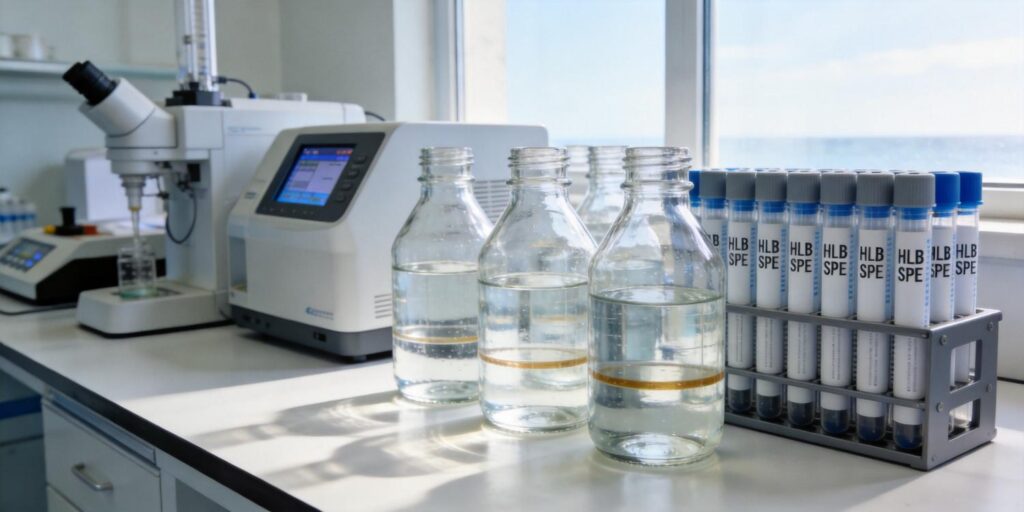
Seawater samples should be collected in amber glass bottles to minimize photodegradation. Filtration through 0.45 μm or 0.7 μm glass fiber filters (e.g., GF/F) removes suspended solids and microorganisms. Filtered samples are stored at 4 °C in the dark and extracted within 48 hours. For longer storage, freeze at -20 °C in amber HDPE containers, but avoid multiple freeze-thaw cycles.
HLB Cartridge Conditioning and Large-Volume Loading
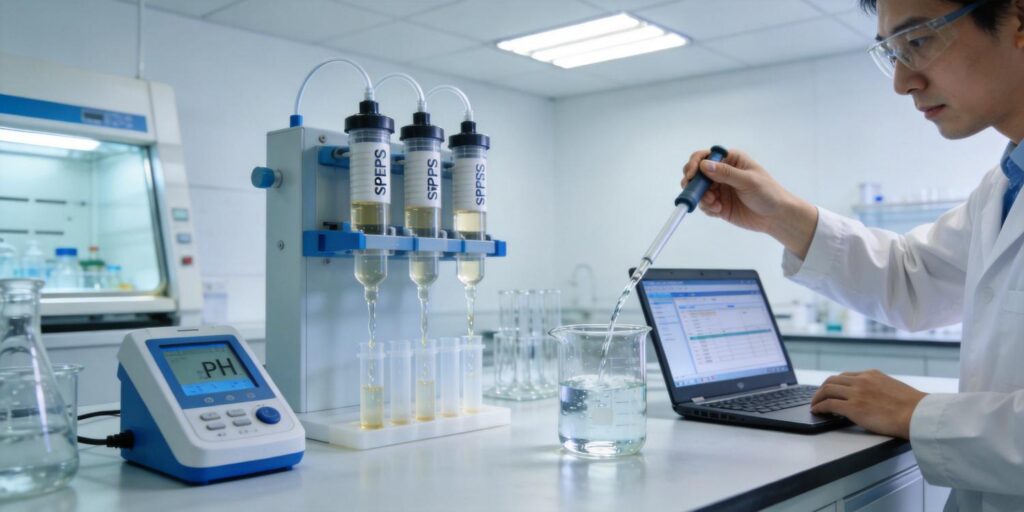
For extraction, use 200 mg or 500 mg HLB SPE cartridges (e.g., Poseidon HLB SPE Cartridges). Condition with 5 mL methanol followed by 5 mL HPLC-grade water. Load large volumes (500–1000 mL) of seawater at a flow rate of 5–10 mL/min under vacuum. The hydrophilic-lipophilic balanced sorbent provides high retention for a wide polarity range of UV filters.
Washing Steps to Remove Salts and Natural Organic Matter
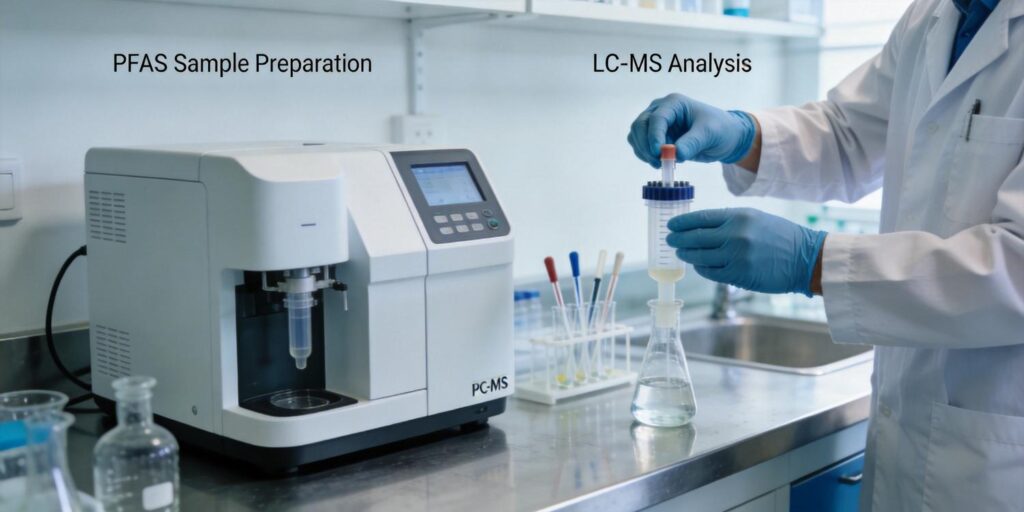
After sample loading, wash the cartridge with 5 mL of 5% methanol in water (v/v) to remove salts and weakly retained polar interferences. A second wash with 5 mL of 30% methanol can further reduce matrix effects. Maintain a gentle vacuum to avoid channeling. These steps are critical for achieving clean extracts suitable for LC-MS/MS.
Elution Using Methanol or Acetonitrile
Elute target analytes with 5 mL of methanol or acetonitrile. For more hydrophobic UV filters like octinoxate, acetonitrile often provides higher recovery. Collect eluate in a clean glass tube and evaporate to near dryness under a gentle nitrogen stream at 40 °C. Reconstitute in 0.5 mL of methanol or mobile phase before analysis.
LC-MS/MS Detection and Environmental Monitoring Results
Analyze extracts using reversed-phase LC-MS/MS with electrospray ionization (positive mode). Typical columns: C18, 2.1 × 100 mm, 1.7 μm. Mobile phase: (A) water + 0.1% formic acid, (B) methanol + 0.1% formic acid, gradient from 30% to 95% B over 10 min. Quantify using multiple reaction monitoring (MRM) with isotopically labeled internal standards (e.g., BP-3-d5). Expected recoveries: 85–105% for oxybenzone and 80–100% for octinoxate at 10–100 ng/L spike levels. Method detection limits: 0.5–2 ng/L. Field studies have reported concentrations up to 125 ng/L for oxybenzone and 65 ng/L for octinoxate in coastal waters.
Conclusion
This HLB SPE workflow provides a reliable and sensitive method for monitoring UV filters in challenging seawater matrices. Proper conditioning, washing, and elution steps ensure high recoveries and minimal matrix effects, enabling accurate environmental risk assessment. For high-throughput applications, the method can be adapted to 96-well SPE plates.