Complex Chemical Composition of Fermented Beverages
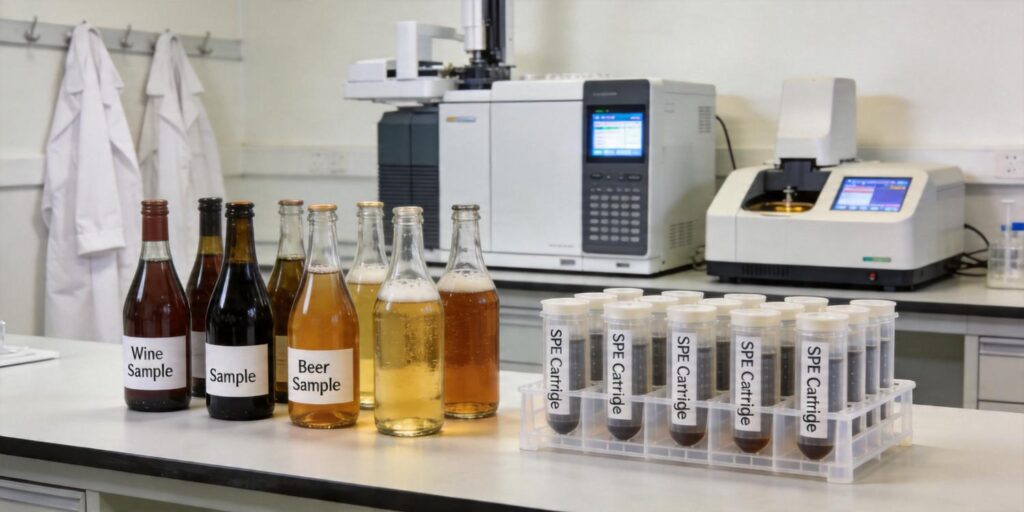
Fermented beverages like beer and wine represent some of the most chemically complex matrices encountered in analytical chemistry. These products contain hundreds of compounds spanning diverse chemical classes including alcohols, organic acids, esters, aldehydes, ketones, phenolic compounds, pigments, sugars, amino acids, and volatile aroma compounds. According to research, wine requires analysis for volatile and semivolatile species largely responsible for the wine’s bouquet, and sugar acids which contribute to the flavor. The complexity arises from the fermentation process itself, where yeast and bacteria metabolize sugars into ethanol while simultaneously producing a wide array of secondary metabolites.
The high variability in raw materials (grapes, barley, hops), fermentation conditions, and aging processes creates additional analytical challenges. Each beverage type presents unique interference profiles that must be addressed during sample preparation. For LC-MS analysis, this complexity can lead to matrix effects, ion suppression, and co-elution issues that compromise data quality and quantification accuracy.
Removal of Interfering Organic Acids and Pigments
Organic acids and pigments represent two of the most problematic interference classes in fermented beverage analysis. Organic acids like tartaric, malic, citric, and lactic acids are present at significant concentrations and can cause ion suppression in electrospray ionization. Pigments, particularly anthocyanins in red wines and polyphenolic compounds in both beer and wine, can adsorb to analytical columns and interfere with detection.
Solid-supported liquid-liquid extraction and SPE have been extensively used for this purpose. The advantage of using SPE is that class fractionation into acid, base, and neutral fractions is simple and the opportunity to concentrate the target analytes offers enhanced sensitivity that may facilitate detection. Further, SPE allows extraction under mild conditions of pH, thereby limiting the incidence of decomposition or rearrangement of labile compounds.
For organic acid removal, anion exchange sorbents (SAX) have proven particularly effective. As noted in literature, “wine has been fractionated into volatile components by employing a solid-supported LLE to trap volatiles in one example and SPE on a CH bonded phase to extract pigments (anthocyanins), leaving sugars in the effluent in another. This crude class fractionation could be taken a stage further by passing the wine through an anion exchanger to trap the wine acids.” This two-cartridge approach provides comprehensive cleanup while preserving target analytes.
SPE Sorbent Selection for Alcohol-Related Metabolites
The selection of appropriate SPE sorbents for alcohol-related metabolites requires careful consideration of both the target analytes and the beverage matrix. For LC-MS analysis of fermented beverages, several sorbent types have demonstrated particular utility:
Mixed-Mode Sorbents (HLB)
Hydrophilic-lipophilic balanced (HLB) sorbents containing poly(divinylbenzene-co-N-vinylpyrrolidone) have revolutionized fermented beverage analysis. These sorbents exhibit both hydrophilic and lipophilic retention characteristics, making them ideal for the extraction of medium-polar and non-polar organic compounds from mixtures of water and organic solvent. As research indicates, “the copolymer which exhibits both hydrophilic and lipophilic retention characteristics plays a valid role in the extraction of medium-polar and non-polar organic compounds from mixtures of water and organic solvent.” This makes HLB cartridges particularly suitable for fermented beverages containing both water-soluble and fat-soluble components.
Reversed-Phase Sorbents (C18, C8)
Traditional reversed-phase sorbents remain valuable for specific applications. C18 sorbents, particularly silica-based, trifunctionally-bonded octadecyl sorbents with high carbon load, provide excellent hydrolytic stability for a wide range of samples. These strong hydrophobic sorbents are used to adsorb analytes of even weak hydrophobicity from aqueous solutions. Typical applications include organic acids in beverages and trace organics in environmental water samples.
Ion Exchange Sorbents (WCX, MAX, WAX)
For targeted cleanup of specific compound classes, ion exchange sorbents offer superior selectivity. Weak cation exchange (WCX) sorbents are ideal for basic compounds, while mixed-mode anion exchange (MAX) and weak anion exchange (WAX) sorbents effectively capture acidic compounds. These sorbents allow for selective retention based on both hydrophobic interactions and ionic interactions, providing cleaner extracts for LC-MS analysis.
Polymer-Based Sorbents
Polymer sorbents based on divinylbenzene combined with styrene, N-vinylpyrrolidone, or methacrylates have been enthusiastically adopted by the research community. Not only do these sorbents offer high recovery for many analytes combined with a simple method, but they are also more tolerant of method variables such as variable ionic strength of the sample and drying out of the cartridge prior to loading.
Example Purification Workflow for Beer or Wine Samples
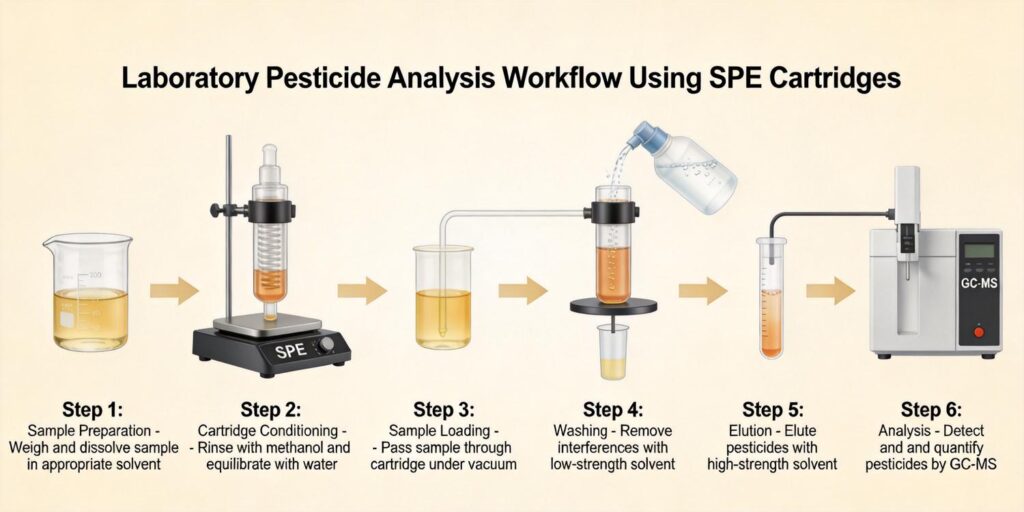
A comprehensive SPE cleanup workflow for fermented beverage analysis typically involves multiple steps to address the diverse interference profile. Here’s a detailed protocol optimized for LC-MS applications:
Sample Preparation
Begin with 5-10 mL of beer or wine sample. For beer, degas by sonication or gentle agitation under vacuum. For both matrices, adjust pH according to target analytes – typically pH 2-3 for acidic compounds or pH 7-8 for basic compounds. Dilute with appropriate buffer (1:1 to 1:5) to reduce matrix effects and alcohol content.
SPE Cartridge Conditioning
Condition HLB or mixed-mode cartridge with 3-5 mL methanol followed by 3-5 mL water or appropriate buffer. Maintain solvent flow at 1-3 drops per second to ensure proper sorbent activation. As noted in SPE methodology, “the conditioning solvent has upon the extraction properties of a sorbent. Methylene chloride, toluene, acetone, and methanol are effective in extracting impurities from improperly purified sorbents.”
Sample Loading
Load prepared sample at controlled flow rate (1-2 mL/min). For optimal recovery, maintain consistent flow throughout loading. Research indicates that “flow rate will be inversely proportional to viscosity, if all other parameters are held constant.” Given the variable viscosity of fermented beverages, flow control is critical.
Wash Steps
Implement sequential wash steps to remove interferences:
- 5% methanol in water (3-5 mL) to remove polar interferences
- Water or buffer (3-5 mL) to remove salts and sugars
- Optional: 0.1-1% formic acid or ammonium hydroxide in water for pH-specific cleanup
As strategies for removing persistent interferences suggest, “the use of pure acetonitrile or even pure methanol as washing solutions” can dramatically improve purity when analytes are completely insoluble in these solvents.
Elution and Concentration
Elute target analytes with appropriate solvent:
- For neutral/basic compounds: 5 mL methanol with 2-5% ammonium hydroxide
- For acidic compounds: 5 mL methanol with 2-5% formic acid
- For comprehensive profiling: Sequential elution with solvents of increasing polarity
Evaporate eluate to dryness under gentle nitrogen stream and reconstitute in LC-MS compatible solvent (typically methanol/water or acetonitrile/water mixtures).
LC-MS Profiling of Fermentation Compounds
Following SPE cleanup, LC-MS analysis provides comprehensive profiling of fermentation compounds. The reduced matrix effects from effective SPE cleanup enable more accurate quantification and identification of target analytes.
Chromatographic Conditions
Utilize reversed-phase chromatography with C18 or phenyl-hexyl columns for optimal separation of fermentation compounds. Gradient elution from aqueous to organic phase (typically water/methanol or water/acetonitrile with 0.1% formic acid) provides excellent resolution of compounds across a wide polarity range.
Mass Spectrometry Parameters
Electrospray ionization in both positive and negative modes captures the full spectrum of fermentation compounds. Data-dependent acquisition (DDA) or data-independent acquisition (DIA) approaches enable both targeted quantification and untargeted profiling. High-resolution mass spectrometry (HRMS) is particularly valuable for compound identification in complex fermented beverage matrices.
Quality Control Measures
Implement comprehensive QC including:
- Method blanks to monitor SPE cartridge contamination
- Matrix-matched calibration standards
- Internal standards for quantification correction
- Replicate analyses to assess method precision
Applications in Beverage Quality Control
The combination of SPE cleanup and LC-MS analysis has revolutionized quality control in the fermented beverage industry. Key applications include:
Authenticity and Adulteration Detection
Comprehensive metabolite profiling enables detection of adulteration through comparison with authentic product profiles. SPE cleanup ensures that subtle differences in metabolite patterns are not obscured by matrix effects.
Process Monitoring and Optimization
Monitoring fermentation metabolites throughout production allows for real-time process adjustments. SPE-LC-MS methods provide the sensitivity and specificity needed to track key quality markers from raw materials through finished product.
Spoilage and Contaminant Detection
Early detection of spoilage organisms and their metabolites prevents product loss. SPE cleanup enhances detection of trace-level contaminants and spoilage markers that might otherwise be masked by the beverage matrix.
Flavor and Aroma Compound Analysis
The volatile aldehydes produced during some fermentation processes, which are normally studied by head-space GC analysis, may also be amenable to trapping and concentration using appropriate SPE techniques. This allows for comprehensive analysis of flavor-active compounds that contribute to product character.
Regulatory Compliance
For pesticide residues, mycotoxins, and other regulated compounds, SPE provides the necessary cleanup for accurate quantification at regulatory limits. As noted in literature, “examples of the use of SPE on beverages for residue analysis, and hence on policies related to the use of agricultural chemicals, include extraction of daminozide (Alar) in apple juice and vinclozolin (an antifungal) on grapes. In most cases the role of SPE is to provide matrix removal and concentration of the target analytes.”
The strategic implementation of SPE cleanup protocols specifically designed for fermented beverage matrices represents a critical advancement in analytical methodology for this industry. By addressing the unique challenges posed by these complex matrices, SPE enables more accurate, sensitive, and comprehensive LC-MS analysis that supports quality control, product development, and regulatory compliance across the fermented beverage sector.