The Critical Importance of Monitoring Marine Biotoxins
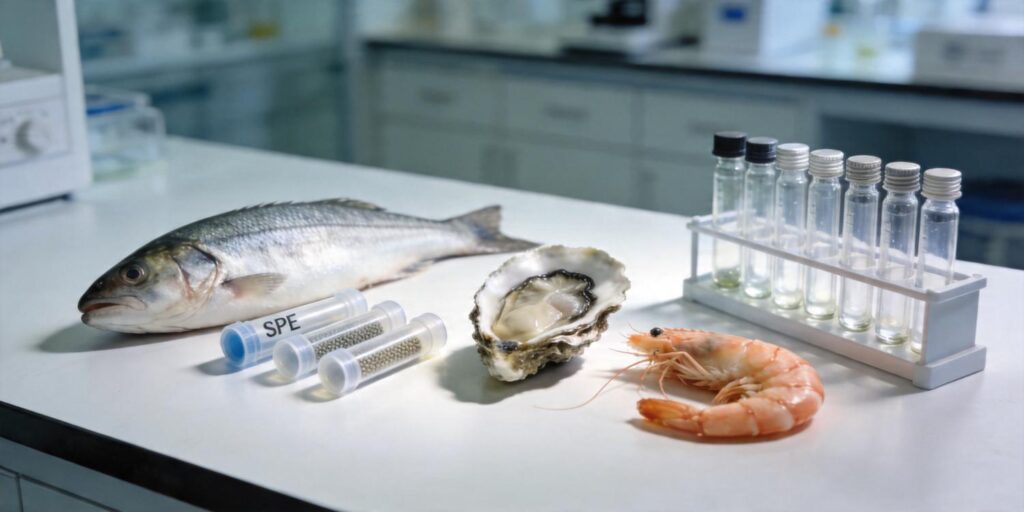
Marine biotoxins represent one of the most significant threats to seafood safety and public health worldwide. These naturally occurring toxins, produced by harmful algal blooms (HABs), can accumulate in shellfish, finfish, and other seafood species, leading to severe human illnesses and economic losses in the seafood industry. According to regulatory frameworks like the European Commission’s food safety standards, monitoring these toxins is essential for consumer protection and international trade compliance.
The primary classes of marine biotoxins include:
- Paralytic Shellfish Poisoning (PSP) toxins (saxitoxins)
- Diarrhetic Shellfish Poisoning (DSP) toxins (okadaic acid, dinophysistoxins)
- Amnesic Shellfish Poisoning (ASP) toxins (domoic acid)
- Neurotoxic Shellfish Poisoning (NSP) toxins (brevetoxins)
- Azaspiracid Shellfish Poisoning (AZP) toxins (azaspiracids)
These toxins can cause symptoms ranging from gastrointestinal distress to neurological impairment and, in severe cases, death. The unpredictable nature of algal blooms makes continuous monitoring essential for early warning systems and regulatory compliance.
Matrix Complexity of Seafood Tissue Extracts
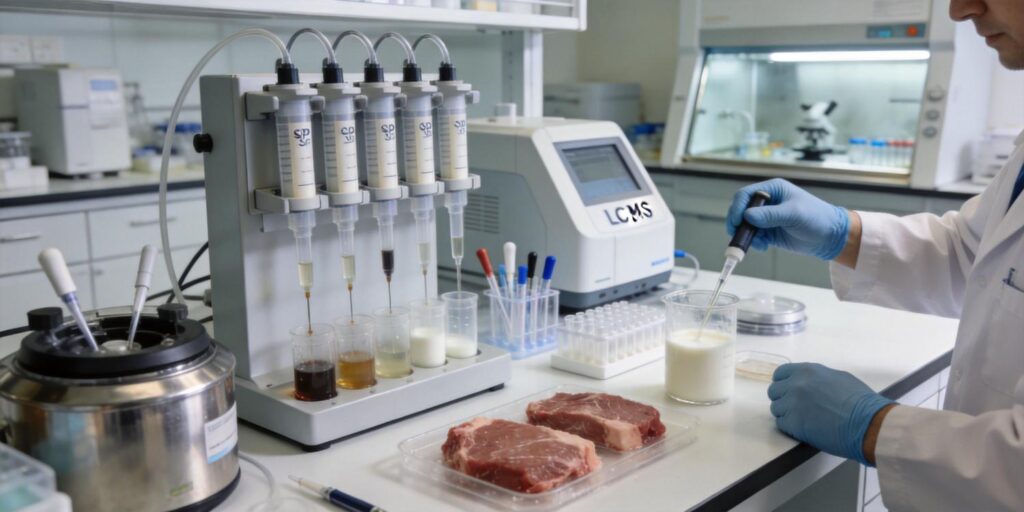
Seafood tissues present some of the most challenging matrices for analytical chemistry due to their complex composition. As noted in the literature, “Milk, butter and cheese present a bigger problem. They have a high fat and protein content and they are quite viscous or completely solid” – this complexity extends to seafood tissues as well. The main matrix components that interfere with toxin analysis include:
Primary Interfering Components:
- Proteins and peptides: Can bind to toxins and interfere with extraction efficiency
- Lipids and fatty acids: Particularly problematic in fatty fish species
- Pigments and color compounds: Especially in shellfish and crustaceans
- Salts and minerals: From the marine environment
- Carbohydrates and glycoproteins: Present in various seafood tissues
Research has shown that “the extraction of PCBs and aflatoxins from milk on C18 sorbents has also been reported,” indicating that similar challenges exist across different food matrices. The high protein and lipid content of seafood samples often makes them prone to emulsification during traditional liquid-liquid extraction (LLE), highlighting the need for more robust sample preparation techniques.
SPE Sorbent Selection for Different Toxin Classes
Selecting the appropriate solid-phase extraction sorbent is critical for successful toxin isolation from seafood matrices. Different toxin classes require specific sorbent chemistries based on their physicochemical properties:
C18 and HLB Sorbents for Lipophilic Toxins
For lipophilic toxins like okadaic acid, dinophysistoxins, and azaspiracids, reversed-phase sorbents such as C18 or HLB (Hydrophilic-Lipophilic Balance) provide excellent retention. These sorbents work through hydrophobic interactions, effectively capturing toxins while allowing polar matrix components to pass through. Studies have demonstrated that “C18 bonded-phase cartridges” are effective for pesticide enrichment from seawater, suggesting similar utility for marine toxins.
Mixed-Mode and Ion Exchange Sorbents for Polar/Ionic Toxins
Polar and ionic toxins like saxitoxins and domoic acid require different approaches. Mixed-mode sorbents combining hydrophobic and ion exchange interactions offer superior selectivity. As research indicates, “The strategy of a mixed-mode cartridge providing hydrophobic and cation exchange interactions, combined with a pH-dependent sample application and extraction, can give high recoveries of analytes from plasma, urine, whole blood, and tissues.”
Specialized Sorbents for Specific Applications
- MAX (Mixed-mode Anion Exchange): Ideal for acidic toxins like domoic acid
- MCX (Mixed-mode Cation Exchange): Suitable for basic toxins
- WAX (Weak Anion Exchange): For weak acidic compounds
- WCX (Weak Cation Exchange): For weak basic compounds
The choice of sorbent depends on the toxin’s pKa, logP, and functional groups, as well as the specific seafood matrix being analyzed.
Example Extraction and Purification Workflow
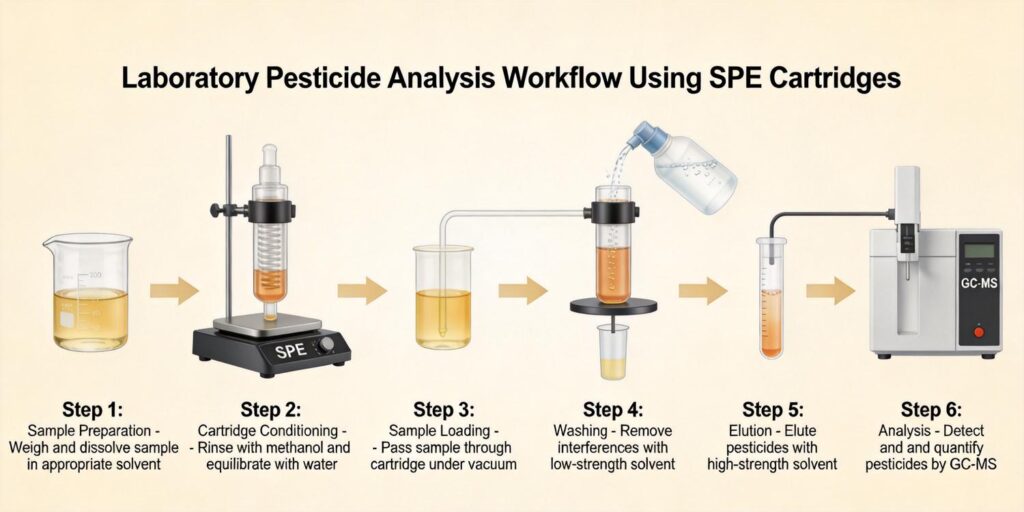
A comprehensive SPE workflow for marine toxin extraction typically follows these optimized steps:
Sample Preparation
- Homogenization: 5g of seafood tissue homogenized in 20mL of methanol:water (80:20, v/v)
- Centrifugation: 10 minutes at 4000×g to remove particulate matter
- Dilution: Supernatant diluted with appropriate buffer to reduce organic content
SPE Procedure
- Conditioning: 3mL methanol followed by 3mL water or appropriate buffer
- Loading: Sample applied at 1-2mL/min flow rate
- Washing: 3mL water followed by 3mL methanol:water (20:80, v/v) to remove interferences
- Drying: Column dried under vacuum for 5 minutes to remove residual water
- Elution: Toxins eluted with 3mL methanol containing 2% formic acid or ammonium hydroxide
Post-Extraction Processing
- Evaporation: Eluate evaporated to dryness under gentle nitrogen stream
- Reconstitution: Residue reconstituted in 200μL mobile phase compatible with LC-MS/MS
- Filtration: Through 0.22μm syringe filter prior to analysis
This workflow has been shown to provide “high recoveries of analytes from plasma, urine, whole blood, and tissues, and the resulting SPE eluates are easily amenable to subsequent GC- and HPLC-analysis.”
LC-MS/MS Detection of Marine Toxins
Liquid chromatography coupled with tandem mass spectrometry (LC-MS/MS) has become the gold standard for marine toxin analysis due to its sensitivity, selectivity, and ability to analyze multiple toxins simultaneously.
Chromatographic Conditions
- Column: C18 or HILIC columns depending on toxin polarity
- Mobile Phase: Water and acetonitrile/methanol with volatile buffers
- Gradient: Optimized for separation of toxin classes within 15-20 minutes
Mass Spectrometric Parameters
As noted in the literature, “The ‘fingerprint’ of a digitized mass spectrum provides more definitive (and therefore more legally defensible) identification of a compound at biological concentrations than other techniques.” Key MS parameters include:
- Ionization Mode: Electrospray ionization (ESI) in positive or negative mode
- Multiple Reaction Monitoring (MRM): Two transitions per toxin for confirmation
- Collision Energies: Optimized for each toxin class
- Source Parameters: Temperature, gas flows, and voltages optimized for sensitivity
Validation Parameters
- Linearity: Typically 0.1-100 ng/mL range with R² > 0.99
- Limit of Detection (LOD): 0.01-0.1 ng/g in tissue
- Limit of Quantification (LOQ): 0.03-0.3 ng/g in tissue
- Recovery: 70-120% with RSD < 15%
- Matrix Effects: Evaluated and compensated using isotope-labeled internal standards
Applications in Seafood Safety Monitoring
The SPE-LC-MS/MS approach for marine toxin analysis has numerous applications in seafood safety programs:
Regulatory Compliance Monitoring
Government agencies and testing laboratories use these methods to ensure compliance with maximum permitted levels established by organizations like the European Food Safety Authority (EFSA) and the U.S. Food and Drug Administration (FDA). The methods provide the sensitivity needed to detect toxins at levels well below regulatory limits.
Early Warning Systems
Regular monitoring of shellfish harvesting areas allows for early detection of toxin accumulation, enabling timely harvesting bans and protecting public health. The high-throughput capabilities of modern SPE systems (including 96-well SPE plates) support large-scale monitoring programs.
Research and Method Development
Academic and research institutions utilize these techniques to study toxin dynamics, metabolism in seafood species, and the development of new detection methods. The flexibility of SPE sorbent selection allows researchers to tailor methods for emerging toxin threats.
Industry Quality Control
Seafood processors and exporters implement these methods for in-house quality control, ensuring product safety and maintaining market access. Automated SPE systems provide the reproducibility needed for consistent results across multiple batches.
Clinical and Forensic Applications
In cases of suspected shellfish poisoning, these methods can confirm toxin presence in patient samples and implicated seafood, supporting clinical diagnosis and epidemiological investigations.
Conclusion
Solid-phase extraction combined with LC-MS/MS represents a powerful approach for monitoring natural toxins in seafood samples. The method’s success depends on careful consideration of matrix complexity, appropriate sorbent selection (from options like HLB, MAX, MCX, WAX, and WCX cartridges), and optimized workflow parameters. As seafood safety regulations become increasingly stringent and new toxin threats emerge, continued refinement of these methods will remain essential for protecting public health and supporting sustainable seafood industries.
The integration of automated SPE systems and advanced mass spectrometric detection has transformed marine toxin monitoring from a labor-intensive, low-throughput activity to a highly efficient, reliable process capable of meeting the demands of modern food safety programs. By leveraging the principles outlined in this article, laboratories can develop robust, validated methods that provide the sensitivity, specificity, and reproducibility required for effective seafood safety monitoring.