Overview of Antibiotic Use in Aquaculture
Antibiotics are widely used in aquaculture to prevent and treat bacterial infections, improve feed efficiency, and promote growth. Common classes include tetracyclines, sulfonamides, fluoroquinolones, and macrolides. However, the misuse of these compounds leads to residues accumulating in fish tissue, posing risks to human health through the food chain. Regulatory bodies like the FDA, EU, and Codex Alimentarius have established maximum residue limits (MRLs) for veterinary drugs in seafood. To enforce these limits, robust analytical methods are required to extract and quantify antibiotic residues from complex fish tissue matrices. Solid-phase extraction (SPE) has become a cornerstone technique for sample cleanup and preconcentration prior to LC-MS/MS analysis.
Tissue Homogenization and Solvent Extraction
Before SPE, fish tissue must be homogenized and extracted with an appropriate solvent system. Typically, muscle tissue is minced and homogenized using a blender or probe homogenizer. Acidified acetonitrile (e.g., 1% formic acid in ACN) or methanol is commonly used, as it denatures proteins and releases bound residues. Aqueous-organic mixtures like McIlvaine buffer–acetonitrile are also effective for extracting both polar and non-polar antibiotics. The homogenate is centrifuged or filtered to remove solid debris. The supernatant is then diluted with water to reduce organic solvent content (typically to <10% v/v) to ensure proper retention on the SPE sorbent during loading.
SPE Sorbent Selection for Antibiotic Residues
The choice of SPE sorbent is critical for achieving high recovery and clean extracts. For multi-class antibiotic analysis, mixed-mode sorbents that combine reversed-phase and ion-exchange mechanisms are often preferred. HLB SPE cartridges (hydrophilic-lipophilic balanced) offer excellent retention for a wide range of polar and non-polar antibiotics. For basic compounds like sulfonamides and fluoroquinolones, MCX SPE cartridges (mixed-mode strong cation exchange) provide superior cleanup by retaining basic analytes while allowing acidic interferences to wash through. For acidic antibiotics (e.g., tetracyclines), WAX SPE cartridges (weak anion exchange) can be used. MAX SPE cartridges (mixed-mode strong anion exchange) are suitable for compounds with acidic functional groups. WCX SPE cartridges (weak cation exchange) are effective for strong bases. For high-throughput applications, 96-well SPE plates offer parallel processing, ideal for laboratories handling large sample batches.
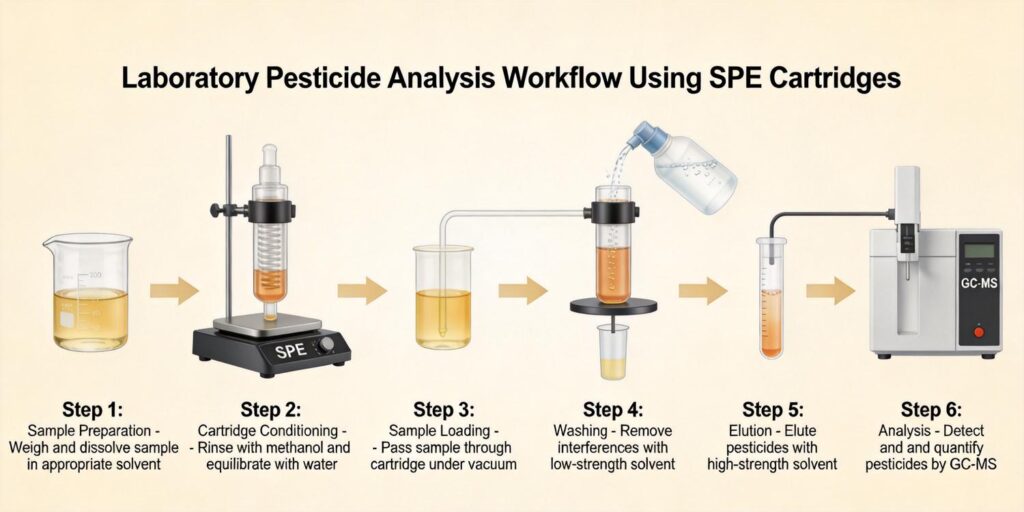
Conditioning Cartridges
Proper conditioning is essential to activate the sorbent and ensure reproducible results. For HLB cartridges, condition with 3-5 mL of methanol followed by 3-5 mL of water or buffer at the same pH as the sample. For mixed-mode ion-exchange cartridges (MCX, MAX, WAX, WCX), conditioning typically includes methanol, water, and a buffer of specific pH (e.g., 50 mM ammonium acetate at pH 6 for MCX). The conditioning step should be performed at a flow rate of 1-2 mL/min, ensuring the sorbent does not dry out before sample loading.
Loading Fish Tissue Extracts
The diluted extract is loaded onto the conditioned cartridge at a flow rate of 1-2 mL/min. The volume loaded depends on the sample mass and extraction volume, typically ranging from 2 to 10 mL. For high-fat samples like salmon, it is advisable to load slowly to prevent channeling. The loading step is critical: if the organic content is too high, breakthrough may occur; if too low, the extraction time increases unnecessarily. After loading, the cartridge is usually dried under vacuum or air for 1-2 minutes to remove residual water before washing.
Washing Steps Removing Lipids and Proteins
To remove interferences such as lipids, proteins, and pigments, a washing step is employed. For HLB cartridges, a typical wash consists of 5% methanol in water (v/v). For MCX cartridges, a wash with 0.1 M HCl followed by methanol effectively removes neutral and acidic interferences while retaining basic analytes. For WAX cartridges, a wash with 95:5 water/methanol at pH 7 removes neutral compounds. For high-fat tissues, a hexane wash can be used after loading to remove non-polar lipids, but care must be taken not to elute the target analytes. A second wash with 2% formic acid in water may be used for protein precipitation removal.
Elution Solvent Optimization
Elution conditions are tailored to the sorbent and target analytes. For HLB, elution with 2-5 mL of methanol or acetonitrile containing 0.1% formic acid is common. For MCX, elution with 5% ammonium hydroxide in methanol (v/v) effectively releases basic compounds. For MAX, elution with 2% formic acid in methanol is used. For WAX, elution with 5% ammonium hydroxide in methanol (or a mixture of methanol and water) works well. For WCX, elution with 2% formic acid in methanol is typical. Optimization may involve testing different solvent strengths (e.g., 50%, 75%, 100% methanol) and modifiers (ammonia, formic acid) to maximize recovery. The eluate is then evaporated to dryness under nitrogen and reconstituted in a suitable mobile phase for LC-MS/MS analysis.
LC-MS/MS Detection of Antibiotic Residues
After SPE cleanup, the reconstituted extract is analyzed by liquid chromatography-tandem mass spectrometry (LC-MS/MS). Separation is typically achieved on a C18 column (e.g., 2.1 × 100 mm, 1.7 μm) using a gradient of water and acetonitrile both containing 0.1% formic acid. Mass spectrometry is performed in positive electrospray ionization (ESI+) mode with multiple reaction monitoring (MRM). Two transitions per analyte are monitored for quantification and confirmation. Method validation includes linearity (R² >0.99), recovery (70–120%), precision (RSD <20%), and limits of quantification (LOQ) below regulatory MRLs. Internal standards (e.g., isotopically labeled analogs) are recommended to correct for matrix effects and extraction losses.