Analytical Testing of Cosmetic Ingredients
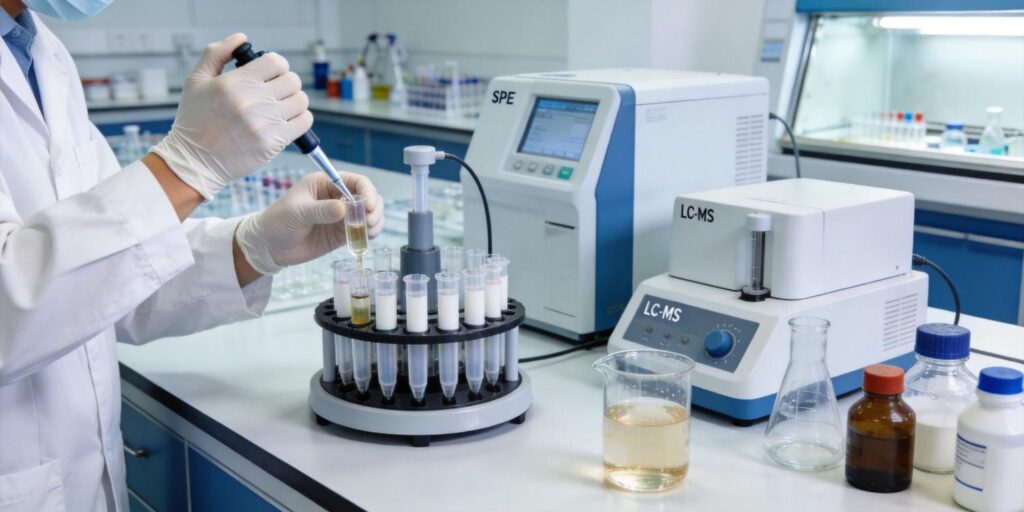
Cosmetic products are complex mixtures containing active ingredients, emulsifiers, preservatives, fragrances, and numerous other additives. Ensuring their safety, efficacy, and regulatory compliance requires rigorous analytical testing. Techniques such as liquid chromatography-mass spectrometry (LC-MS) and high-performance liquid chromatography (HPLC) are commonly employed to quantify active compounds, detect contaminants, and verify label claims. However, the complexity of cosmetic matrices demands effective sample preparation to achieve accurate, reproducible results. Solid-phase extraction (SPE) has emerged as a cornerstone technique for cleanup and preconcentration in cosmetic analysis.
Challenges of Creams and Lotions Matrices
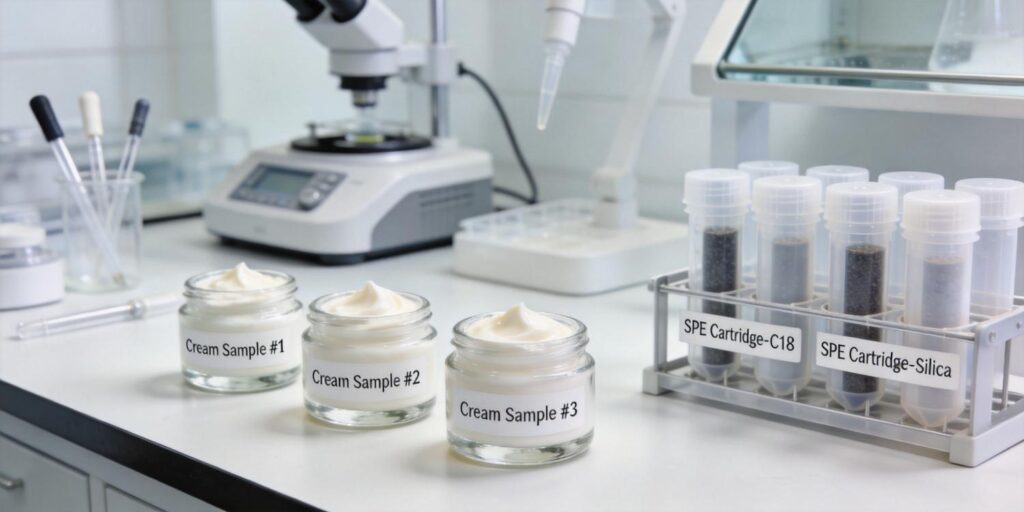
Creams and lotions present unique analytical challenges due to their high lipid content, emulsifiers, thickeners, and water-oil phases. The presence of oils, waxes, surfactants, and polymers can interfere with chromatographic separation, suppress ionization in mass spectrometry, and shorten column lifetime. Direct injection of such complex samples is rarely feasible. Consequently, efficient sample cleanup is essential to remove matrix interferences while retaining target analytes. SPE offers selectivity and flexibility to address these challenges, enabling reliable quantification of preservatives, UV filters, antioxidants, and other cosmetic ingredients.
Extraction of Analytes Using Organic Solvents
Before SPE, analytes must be extracted from the cosmetic matrix. Typically, a weighed sample (0.5–2 g) is dispersed in a suitable organic solvent or solvent mixture. Common extraction solvents include methanol, acetonitrile, ethanol, or combinations with water. For lipophilic compounds like parabens or UV filters, pure methanol or acetonitrile is often effective. For more polar analytes, a mixture with water (e.g., 80:20 methanol/water) improves recovery. The sample is vortexed, sonicated, and centrifuged to separate the liquid extract from insoluble components. The supernatant is then subjected to SPE cleanup.
SPE Sorbent Selection for Cleanup
Choosing the right SPE sorbent is critical. For cosmetic analysis, reversed-phase sorbents like C18 or polymeric HLB are most common. HLB (Hydrophilic-Lipophilic Balanced) cartridges from Poseidon Scientific provide excellent retention for a wide polarity range, making them ideal for multi-residue methods. For ionic analytes, ion-exchange sorbents such as MAX (mixed-mode anion exchange), MCX (mixed-mode cation exchange), WAX (weak anion exchange), or WCX (weak cation exchange) offer selective retention. These mixed-mode sorbents combine reversed-phase and ion-exchange mechanisms, enabling efficient cleanup of charged compounds from complex matrices. For high-throughput needs, 96-well SPE plates provide parallel processing of multiple samples.
Conditioning and Sample Loading Protocols
Proper cartridge conditioning ensures reproducible retention. For reversed-phase sorbents, condition with 1–2 bed volumes of methanol followed by equilibration with water or loading solvent (e.g., 5% methanol in water). For mixed-mode sorbents, follow manufacturer recommendations. Sample loading should be done at a slow, consistent flow rate (1–2 mL/min) to maximize analyte binding. The aqueous extract, often diluted to reduce organic solvent content, is loaded onto the conditioned cartridge. For lotions and creams, diluting the extract to 10–20% organic phase improves retention and prevents early breakthrough.
Washing to Remove Oils and Waxes
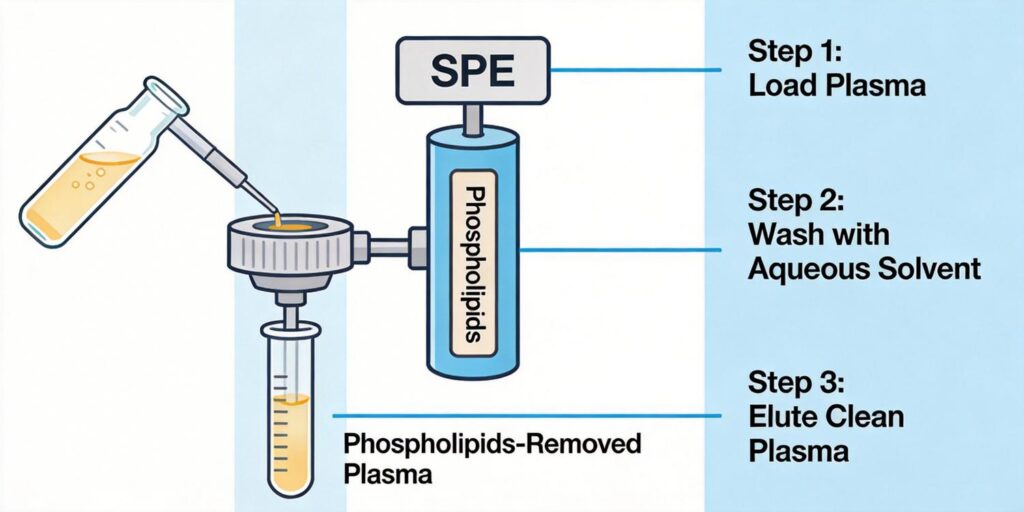
After loading, a washing step removes unwanted matrix components. For reversed-phase SPE, a wash with 5–10% methanol in water elutes polar interferences like salts and sugars without affecting retained analytes. For lipid-rich samples, a wash with a higher organic content (e.g., 40% methanol) may be needed to remove oils and waxes. Mixed-mode sorbents allow for additional wash steps at specific pH to remove neutral or oppositely charged interferences. For example, after loading on a MAX cartridge, washing with 2% ammonium hydroxide solution elutes neutral and basic compounds while retaining acidic analytes. This step is crucial for achieving clean extracts suitable for LC-MS analysis.
Elution of Target Analytes
Target analytes are eluted with a solvent that disrupts retention. For reversed-phase sorbents, pure methanol or acetonitrile is typically used. For mixed-mode sorbents, elution requires both organic solvent and an appropriate pH modifier. For acidic analytes on MAX, elute with 2% formic acid in methanol. For basic analytes on MCX, use 5% ammonium hydroxide in methanol. The elution volume should be minimal (1–3 mL) to maximize concentration. The eluate is then collected, evaporated under nitrogen, and reconstituted in mobile phase for injection.
LC-MS and HPLC Analysis Workflows
After SPE cleanup, the reconstituted sample is ready for chromatographic analysis. Reversed-phase HPLC with C18 columns is standard for cosmetic ingredients. Mobile phases often consist of water and methanol or acetonitrile with additives like formic acid or ammonium acetate to improve ionization and peak shape. LC-MS/MS provides sensitive, selective quantification, while HPLC-UV/DAD is suitable for compounds with strong chromophores. The cleaned extract reduces matrix effects, enhances signal-to-noise, and extends column life. Final results are reported in mg/kg or % w/w, ensuring compliance with regulatory limits set by bodies like the EU Cosmetics Regulation or FDA.