Overview of Veterinary Drugs Monitored in Dairy Testing
Veterinary drug residue monitoring in milk represents a critical component of food safety programs worldwide. Regulatory agencies including the FDA, EU, and Codex Alimentarius establish maximum residue limits (MRLs) for various drug classes to ensure consumer protection. The primary veterinary drugs monitored in dairy testing fall into several categories: antibiotics (β-lactams, tetracyclines, sulfonamides, macrolides, aminoglycosides), anthelmintics (benzimidazoles), anti-inflammatory drugs (NSAIDs), and various other therapeutic agents.
Research by Long et al. (1990c) demonstrated effective isolation of oxytetracycline, tetracycline, and chlortetracycline from milk using matrix solid phase dispersion (MSPD), highlighting the importance of proper extraction techniques for tetracycline antibiotics. Similarly, Van Poucke et al. (1991) developed quantitative methods for sulfonamide residues in milk samples, emphasizing the need for sensitive detection methods in regulatory compliance.
The complexity of veterinary drug monitoring extends beyond parent compounds to include metabolites and degradation products. As noted in veterinary drug abuse applications, metabolites often exhibit greater polarity than parent drugs, presenting additional challenges in separation and analysis. This is particularly relevant for compounds like sulfadimethoxine and its N-acetyl metabolites, which require comprehensive extraction strategies.
Matrix Complexity of Milk Samples
Milk represents one of the most challenging biological matrices for analytical chemistry due to its complex composition. The matrix contains approximately 3-4% fat, 3-4% protein (primarily casein and whey proteins), 4-5% lactose, and various minerals, vitamins, and enzymes. This complexity creates multiple interference sources that must be addressed during sample preparation.
The high fat and protein content of milk samples presents particular challenges for SPE applications. As noted in SPE literature, “Milk, butter and cheese present a bigger problem. They have a high fat and protein content and they are quite viscous or completely solid.” Traditional SPE methods must be carefully optimized to handle these matrix characteristics, though MSPD has emerged as a valuable alternative technique for these sample types.
Research by Schenck and Wagner (1995) demonstrated that milk samples could be effectively processed using MSPD approaches, where 2.0 g of solid support is blended in the column with 1.5 mL of acetonitrile and 5.0 mL of milk. This approach permits the use of larger milk samples (5.0 mL versus the common blending of 0.5 mL) per analysis and greatly enhances the limits of detection of the overall method.
Sample Pretreatment Before SPE Extraction
Proper sample pretreatment is essential for successful veterinary drug residue extraction from milk. The initial step typically involves sample homogenization to ensure uniform distribution of analytes. For milk samples, this may involve gentle mixing or vortexing to disrupt the natural emulsion without causing excessive protein denaturation.
Protein precipitation represents a critical pretreatment step for milk samples. Common approaches include acid precipitation using metaphosphoric acid/methanol mixtures (3:2 v/v) as demonstrated by Horie et al. (1991) for antibacterial drug extraction from fish tissue. This approach effectively deproteinizes the sample, making it suitable for subsequent SPE procedures. Alternative protein precipitation methods include using acetonitrile, trichloroacetic acid, or tungstic acid, depending on the target analytes’ stability and compatibility.
For viscous samples like raw or homogenized milk, researchers have successfully applied blending techniques where samples are added to solid support material contained in snap-cap vials and mixed to homogeneity using stirring rods or vortexing. This approach has been particularly effective for whole blood, plasma, serum, and especially raw and homogenized milk samples, as noted in MSPD applications.
Cartridge Selection for Antibiotic Classes
Selecting appropriate SPE cartridges is crucial for effective veterinary drug residue extraction from milk. Different antibiotic classes require specific sorbent chemistries based on their physicochemical properties:
Mixed-Mode Cartridges for Broad-Spectrum Extraction
Mixed-mode cartridges combining hydrophobic and ion-exchange functionalities offer excellent versatility for veterinary drug extraction. The Certify® mixed-mode (SCX/non-polar) cartridge has demonstrated effectiveness for extracting diverse drug groups including β-blockers, β-agonists, opiates, and various basic drugs. These cartridges allow isolation of compounds from urine at neutral pH, enabling extraction of compounds that may be otherwise unstable under extreme pH conditions.
C18 and C8 Cartridges for Lipophilic Compounds
Traditional reversed-phase cartridges remain valuable for extracting less polar veterinary drugs. Research by Van Poucke et al. (1991) found that 5.0 to 10.0 mL of milk blended with 2.0 g of C18 material achieved approximately 95% recovery for sulfonamide residues. Poorer recoveries were obtained for smaller quantities of C18, regardless of sample size, highlighting the importance of adequate sorbent mass for milk applications.
Ion-Exchange Cartridges for Charged Analytes
Strong cation exchange (SCX) and strong anion exchange (SAX) cartridges provide selective extraction for basic and acidic veterinary drugs, respectively. For strongly acidic drugs like sulfonic acids, SAX cartridges conditioned with methanol and acetic acid have proven effective, with elution using methanol containing sulfuric acid for subsequent HPLC analysis.
Specialty Phases for Specific Applications
Phenylboronic acid (PBA) cartridges offer advantages for catecholamine extraction, providing more consistent recoveries of compounds like DOPA and dopamine compared to traditional alumina adsorption methods. Similarly, immunoaffinity cartridges provide exceptional selectivity for specific drug classes, though their higher cost may limit routine application.
Washing Procedures to Remove Fats and Proteins
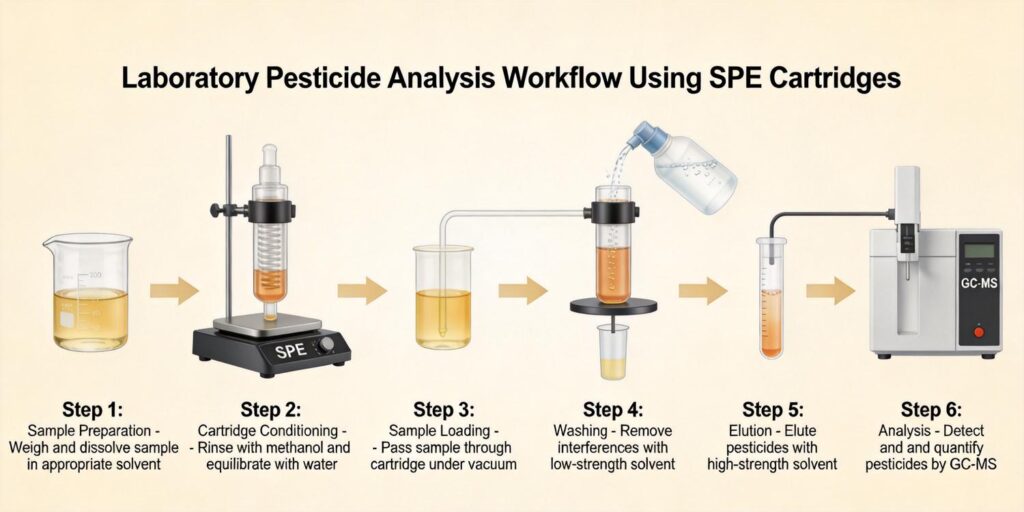
Effective washing protocols are essential for removing matrix interferences while retaining target analytes. The washing strategy must balance cleanup efficiency with analyte recovery, particularly for milk samples with high fat and protein content.
Fat Removal Strategies
Non-polar solvents like hexane or heptane effectively remove lipids without eluting most veterinary drugs. For milk samples, initial washes with 5-10% methanol in water help remove water-soluble interferences while maintaining analyte retention. Subsequent washes with hexane or similar non-polar solvents effectively remove lipid components that could interfere with chromatographic analysis.
Protein and Polar Interference Removal
Aqueous washes with appropriate pH adjustment help remove polar interferences. For basic drugs, washing with water or low-percentage methanol/water at pH 6-7 removes acidic and neutral interferences while retaining target analytes. For acidic drugs, slightly basic washes (pH 8-9) achieve similar cleanup while maintaining analyte retention through ion-exchange mechanisms.
Optimized Wash Solvent Composition
Research demonstrates that methanol/water mixtures typically ranging from 5-30% methanol provide optimal cleanup for most veterinary drug applications. The exact composition depends on analyte hydrophobicity and sorbent chemistry. For mixed-mode cartridges, sequential washes with water, methanol/water, and hexane often provide comprehensive cleanup while maintaining high analyte recovery.
Elution Solvents Compatible with LC-MS
Elution solvent selection must consider both extraction efficiency and compatibility with subsequent analytical techniques, particularly LC-MS which has become the gold standard for veterinary drug residue analysis.
Acidic Elution for Basic Compounds
For basic veterinary drugs retained on mixed-mode or SCX cartridges, elution with methanol or acetonitrile containing 2-5% formic acid or acetic acid provides efficient recovery. The acidic conditions protonate the sorbent’s cation-exchange sites, releasing retained basic compounds. This approach is compatible with positive-ion mode LC-MS analysis.
Basic Elution for Acidic Compounds
Acidic veterinary drugs require basic elution conditions for efficient recovery from mixed-mode or SAX cartridges. Ammonium hydroxide (2-5%) in methanol or acetonitrile effectively elutes acidic compounds while maintaining compatibility with negative-ion mode LC-MS analysis. The addition of volatile bases like ammonium acetate or ammonium bicarbonate also facilitates subsequent LC-MS analysis.
Optimized Solvent Combinations
Research by various groups has identified optimal elution solvent combinations for specific veterinary drug classes. For tetracyclines, methanol containing 0.4 M oxalic acid provides excellent recovery while maintaining analyte stability. For sulfonamides, acetonitrile with 2% acetic acid offers both efficient elution and LC-MS compatibility. The elution volume typically ranges from 2-5 mL, with collection in glass tubes to minimize analyte adsorption.
Evaporation and Reconstitution Considerations
Following elution, solvent evaporation and reconstitution in mobile phase-compatible solvents represent critical steps. Gentle evaporation under nitrogen at 40-50°C prevents analyte degradation, with reconstitution in initial mobile phase composition (typically water with 0.1% formic acid for positive mode or 5 mM ammonium acetate for negative mode LC-MS).
Regulatory Validation Considerations
Method validation for veterinary drug residue analysis in milk must comply with regulatory guidelines including FDA Guidance for Industry, EU Commission Decision 2002/657/EC, and Codex Alimentarius standards.
Recovery and Precision Requirements
Acceptable recovery ranges typically fall between 70-120% with relative standard deviations below 20% for within-laboratory reproducibility. For confirmatory methods using LC-MS/MS, ion ratio criteria must be established with maximum permitted tolerances based on regulatory requirements.
Matrix Effects and Calibration Approaches
Milk’s complex matrix necessitates careful evaluation of matrix effects in LC-MS analysis. Matrix-matched calibration or standard addition approaches are often required to compensate for ionization suppression or enhancement. The use of stable isotope-labeled internal standards provides the most reliable quantification, particularly for regulatory applications requiring high accuracy.
Limit of Quantification and Detection
Method sensitivity must meet or exceed established MRLs, which range from 1-100 μg/kg for most veterinary drugs in milk. For banned substances with zero tolerance, methods must achieve detection limits at or below 0.1-1 μg/kg. Signal-to-noise ratios of at least 10:1 for quantification and 3:1 for detection represent typical acceptance criteria.
Ruggedness and Cross-Validation
Method ruggedness testing evaluates performance under deliberate variations in critical parameters including pH, solvent volumes, and incubation times. Cross-validation against reference methods or participation in proficiency testing schemes provides additional confidence in method performance for regulatory compliance.
As noted in veterinary drug testing applications, “SPE can be highly reproducible if a rugged method is developed, and provides clean extracts for analysis by GC/NPD, HPLC, GC/MS, LC/MS and many other analytical techniques.” This reproducibility, combined with safety benefits and potential for automation, makes SPE an increasingly preferred technique for veterinary drug residue analysis in milk within regulatory frameworks worldwide.