Nature of Humic Substances in Environmental Waters
Humic substances represent a complex mixture of naturally occurring organic compounds formed through the decomposition of plant and animal matter in soil and aquatic environments. These substances, which include humic acids, fulvic acids, and humin, constitute the majority of dissolved organic matter (DOM) in natural waters. Their molecular weights range from a few hundred to several hundred thousand Daltons, with complex aromatic structures containing numerous carboxylic, phenolic, and hydroxyl functional groups.
In environmental waters, humic substances typically exist at concentrations ranging from 0.1 to 100 mg/L, with higher concentrations found in surface waters, wetlands, and areas with significant organic matter input. Their presence creates a complex matrix that presents significant challenges for analytical chemists attempting to detect trace-level contaminants. According to research by Landrum et al. (1984), pollutants can reversibly or irreversibly bind to DOM, creating analyte-humic complexes that behave differently during extraction processes.
Impact on Analytical Detection Methods
Humic substances interfere with analytical detection methods through multiple mechanisms that can compromise data accuracy and reliability. These interferences manifest in several critical ways:
Matrix Effects and Signal Suppression
Co-extracted humic substances can cause significant matrix effects in detection systems, particularly in LC-MS applications. The complex organic molecules can suppress or enhance ionization efficiency, leading to inaccurate quantification. Altenbach and Giger (1995) demonstrated that humic substances co-extracted with analytes could enhance “matrix effects” resulting in spuriously high signals.
Reduced Analyte Recovery
Research by Johnson et al. (1991) and Nakamura et al. (1996) established that humic substances can significantly reduce analyte recovery during SPE. The recovery of chemicals having a log Pow below about 4 when alkyl-bonded silicas were used for SPE, or below 3 when polystyrene sorbents were used, were not influenced by the presence of 1 ppm of humic acid. However, recoveries of analytes with higher partition coefficients decreased substantially.
Column Fouling and System Contamination
High molecular weight humic fractions can accumulate on analytical columns and instrument components, reducing column lifetime and increasing maintenance requirements. This fouling effect is particularly problematic in high-throughput laboratories where instrument downtime translates directly to lost productivity.
SPE Sorbent Choices for Humic Removal
Selecting appropriate SPE sorbents is critical for effective humic substance removal while maintaining target analyte recovery. Different sorbent chemistries offer distinct advantages for this challenging application:
Mixed-Mode Sorbents
Mixed-mode sorbents combining reversed-phase and ion-exchange mechanisms provide superior selectivity for humic removal. Our MCX SPE cartridges (mixed-mode cation exchange) and MAX SPE cartridges (mixed-mode anion exchange) offer dual retention mechanisms that can selectively retain humic substances while allowing target analytes to pass through or be selectively eluted.
Hydrophilic-Lipophilic Balanced (HLB) Sorbents
HLB SPE cartridges provide excellent retention for a wide range of compounds while offering good humic removal capabilities. The balanced hydrophilic-lipophilic properties make them particularly effective for polar analytes that might co-elute with humic substances on traditional reversed-phase sorbents.
Weak Anion Exchange (WAX) and Weak Cation Exchange (WCX)
For targeted humic removal based on charge characteristics, WAX SPE cartridges and WCX SPE cartridges offer selective retention of negatively charged humic substances. Altenbach and Giger (1995) successfully used strongly positively charged, graphitized carbon black for determination of benzene and naphthalene sulfonates in wastewater, where negatively charged humic substances were permanently retained.
Polystyrene-Divinylbenzene (PS-DVB) Sorbents
Research indicates that polystyrene sorbents show less remarkable decrease in recovery for high log Pow analytes in the presence of humic acid compared to alkyl-bonded silicas. This makes PS-DVB sorbents particularly valuable for hydrophobic analytes in humic-rich matrices.
Washing Strategies Targeting Organic Matter
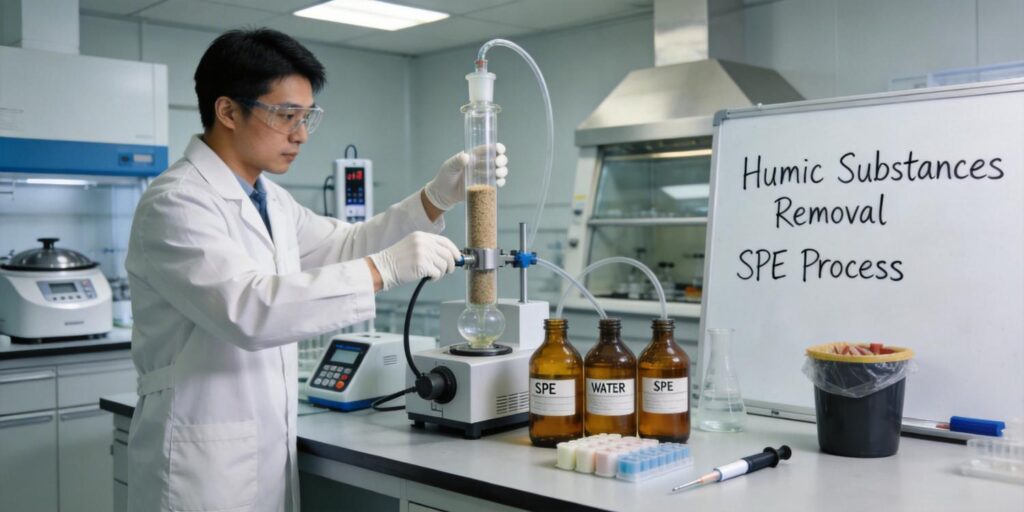
Effective washing protocols are essential for removing humic substances while retaining target analytes. The washing strategy must be tailored to both the sorbent chemistry and the characteristics of the humic substances in the sample matrix.
pH-Controlled Washing
Humic substances exhibit pH-dependent solubility and charge characteristics. At low pH (2-3), humic acids precipitate and can be more easily removed. A washing step with acidified water (0.1-1% formic acid) can effectively remove humic substances while retaining many target analytes on reversed-phase sorbents.
Organic-Modified Wash Solvents
Wash solvents containing 5-20% methanol or acetonitrile in water can remove moderately retained humic fractions without eluting target analytes. The optimal organic percentage depends on the hydrophobicity of both the analytes and the humic substances present.
Salt-Enhanced Washing
Adding salts (such as ammonium acetate or sodium chloride) to wash solvents can enhance humic removal through salting-out effects and ionic strength adjustments. This approach is particularly effective for samples with high ionic strength, such as seawater or brackish water.
Sequential Washing Protocols
A multi-step washing approach often yields the best results:
- Water wash (2-5 mL) to remove salts and highly polar interferences
- Acidified water wash (pH 2-3, 2-5 mL) to precipitate and remove humic acids
- Low-percentage organic wash (5-10% methanol, 2-5 mL) to remove moderately retained humic fractions
- Optional: Drying step (5-10 minutes under vacuum) to remove residual water before elution
Ensuring Analyte Retention During Cleanup
Maintaining target analyte retention while removing humic substances requires careful optimization of several parameters:
Sample pH Adjustment
Adjusting sample pH to maximize analyte retention while minimizing humic retention is crucial. For basic analytes, acidifying samples to pH 2-3 below their pKa values ensures they remain protonated and strongly retained on mixed-mode cation exchange sorbents while humic substances are removed during washing.
Ionic Strength Optimization
Controlling ionic strength can differentially affect analyte and humic retention. Increasing ionic strength typically enhances retention of hydrophobic analytes on reversed-phase sorbents while potentially reducing humic retention through charge screening effects.
Organic Modifier Concentration
Minimizing organic modifier in the sample loading solution (typically <5% methanol or acetonitrile) ensures maximum analyte retention. This is particularly important for early-eluting or polar analytes that might show breakthrough in the presence of humic substances.
Flow Rate Control
Maintaining controlled flow rates (1-3 mL/min for cartridges, 5-10 mL/min for 96-well plates) ensures adequate contact time for both analyte retention and humic removal. Excessive flow rates can compromise both processes.
Example LC-MS Workflow for Humic-Rich Water Samples
The following optimized workflow demonstrates effective humic removal for LC-MS analysis of pesticides in surface water:
Sample Preparation
1. Filter water samples through 0.45 μm glass fiber filters to remove particulates
2. Adjust pH to 3.0 using formic acid
3. Add internal standards and mix thoroughly
SPE Procedure Using MCX Cartridges
1. Condition: 3 mL methanol followed by 3 mL acidified water (pH 3)
2. Load: 100-500 mL sample at 5 mL/min
3. Wash 1: 3 mL acidified water (pH 3)
4. Wash 2: 3 mL 5% methanol in water
5. Dry: 10 minutes under vacuum (15 in Hg)
6. Elute: 2 × 3 mL methanol with 5% ammonium hydroxide
7. Evaporate to dryness under nitrogen at 40°C
8. Reconstitute in 1 mL initial mobile phase for LC-MS analysis
LC-MS Conditions
Column: C18, 2.1 × 100 mm, 1.7 μm
Mobile Phase: A) 0.1% formic acid in water, B) 0.1% formic acid in acetonitrile
Gradient: 5-95% B over 10 minutes
Flow Rate: 0.3 mL/min
Injection Volume: 10 μL
MS Detection: ESI positive/negative switching, MRM mode
Monitoring Applications and Quality Control
Effective monitoring of humic removal requires both procedural controls and analytical verification:
Procedural Blanks and Controls
Include method blanks with each batch to monitor humic breakthrough and system contamination. Use humic acid-spiked controls at relevant environmental concentrations (typically 1-10 mg/L DOC) to validate removal efficiency.
Recovery Assessment
Compare recoveries from humic-spiked samples versus clean water spikes. According to Nakamura et al. (1996), analytes with log Pow >4 on alkyl-bonded silicas or >3 on polystyrene sorbents may show reduced recovery in the presence of humic substances and require method modification.
Matrix Effect Evaluation
Use post-extraction spiking to assess matrix effects in the final extract. Signal suppression/enhancement should be <20% for reliable quantification. If matrix effects exceed this threshold, additional cleanup or dilution may be necessary.
High-Throughput Applications
For laboratories processing large numbers of environmental samples, 96-well SPE plates offer significant advantages in throughput and consistency. The same principles of sorbent selection and washing optimization apply, with flow rates adjusted for the plate format.
Documentation and Method Validation
Maintain detailed records of humic removal efficiency across different water types and seasons. Method validation should include precision, accuracy, detection limits, and robustness testing with humic-rich samples to ensure reliable performance under real-world conditions.
By implementing these SPE techniques for humic substance removal, environmental laboratories can achieve cleaner extracts, reduced matrix effects, and more reliable quantification of trace contaminants in complex water matrices. The key to success lies in understanding the specific characteristics of both the humic substances and target analytes, then selecting and optimizing SPE conditions accordingly.