Role of SPE in Metabolomics Workflows
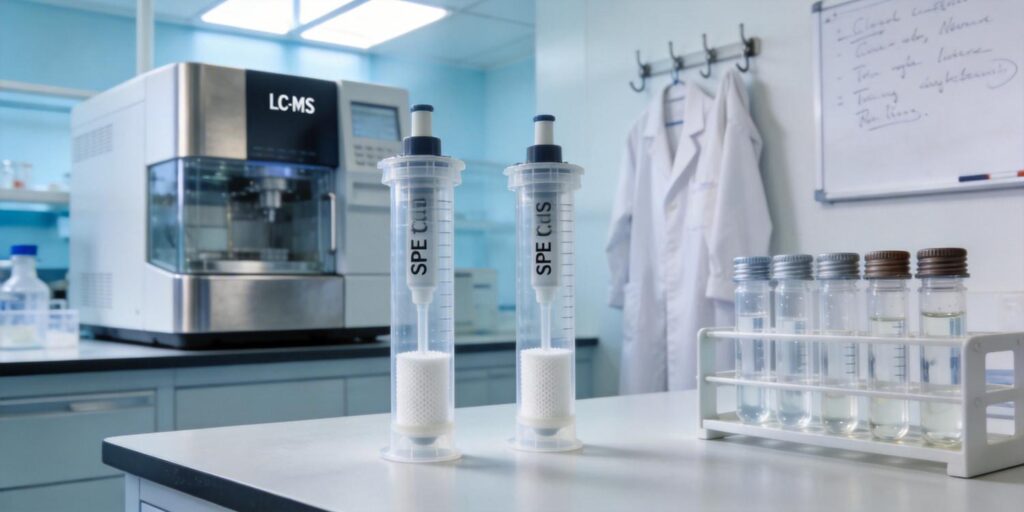
Solid Phase Extraction (SPE) serves as a critical sample preparation technique in LC-MS metabolite profiling, functioning as a bridge between complex biological samples and sensitive analytical instrumentation. In metabolomics workflows, SPE performs three essential functions: clean-up to remove matrix interferences, concentration to enhance detection sensitivity, and selective isolation of metabolite classes. As noted in SPE literature, “Biological samples are notoriously dirty; injecting them with minimum cleanup onto very sensitive and expensive instruments makes very little sense. SPE has been shown to significantly increase gas (GC) and liquid chromatography (LC) column life while reducing the downtime on equipment like gas chromatography and liquid chromatography mass spectrometers (GCMS and LCMS) for source cleaning.”
The fundamental advantage of SPE over traditional liquid-liquid extraction (LLE) lies in its ability to provide “higher and more reproducible recoveries” and “cleaner extracts” while decreasing organic solvent usage and waste generation. For metabolomics applications, where samples may contain “anywhere from a few hundred to many thousand chemical components,” SPE’s tunable selectivity through different phase chemistries becomes particularly valuable.
Challenges of Extracting Diverse Metabolites
Metabolite extraction presents unique challenges due to the extraordinary chemical diversity of metabolites, ranging from highly polar amino acids and sugars to non-polar lipids and steroids. These compounds exhibit wide variations in polarity, pKa values, molecular weight, and functional group chemistry. The extraction must accommodate zwitterionic compounds, acidic and basic metabolites, and neutral species simultaneously.
As described in SPE methodology, “Modern drug candidates are often very potent substances, for which reason the doses administered in preclinical and clinical studies are relatively low. Thus, assay sensitivity is a major goal of pharmacokinetic studies; sensitivity must be high enough to allow estimation of the terminal plasma half-life in vivo. In order to obtain such sensitivities, clean plasma extracts are essential.” This principle applies equally to metabolomics, where metabolites often exist at trace concentrations amidst abundant matrix components.
Additional challenges include protein binding of metabolites, the presence of endogenous interferences that can suppress ionization in LC-MS, and the need to preserve labile metabolites during extraction. The SPE approach must address “prevention of clogging of analytical columns” and “elimination of protein binding” while maintaining metabolite stability.
Selecting Sorbent Chemistries for Metabolite Coverage
The choice of SPE sorbent chemistry determines which metabolite classes will be recovered and to what extent. For comprehensive metabolomics, a strategic approach often involves multiple sorbents or mixed-mode chemistries:
Reversed-Phase Sorbents (C18, C8, HLB)
These sorbents retain non-polar and moderately polar metabolites through hydrophobic interactions. HLB (Hydrophilic-Lipophilic Balance) sorbents, such as those offered by Poseidon Scientific, provide enhanced retention of polar compounds while maintaining good recovery of non-polar metabolites. The “strategy of a mixed-mode cartridge providing hydrophobic and cation exchange interactions, combined with a pH-dependent sample application and extraction, can give high recoveries of analytes from plasma, urine, whole blood, and tissues.”
Mixed-Mode Sorbents (MCX, MAX, WAX, WCX)
Mixed-mode sorbents combine reversed-phase retention with ion-exchange functionality:
- MCX (Mixed-mode Cation Exchange): Combines hydrophobic retention with strong cation exchange for basic metabolites
- MAX (Mixed-mode Anion Exchange): Combines hydrophobic retention with strong anion exchange for acidic metabolites
- WAX (Weak Anion Exchange): Uses weak anion exchange for selective extraction of acidic compounds
- WCX (Weak Cation Exchange): Employs weak cation exchange for basic metabolite isolation
These sorbents allow selective extraction based on both hydrophobicity and charge state, enabling class-specific metabolite isolation. As demonstrated in pharmaceutical applications, “SPE can be automated quite easily with a variety of currently available equipment,” making mixed-mode approaches practical for high-throughput metabolomics.
Sample Loading Solvent Considerations
The composition of the sample loading solvent critically affects metabolite retention on SPE sorbents. Key considerations include:
Solvent Strength
The loading solvent should be sufficiently weak to ensure metabolite retention. For reversed-phase sorbents, aqueous solutions with minimal organic content (typically ≤5% organic solvent) provide optimal retention. As noted in SPE fundamentals, “For most liquid-liquid extractions, properly chosen conditions will result in most of the compound of interest migrating into the extracting phase.”
pH Adjustment
pH control during loading determines the ionization state of metabolites and their interaction with ion-exchange sorbents. For basic metabolites, acidification (pH 2-3) ensures protonation and retention on cation-exchange sorbents. For acidic metabolites, alkalization (pH 8-9) promotes deprotonation and retention on anion-exchange sorbents. The literature emphasizes that “identifying and eliminating interferences and troubleshooting low recoveries requires good knowledge of the matrix composition.”
Protein Precipitation Compatibility
When SPE follows protein precipitation, the precipitation solvent (typically methanol or acetonitrile) must be diluted to appropriate concentrations to prevent premature elution of metabolites. As described in method development strategies, “Characterize the analyte—Structure, pKa, polarity, functional groups—Solvent solubility and stability” to optimize loading conditions.
Washing Strategies for Clean Extracts
Effective washing removes matrix interferences while retaining metabolites of interest. The washing strategy depends on the sorbent chemistry and metabolite properties:
Reversed-Phase Washing
For reversed-phase sorbents, washing typically involves aqueous solutions with low organic content (5-20% methanol or acetonitrile in water). The wash solvent strength should be sufficient to remove polar interferences but insufficient to elute retained metabolites. As optimization procedures note, “Wash with solvent that won’t elute analyte” is a fundamental SPE step.
Ion-Exchange Washing
For mixed-mode sorbents, washing strategies combine organic solvents with pH-adjusted aqueous solutions to remove neutral and weakly retained compounds while maintaining ionic interactions. The literature recommends “optimizing the washing procedure” as part of method development for biological samples.
Selective Washing for Specific Interferences
Certain matrix components require targeted washing approaches. For example, phospholipids can be removed with specific solvent mixtures, while salts may require water washes. The goal is to achieve “cleaner extracts (contamination, solvent impurities)” as noted in SPE advantages over LLE.
Elution Solvents Compatible with LC-MS
Elution solvent selection must balance complete metabolite recovery with LC-MS compatibility:
Organic Solvent Composition
For reversed-phase sorbents, elution typically requires high organic content (70-100% methanol or acetonitrile). For ion-exchange sorbents, elution involves organic solvents with competing ions or pH adjustment to disrupt ionic interactions. The literature emphasizes “eluting analyte in smallest volume possible” for concentration purposes.
LC-MS Compatibility
Elution solvents must be compatible with LC-MS analysis. Common choices include methanol, acetonitrile, and mixtures with water or volatile buffers. Non-volatile additives should be avoided as they can suppress ionization and contaminate MS sources. As noted in SPE-LC-MS integration, “An undesirable feature of atmospheric pressure ionization-MS analysis is suppression of ionization by co-extracted endogenous interferences from biofluids. To avoid false negatives, selective SPE extraction applications are required.”
Evaporation and Reconstitution
Following elution, solvent evaporation and reconstitution in LC-MS compatible solvents may be necessary. The reconstitution solvent should match the initial LC mobile phase composition to prevent peak distortion. Method development should consider “any restrictions on final solvent and concentration (technique or instrument).”
Quality Control in Metabolomics Studies
Robust quality control measures ensure the reliability of metabolomics data generated through SPE sample preparation:
Process Controls
Include blank samples (extraction without matrix), matrix blanks (matrix without metabolites), and quality control samples with known metabolite concentrations. As emphasized in analytical procedures, “SPE recoveries should exceed 90% absolute recovery. If you don’t get that kind of recovery you are not adjusting other parameters (such as solubility, pH, and solvent strength) correctly.”
Internal Standards
Use stable isotope-labeled internal standards for each metabolite class to correct for extraction efficiency and matrix effects. These standards should be added before extraction to monitor the entire process. The literature demonstrates successful applications where “SPE-LC/MS has been successfully demonstrated in many papers.”
Batch-to-Batch Consistency
Monitor extraction efficiency across different SPE cartridge lots and batches. Quality control samples should demonstrate consistent recovery and minimal variation. As noted in SPE applications, “The resulting SPE eluates are easily amenable to subsequent GC- and HPLC-analysis. The chromatograms show almost no interference from endogenous matrix components.”
Method Validation
Validate SPE methods for specificity, sensitivity, linearity, accuracy, and precision. Include stability assessments of metabolites during extraction and storage. The approach should follow established guidelines where “a rational approach to the development of solid phase extraction methods for drugs in biological matrices” is recommended.
For comprehensive metabolomics profiling, consider using Poseidon Scientific’s HLB SPE cartridges for broad metabolite coverage, or their specialized MCX, MAX, WAX, and WCX cartridges for class-specific extractions. For high-throughput applications, their 96-well SPE plates offer automation compatibility and improved productivity.